Indeed job scraping means collecting job-listing data from Indeed with software. The practical answer is to begin with permission, not a parser: Indeed's current Terms of Service prohibit automated access, data mining, and scraping without express written permission, apart from conditional crawling described by its robots.txt rules.
If you need data about jobs your organization manages, use an ATS export or an approved Indeed partner API. For broader market data, use a licensed source with clear provenance or obtain written authorization that defines the pages, fields, frequency, storage, and permitted use. A proxy changes the network path; it does not turn prohibited collection into an approved workflow.
This guide explains how to choose an allowed source, design a reliable job-record pipeline, and use proxies only where they support an authorized operational need.
Indeed Job Scraping: Check Permission Before Code
Do not infer permission from the fact that a listing is visible in a browser. Indeed's Site Rules distinguish ordinary use through public interfaces from access by bots, scrapers, spiders, and other automated systems. They also prohibit bypassing security measures or site limitations.
Use this source order:
| Your requirement | Best starting point | What to verify |
|---|---|---|
| Analyze jobs your company publishes | Your ATS export, database, or webhook | Ownership, fields, update timing, and retention |
| Manage or inspect employer jobs on Indeed | Approved Job Sync or Job Update integration | Partner access, OAuth scopes, employer association, and API terms |
| Build labor-market research | Licensed job dataset | Provenance, coverage, reuse rights, refresh interval, and deletion process |
| Test an explicitly approved web workflow | Written authorization for a narrow page set | Hostnames, fields, request budget, test window, and stop conditions |
| No approved source covers the request | Do not collect | Redesign the project or request access |
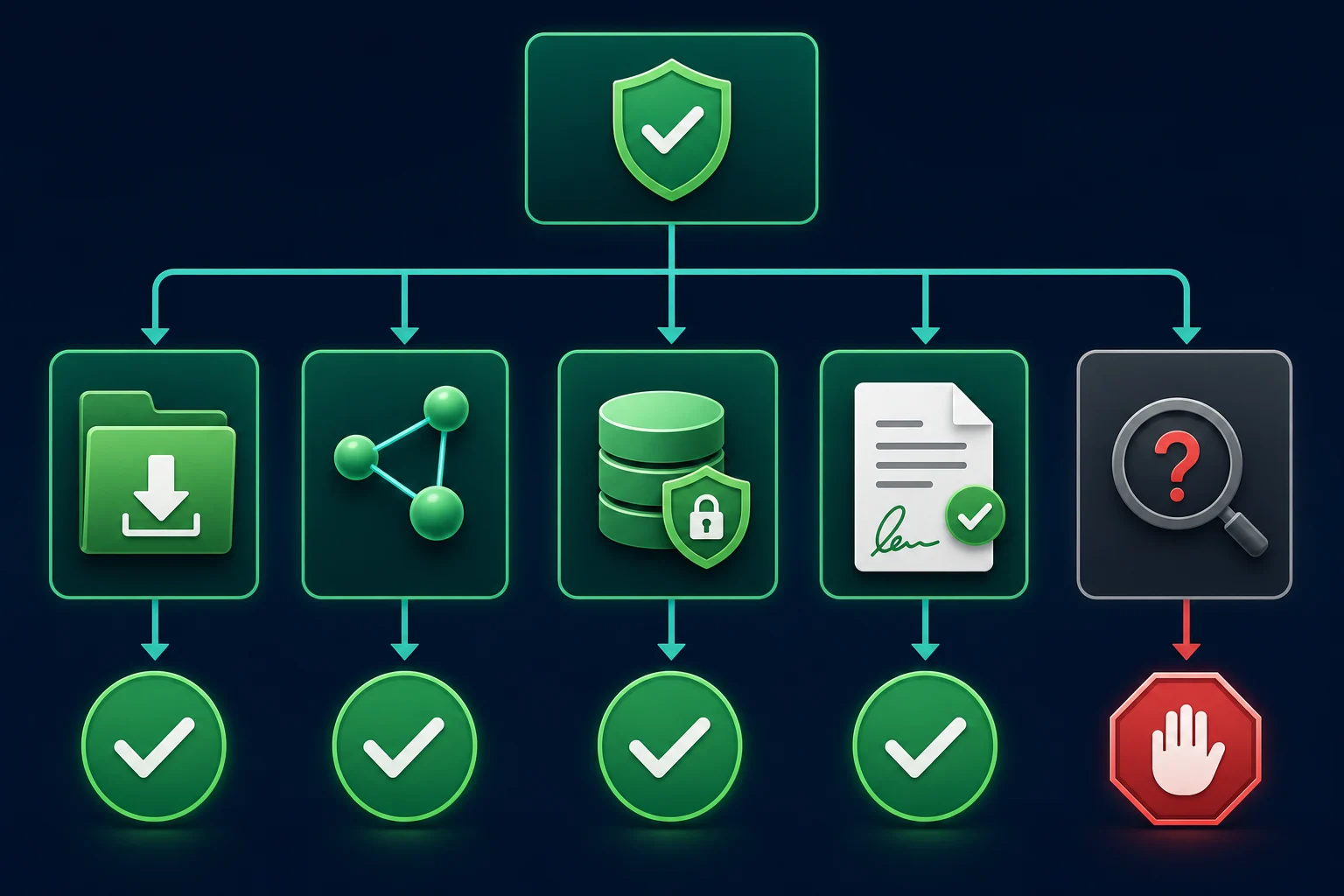
This decision should be recorded for each source rather than hidden in a general legal note. The broader job data scraping guide covers schemas, normalization, duplicates, and listing lifecycles across job sites; this article stays focused on Indeed-specific access choices and controls.
What Indeed's Official APIs Actually Cover
Indeed documents several employer and partner integrations, but their names can be misleading if you are looking for a general job-search dataset.
The Job Sync API documentation describes an ATS partner integration for creating, updating, expiring, and checking the status of job postings. Confirm with Indeed which integration model is available to your organization and complete its approval and setup process. Access to this publishing integration does not provide a public job-search API.
The Job Update API is likewise a controlled integration for jobs an employer or authorized agency manages, not a public corpus API. Use it only for the employer accounts and operations covered by your approval. Indeed's API Terms condition API use on the applicable documentation and prohibit retrieving more information than an approved integration minimally requires.
Treat API approval and data rights as part of the implementation:
- Confirm the API product matches the business use.
- Complete the Indeed setup and approval for your supported integration model, and obtain employer authorization where applicable.
- Request only the documented OAuth scopes.
- Store the employer, integration, and source identifiers with each record.
- Follow the endpoint's documented rate limits and allowed purposes.
- Revisit storage and downstream-use rules before sharing or reselling data.
If you only need to monitor jobs your organization owns, your ATS is often simpler and more authoritative than reading the copy displayed on Indeed. It also avoids treating a distribution channel as the system of record.
Define a Narrow Indeed Job Record
An approved source is only the first control. Define the exact fields needed for the analysis before retrieving anything. Do not store full HTML, page assets, or unrelated user data by default.
A practical record for employer-owned listings might look like this:
{
  "source": "indeed-partner-api",
  "employer_id": "authorized-employer-id",
  "source_job_id": "stable-job-id",
  "employer_requisition_id": "ENG-142",
  "title": "Platform Engineer",
  "company": "Example Company",
  "location": {
    "country": "US",
    "region": "NY",
    "locality": "New York"
  },
  "date_posted": "2026-08-28",
  "status": "active",
  "observed_at": "2026-09-01T12:00:00Z"
}
Keep the raw source value beside any normalized value that can change meaning. For example, separate a displayed location from remote-work eligibility, and separate an employer's requisition ID from an Indeed or partner API identifier.
The JobPosting vocabulary on Schema.org is a useful reference for common fields. It is not proof that every visible field is accurate or reusable. Validate title, company, location, dates, employment type, compensation, and status against the authorized source contract.
Avoid candidate profiles, resumes, application answers, contact details, and inferred sensitive characteristics. Those fields are unnecessary for listing analytics and create a different privacy and security risk.
Build the Authorized Collection Pipeline
Whether the input is an export, API response, or specifically permitted page, put a validation boundary between retrieval and storage.
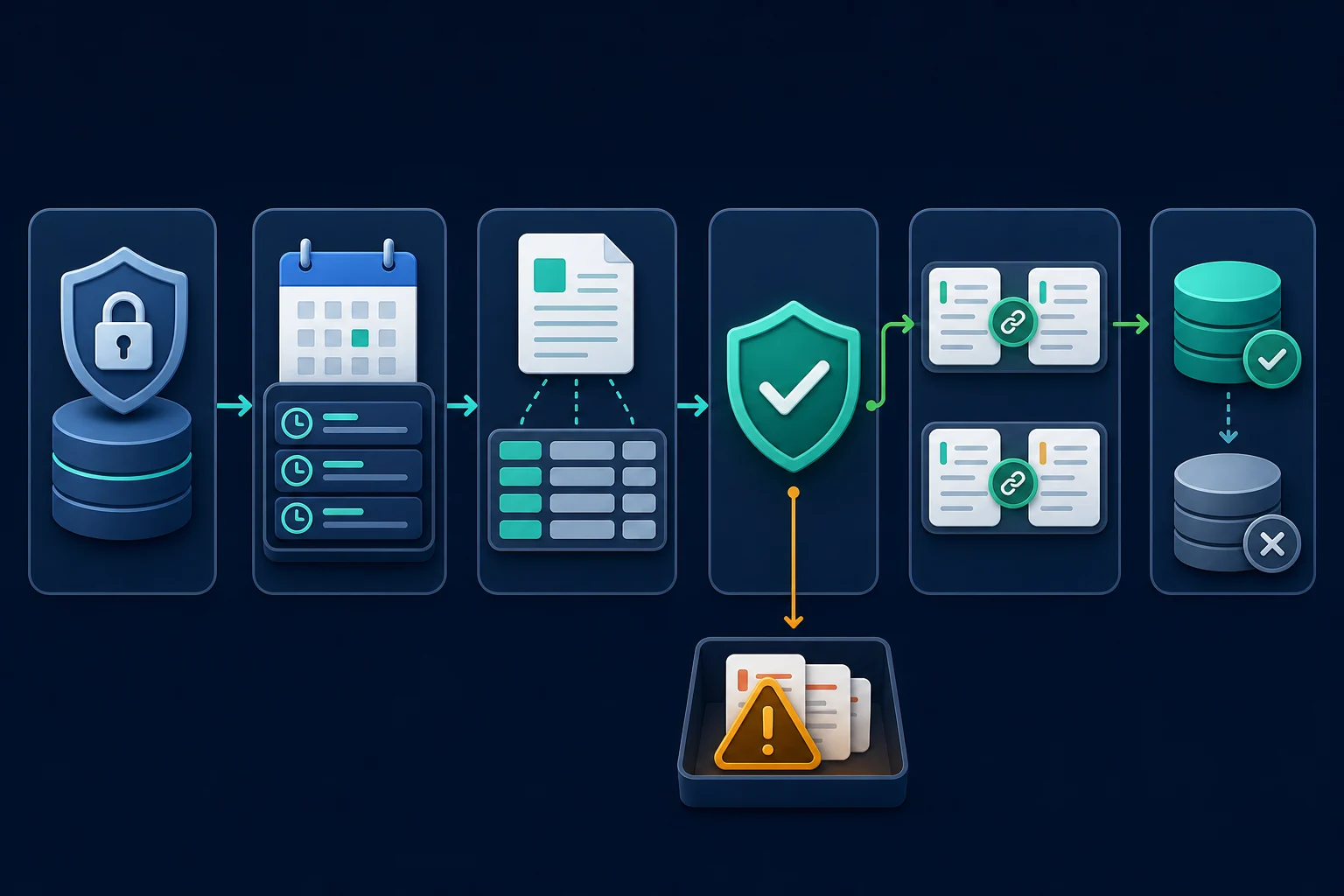
Use these stages:
- Source registry. Store the approved interface, employer or account owner, permitted fields, allowed purpose, review date, request budget, and kill switch.
- Bounded discovery. Read IDs from the approved API, export, webhook, or fixed allowlist. Do not let arbitrary links expand the crawl scope.
- Structured extraction. Map documented API or export fields first. Use page selectors only when written authorization covers that page workflow.
- Validation. Reject missing IDs, impossible dates, unexpected employers, login pages, challenges, consent pages, and schema drift.
- Deduplication. Prefer stable source and requisition IDs. Use normalized title, company, location, and description similarity only as supporting evidence.
- Lifecycle storage. Append observations, derive current state, and retain source lineage rather than overwriting history without an audit trail.
Every run should produce counts for discovered, accepted, quarantined, duplicated, updated, and closed records. A scraper that exits successfully while accepted records fall from 95% to 40% is still failing.
Deduplicate Indeed Listings Without Losing Lineage
The same role can have several relevant identifiers: an employer requisition ID, an ATS posting ID, an Indeed-side job ID, and a public URL. Preserve them separately.
Use a composite identity strategy:
- Within one authorized employer feed, match the stable source ID first.
- Treat the same source ID with changed content as an update, not a new job.
- Merge location variants only when the requisition or source metadata provides evidence that they represent one opening.
- Keep a source relationship when an Indeed listing points to an employer-hosted application page.
- Send uncertain cross-source matches to review instead of collapsing them automatically.
Title-only matching is unsafe. Two companies can both advertise a “Sales Associate,” and one employer can have distinct openings with the same title in several cities.
For change detection, hash a canonical subset of fields rather than the entire payload. Exclude observation timestamps and presentation-only markup so they do not create false updates. Store the parser or mapper version with the hash.
Track Updates, Closures, and Uncertain Results
Job data decays quickly when a pipeline keeps closed positions active. Distinguish source status from retrieval status.
Useful states include:
active: the approved source explicitly reports the job as active.updated: a material field changed while the source ID remained stable.expired: the source reports an expiry or closed state.missing_pending_confirmation: a previously known ID is absent once.closed: an explicit closure or repeated confirmed absence meets your rule.unknown: the request failed, authentication expired, or the payload could not be validated.
Do not mark a job closed because one request timed out or returned an unexpected page. Retry transient server failures inside a capped budget, but stop the source on authentication failures, permission errors, or access denials.
Indeed's API Terms say it monitors and limits API usage and may document or communicate those limits. Follow the request budget assigned to the approved interface you actually use. If that interface returns HTTP 429, reduce concurrency and honor Retry-After; RFC 6585 defines the status and permits a response to include that header. The HTTP 429 guide explains capped retries, exponential backoff, jitter, and concurrency reduction.
When Proxies Fit an Indeed Job Data Workflow
Most employer API and export jobs do not need a rotating proxy. A direct connection or one stable egress address is easier to authenticate, audit, and allowlist.
A proxy can serve a legitimate role when your authorization specifically covers:
- Testing how your own job appears from approved regions.
- Giving an integration a fixed egress IP for an allowlist.
- Isolating independent customer environments.
- Keeping one browser test session on a consistent network route.
For an approved regional QA task, residential proxies can provide location-specific egress. Keep the proxy, cookies, and browser context stable for the session, and record which region produced each observation.
Do not rotate IPs after 403 responses, challenges, or other denials in an attempt to continue. Stop, classify the response, confirm the authorization and request behavior, and contact the source owner when necessary. IP rotation cannot repair expired OAuth credentials, missing scopes, a broken data mapper, or prohibited access.
Operational Checklist Before Launch
Before an Indeed-related collector runs in production, confirm all of the following:
- The data owner and permitted business purpose are named.
- The source is an approved API, export, licensed dataset, or written-authorized page set.
- The allowed hostnames, employer IDs, fields, and downstream consumers are recorded.
- Credentials use the minimum scopes and are stored outside logs and source control.
- Each source has its own concurrency, retry, and daily request budget.
401,403,429, challenges, and schema changes have explicit stop or backoff behavior.- Validation rejects unexpected personal data and non-job pages.
- Deletion, correction, retention, and access-review procedures are tested.
- Proxies, if any, solve a documented routing requirement rather than conceal traffic.
For the broader legal review—contracts, privacy, copyright, database rights, and jurisdiction—use the data scraping legality checklist. Qualified counsel should review a real collection project when the authorization or intended reuse is unclear.
Indeed Job Scraping FAQ
Is it allowed to scrape Indeed job listings?
Indeed's current Terms prohibit using automated systems to access, data-mine, or scrape the site without express written permission, with conditional crawler access governed by its robots.txt file. Review the current terms for your market and obtain permission for the exact project; public visibility alone is not authorization.
Does Indeed have an API for job listings?
Indeed provides APIs for defined partner and employer workflows. Its Job Sync documentation describes an ATS partner publishing integration. Job Update can retrieve jobs associated with an authorized employer token. Confirm eligibility with Indeed; these products do not provide general permission to collect arbitrary search results.
Can I build an Indeed scraper in Python?
Python can process an authorized export or call an approved API, but the language does not change the access rules. Build the source contract, authentication, rate limits, field allowlist, validation, and stop conditions first. Do not use Python browser automation to bypass a restriction or challenge.
Does robots.txt make Indeed scraping legal?
No. The Robots Exclusion Protocol communicates crawler rules, while permission, contracts, privacy, intellectual-property rights, and applicable law are separate questions. Indeed's Terms expressly tie conditional crawling permission to its robots rules, so both sources must be reviewed together.
Can proxies prevent an Indeed scraper from being blocked?
No. Proxies can support approved regional testing, stable egress, or workload isolation. They do not grant permission or fix excessive request rates, invalid credentials, missing API scopes, broken parsing, or site-policy denials.
What should I store from an Indeed job record?
Store only the fields required for the approved purpose: source and requisition IDs, title, employer, location, employment type, compensation when permitted, source dates, status, canonical URL, and observation timestamps. Avoid applicant, profile, resume, and contact data unless a separate authorized workflow explicitly requires them.
Conclusion
Indeed job scraping should start with an approved data path: your ATS, an employer-authorized Indeed partner API, a licensed dataset, or narrow written permission. Once access is settled, define a small schema, preserve source identifiers, validate every observation, deduplicate with evidence, and track listings through confirmed closure.
Use proxies only for a documented routing need inside that authorization. If the source rules or response tell you to stop, changing IPs is not a solution; revisiting the source, scope, or permission is.