
An Instagram scraping tool collects selected Instagram data and turns it into structured records or exports. The right tool is the one that fits an authorized source, returns only the fields you need, preserves provenance, and stops cleanly when permissions or response conditions change.
Start with the access method, not a feature list. Use Instagram's own export for a copy of data from an account you control. For a supported professional-account integration, evaluate the official Instagram API. Consider a licensed data source or custom browser collector only when its permissions and your use case are explicit.
Instagram's Terms of Use prohibit automated access or collection without express permission. A scraper, proxy, or logged-in session does not create that permission. This guide helps you choose and test an Instagram scraping tool for approved research, account-owned data, business reporting, or authorized QA. It is not a playbook for bypassing platform controls, and it is not legal advice.
What Instagram's Terms and Meta's Automated Data Collection Terms Say
Two documents matter for any Instagram scraping project. Read the current versions yourself, because Meta updates them.
Instagram Terms of Use. In the section on your commitments, the terms say:
"You can't attempt to create accounts or access or collect information in unauthorized ways. This includes creating accounts or collecting information in an automated way without our express permission."
The current version also links this rule to Meta's Automated Data Collection Terms and states that it applies whether or not the automated collection happens while you are logged in to an Instagram account.
Meta's Automated Data Collection Terms. Meta's Automated Data Collection Terms cover collecting data from Meta products by automated means, such as bots, spiders, or scrapers. In summary, they say:
- You must not collect data this way without Meta's express written permission.
- Accepting the terms is not that permission. You must get it separately.
- Data collected with permission can be used only for the purposes Meta allows, such as search engine results or link previews, or purposes Meta has approved in writing.
Why the "logged in or not" wording matters. In Meta v. Bright Data (N.D. Cal., January 2024), the court ruled that Meta's terms at that time did not cover scraping of public data by a visitor who was logged out. Meta later dropped the case. The current Instagram wording addresses logged-out collection directly. Do not rely on that ruling as permission for a new project. Get advice on the current terms and your facts.
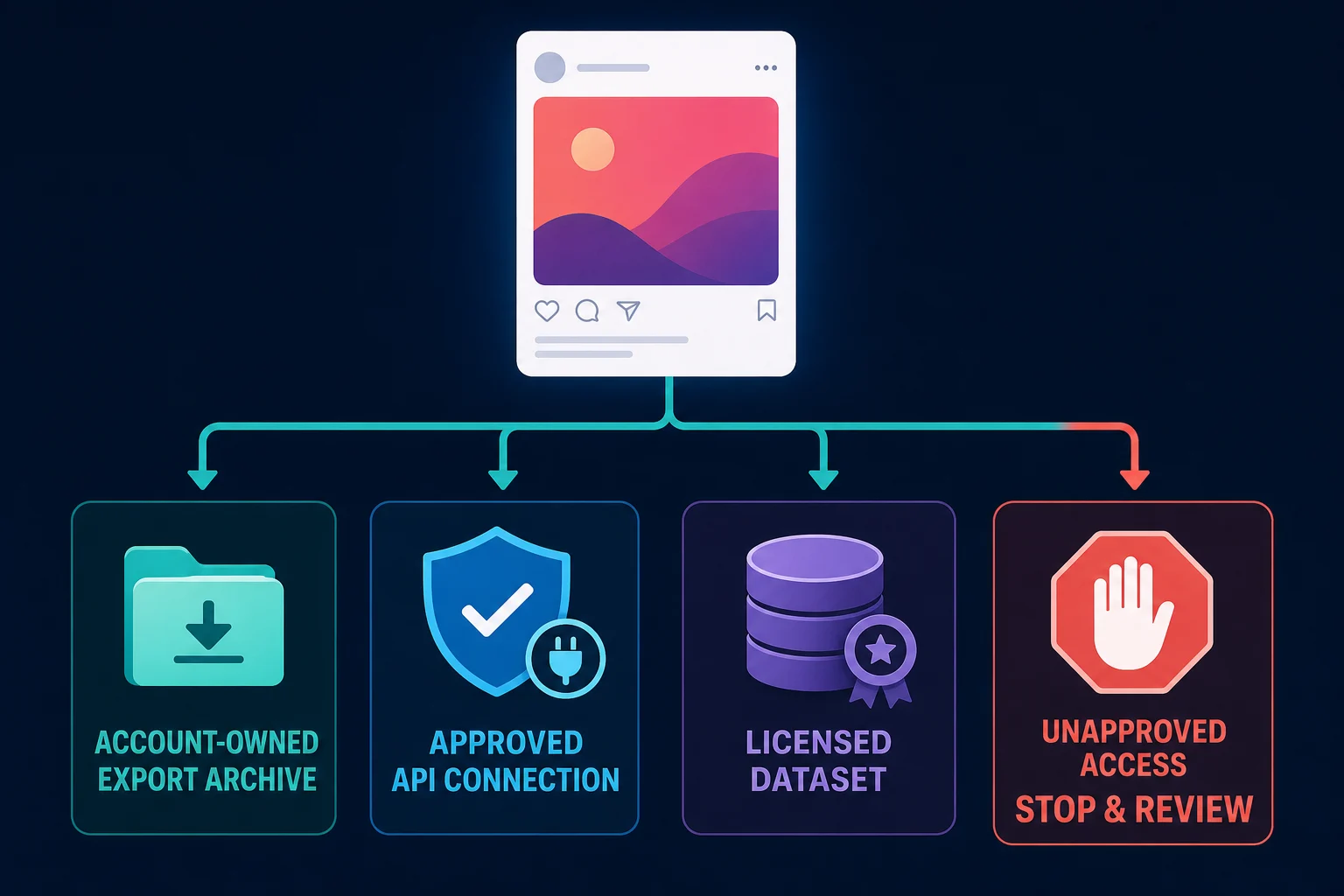
In practice, these terms leave three routes: your own account export, the official Instagram API within its permissions, or written permission from Meta (directly or through a licensed data provider that holds it).
Instagram Scraping Tool: Quick Choice
Match the tool to the source you are allowed to use:
| Your actual goal | Start with | Why |
|---|---|---|
| Export posts, comments, or account history from your own profile | Instagram's account export | First-party, account-controlled source with selectable data and date range |
| Build an approved integration for a professional account | Instagram API | OAuth permissions, documented objects, versioned responses, and supported workflows |
| Collect a licensed dataset for analysis | Licensed provider or feed | The contract can define provenance, permitted uses, refreshes, and deletion duties |
| Test a company-managed page or workflow | Authorized browser automation | Useful when the approved test genuinely requires rendering or interaction |
| Gather arbitrary profiles, followers, or private data | Stop and review | Public visibility, a login, and a scraping tool do not establish permission |
The best Instagram scraper is therefore use-case specific. A polished dashboard is irrelevant if its data source, authorization, field coverage, or retention terms do not match your project.
Check Permission Before Comparing Features
Tool selection comes after access review. Given the terms above, document where your permission comes from before you compare features.
For each proposed source, record:
- Who controls the account, page, application, or dataset.
- Which interface supplies the data: account export, official API, licensed feed, or authorized page.
- Which fields and date ranges are approved.
- Whether records contain personal data, copyrighted media, location, or sensitive inferences.
- The allowed purpose, recipients, refresh schedule, and retention period.
- The event that must stop collection, such as revoked access, a changed scope, repeated denial, or an expired agreement.
The broader guide to whether data scraping is legal explains why access, contracts, privacy, content rights, jurisdiction, and downstream use are separate gates. Get qualified legal and privacy advice for a real project involving people, profiling, regulated decisions, or large-scale reuse.
Compare Instagram Data Access Methods
An Instagram scraping tool may hide its source behind a single input box, but the source determines most of the risk and reliability.
Instagram account export
If you need data from an account you control, start with Instagram's Export your information feature. Meta says you can select specific information, a date range, format, notification address, and media quality when creating an export.
This route is a strong fit for one-time archives, internal migration, account audits, and analysis that does not require minute-by-minute updates. The tradeoff is that the export is asynchronous and its structure is designed for account portability rather than a continuously running application.
Before buying a tool for your own history, request a sample export. Confirm whether its JSON or HTML files already contain the necessary fields. A small parser around an official export can be cheaper, safer, and more stable than maintaining a browser collector.
Official Instagram API
For supported business and creator workflows, evaluate the Instagram Platform first. Capabilities depend on the login method, account type, API version, app mode, approved permissions, and the accounts that authorize the application.
The API is not a general-purpose endpoint for downloading any Instagram profile. A tool that uses it should show the OAuth consent flow, requested permissions, supported account types, and exact fields before you subscribe. It should also expose API errors rather than relabeling every empty response as "no data."
Use the official API when it covers the required data and workflow. Versioned structured responses are easier to validate than browser markup, and permission changes are easier to audit than shared passwords or imported session cookies.
Licensed datasets and managed providers
A licensed provider can fit recurring research when the license expressly covers the source, fields, refresh frequency, territory, purpose, and downstream recipients. Ask for written answers about provenance instead of accepting a vague claim that the data is public.
Review how the provider handles removals, corrections, opt-outs, account deletion, source changes, and contract termination. Your team still needs a lawful purpose and appropriate controls for personal data; outsourcing acquisition does not outsource responsibility for how you use the dataset.
Authorized browser automation
Browser automation is the last option, not the default. It may be appropriate for QA on a company-managed profile or another narrowly authorized workflow that cannot be tested through an export or supported API.
A browser collector is heavier and more fragile because rendering, consent state, cookies, page experiments, and selectors can all affect the result. If permission covers that method, isolate the browser profile, preserve one session identity, cap navigation, and test against stored fixtures. The Playwright proxy guide covers route configuration without mixing proxy credentials into page code.
Do not give a third-party tool your Instagram password or session cookie merely because it promises broader coverage. Prefer OAuth for approved integrations, and treat tools that request raw credentials, promise invisible scraping, or advertise unlimited collection as high-risk.
Features an Instagram Scraping Tool Should Have
A useful tool must do more than return a CSV. Evaluate these controls in a trial:
- Transparent source: It identifies whether each record came from an export, official API, licensed feed, or authorized page.
- Scoped authentication: It uses approved OAuth permissions where available and never asks operators to paste secrets into job descriptions.
- Field allowlists: You can choose exact fields before collection and reject unexpected fields by default.
- Bounded inputs: Account IDs, approved URLs, date ranges, page counts, and record limits are explicit.
- Response classification: Permission errors, rate limits, empty datasets, expired tokens, and parser failures remain distinguishable.
- Checkpointed jobs: A retry resumes from a cursor or stable checkpoint instead of starting an unbounded duplicate crawl.
- Validation and deduplication: Records have stable source IDs, types, timestamps, and rejection reasons.
- Provenance: Every record carries its source, collection time, tool version, and authorization reference.
- Retention controls: Raw responses, media, logs, backups, and exports have deletion schedules.
- Operational exits: You can pause a job, revoke credentials, delete a dataset, and export an audit log without vendor support.
Avoid feature counts that do not map to your schema. "Exports 50 fields" is not a benefit when you need six approved fields and the remaining 44 increase privacy and cleanup work.
Use a Scorecard Instead of a Feature Demo
Run the same approved sample through every candidate and score evidence, not sales claims.
| Evaluation area | Weight | Pass condition |
|---|---|---|
| Source and permission fit | 25% | Source, authorization, account types, and permitted uses are documented |
| Required field coverage | 20% | All required fields exist; unapproved fields can be excluded |
| Data quality | 20% | IDs, timestamps, types, and record counts validate against the source |
| Security and privacy | 15% | OAuth or managed secrets, access controls, retention, and deletion are supported |
| Failure handling | 10% | Errors, limits, partial runs, and retries are visible and bounded |
| Export and integration | 5% | Stable JSON/CSV schema, webhooks, or storage destination matches your stack |
| Cost predictability | 5% | Billing units, retries, media transfer, and overages can be estimated |
Set the permission category as a hard gate. Do not let a high score for speed or price compensate for an unclear source or unsupported use.
Test the Tool With a Small Approved Dataset
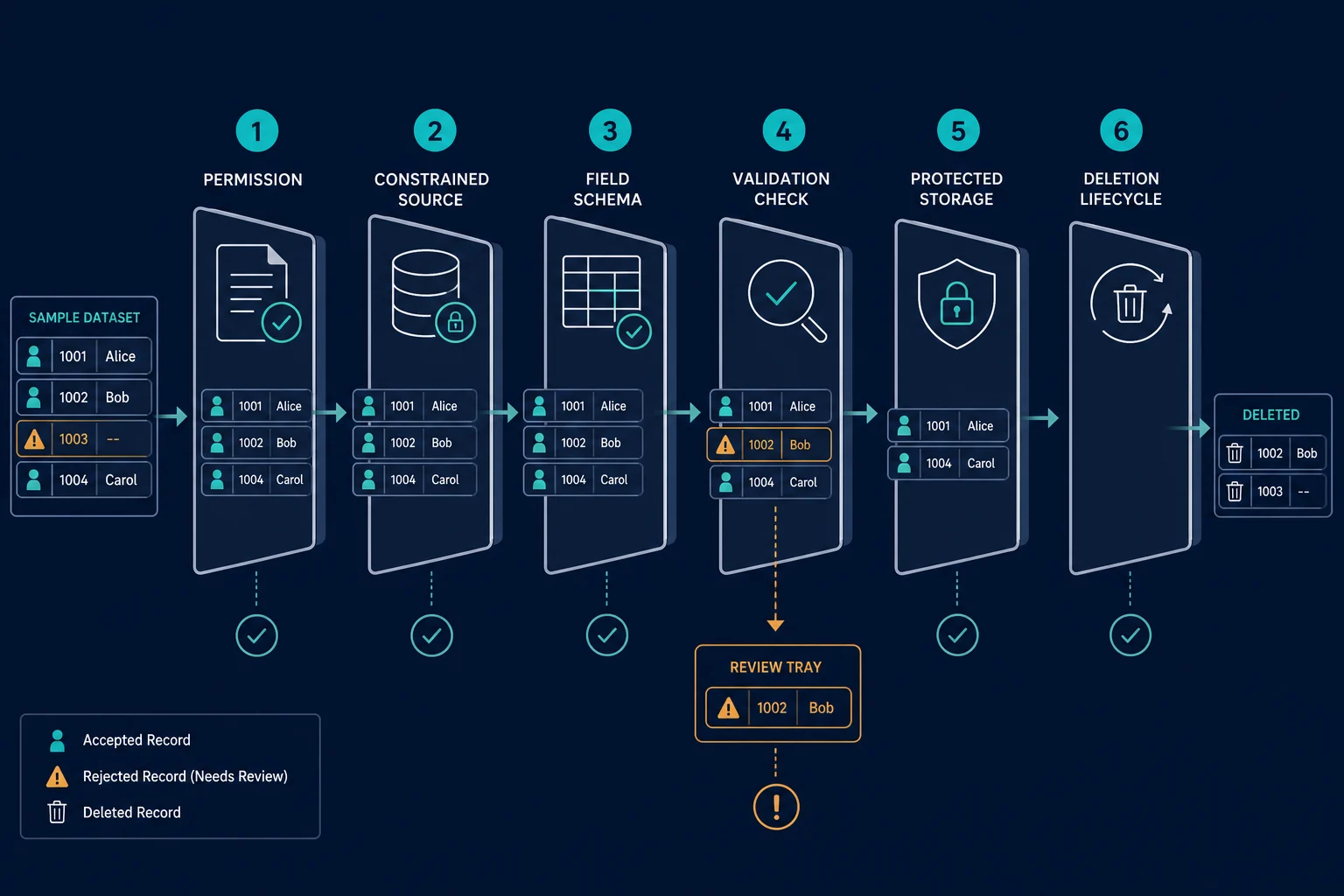
Do not begin with thousands of profiles or posts. Build a 20- to 50-record reference set from a source you control or are authorized to access.
Include cases that expose common errors:
- A post with a caption and one without.
- More than one media type your scope requires.
- Timestamps near a date-range boundary.
- A deleted or unavailable source record.
- Pagination across at least two pages or cursors.
- Unicode, emoji, line breaks, and empty optional fields.
- A duplicate returned after a retry.
For each record, compare source ID, timestamp, media type, text, URL, account reference, and any permitted metrics with the reference source. Compute completeness and duplicate rates by field; do not settle for "the CSV looks right."
Then run four operational tests:
- Revoke or expire a test credential and confirm the job stops with an authentication error.
- Interrupt a run and verify that resume does not duplicate accepted records.
- Change one optional field and confirm the schema version records the difference.
- Delete the test dataset and verify removal from active storage, exports, and documented backup schedules.
The result should be a repeatable acceptance test you can rerun after an API version, provider, schema, or permission change.
Design the Output Schema Before Collection
Define the record contract before a tool shows you everything it can extract. A minimal content-observation record might contain:
{
  "source_record_id": "approved-source-id",
  "source_account_id": "authorized-account-id",
  "media_type": "approved-type",
  "published_at": "2026-08-01T10:15:00Z",
  "observed_at": "2026-08-03T12:00:00Z",
  "source_method": "official-api",
  "authorization_ref": "project-scope-2026-08"
}
Add a caption, permalink, metric, or media reference only when the use case and permission require it. Keep access tokens, session cookies, proxy credentials, and unrelated response fields out of records and logs.
Store observations separately from source facts. published_at describes the source record; observed_at describes when your system saw it. That distinction supports freshness checks, change history, and deletion without pretending the collector knows when every source-side edit occurred.
Failure Signals the Tool Must Preserve
A good tool makes stop conditions obvious:
| Signal | What it may mean | Correct response |
|---|---|---|
| OAuth or permission error | Token expired, scope missing, account disconnected, or app access revoked | Pause and restore access through the approved flow |
403 Forbidden |
Resource, policy, permission, session, or network denial | Stop retries and review authorization plus response details |
429 Too Many Requests |
Documented budget or operational rate exceeded | Honor server guidance, reduce concurrency, and apply capped backoff |
| Login, checkpoint, or challenge page | Session needs supported recovery or collection is outside the approved path | Pause; do not rotate identities and continue |
200 OK with empty records |
Schema changed, wrong source, expired access, or unexpected page | Quarantine the response and compare it with a known fixture |
| Duplicate IDs after resume | Cursor or retry state is broken | Stop writes and repair idempotency before the next run |
The guides to HTTP 403 Forbidden and HTTP 429 Too Many Requests explain those response classes in more detail. Neither should trigger an unlimited retry or proxy-rotation loop.
When Proxies Fit an Instagram Scraping Tool
Many approved API and account-export workflows do not need a proxy. A stable direct connection is simpler to authenticate, attribute, and debug.
Proxies can serve a legitimate operational purpose for authorized regional QA, fixed outbound egress, environment isolation, or testing how a company-managed page renders from an approved location. They do not grant Instagram permissions, expand API fields, remove account limits, or make prohibited collection acceptable.
For stateful browser QA, keep one browser profile, cookie jar, and stable proxy session together. Rotating the IP mid-session can create inconsistent state and makes failures harder to diagnose. The sticky vs rotating proxies guide explains the session tradeoff.
When consumer-style regional egress is genuinely required for an authorized test, residential proxies provide location targeting and sticky sessions. When fixed dedicated egress is the requirement, compare ISP options on the pricing page. Start with low volume, a bounded location list, and documented stop conditions.
Red Flags When Choosing a Vendor
Walk away or escalate review when a vendor:
- Cannot name the source method for each dataset.
- Claims that public visibility automatically permits collection and resale.
- Requires account passwords, copied cookies, or unknown browser extensions.
- Promises unlimited extraction, no blocks, or undetectable automation.
- Treats permission errors and empty results as retryable network failures.
- Cannot exclude fields you did not approve.
- Provides no stable record IDs, timestamps, or source provenance.
- Has no deletion, correction, opt-out, security, or incident process.
- Suggests rotating proxies to continue after an explicit denial.
Also inspect the contract for field definitions, service limits, data ownership, subprocessors, security commitments, deletion timeframes, and what happens to cached or derived data when the subscription ends.
Instagram Scraping Tool Checklist
Before production, confirm:
- The purpose and data owner are named.
- The access method is an account export, supported API, licensed source, or written authorization.
- Current Instagram and Meta terms were reviewed for that method.
- Required fields, prohibited fields, date range, accounts, and volume are fixed.
- Authentication uses approved OAuth or managed secrets.
- The tool exposes errors, cursors, retries, rejections, and schema versions.
- A small reference dataset passed completeness and duplicate checks.
- Personal data and content rights were reviewed.
- Retention, correction, deletion, and access controls cover every storage layer.
- Proxies, if used, have a documented routing purpose inside the approved scope.
- Repeated denial, changed permissions, or source drift automatically pauses collection.
If the source or authorization is unclear, the evaluation is not complete no matter how good the demo looks.
Frequently Asked Questions
What is the best Instagram scraping tool?
The best tool is the least complex authorized source that satisfies the data need. Use Instagram's export for data from your own account, the official API for supported professional-account integrations, a licensed provider when its rights and provenance fit, or authorized browser automation only for a narrowly approved workflow.
Can I scrape Instagram without logging in?
Being able to view a page without logging in does not grant permission for automated collection or reuse. Instagram's current terms say the automated-collection rule applies whether or not you are logged in. Review the current terms, privacy and content rights, and your specific authorization before choosing any tool.
What are Meta's Automated Data Collection Terms?
They are Meta's rules for collecting data from Meta products, including Instagram, with bots, spiders, scrapers, or other automated means. They require Meta's express written permission, and they state that accepting the terms does not by itself grant that permission.
Does Instagram have a scraping API?
Instagram provides official APIs for defined business and creator workflows, not a general-purpose scraping API for arbitrary accounts. Check the current Instagram Platform documentation for supported account types, permissions, objects, and app-review requirements.
Can an Instagram scraper export to CSV or JSON?
Many tools can, but the format matters less than schema stability. Require stable source IDs, timestamps, field definitions, provenance, encoding tests, duplicate handling, and a documented schema version.
Do I need residential proxies for Instagram scraping?
Not by default. Approved API and export workflows usually work best with simple, stable connectivity. Residential proxies may fit authorized regional QA, but they do not grant access or solve account-, permission-, or application-level limits.
How should an Instagram scraping tool handle rate limits?
It should preserve the original response, honor documented server guidance, lower concurrency, use capped backoff with jitter, and resume from a checkpoint. It should not hide rate limits behind automatic identity rotation or infinite retries.
Conclusion
Choose an Instagram scraping tool by verifying the source and permission first, then testing field coverage, data quality, security, failure handling, retention, and cost on a small approved dataset. Account exports and supported APIs are preferable when they cover the job; licensed sources and browser automation need equally clear authorization and provenance.
Proxies can support stable egress or authorized regional QA, but they remain routing infrastructure rather than permission. A reliable Instagram scraping tool makes its boundaries visible, collects only what the project needs, and stops when those boundaries change.