Sticky vs rotating proxies is a session strategy decision. Use sticky proxies when the target website expects one visitor identity to stay consistent across multiple requests. Use rotating proxies when each request can stand alone and you want to reduce request concentration on a single IP.
For residential proxy users, this choice matters as much as country, protocol, or proxy type. A rotating setup can improve stateless scraping, localized checks, and public-page monitoring. A sticky setup is safer for logins, carts, queues, checkout, account checks, and browser flows where cookies and IP identity should stay aligned.
Unknown Proxies residential plans support both modes. Sticky residential sessions rotate every 2 hours, while rotating residential proxies rotate on every request. If you are setting up residential sessions for the first time, read the residential proxy setup guide, then choose the session mode that matches the workflow. For broad consumer-style IP coverage, start with residential proxies.
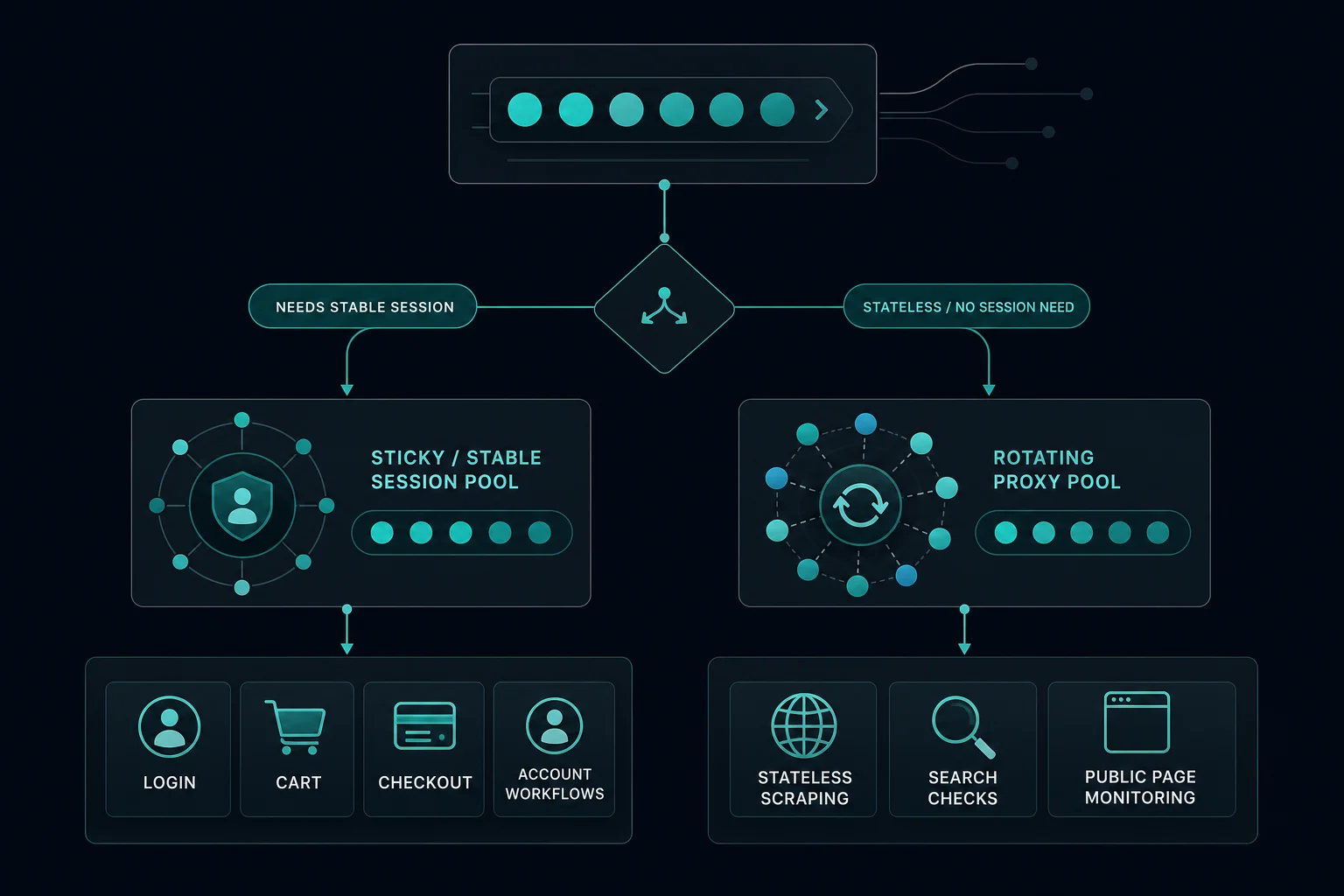
Sticky vs Rotating Proxies: Quick Decision
Start with whether the site should see continuity.
| Workflow | Better session type | Why |
|---|---|---|
| Account login | Sticky | Cookies, IP, and browser profile should stay together |
| Cart, queue, checkout, or ticketing | Sticky | Multi-step state can break if the IP changes mid-flow |
| Retail or sneaker bot account tasks | Sticky or ISP | Stable identity is usually more important than constant rotation |
| Public-page scraping | Rotating | Each page request can usually stand alone |
| Search result checks | Rotating | Rotation helps spread independent localized lookups |
| Ad verification and localized QA | Rotating | You often need many locations and independent sessions |
| API access with account limits | Neither by itself | Respect API limits, cache responses, and reduce concurrency |
The fastest rule: if the next request depends on the previous request, use sticky. If the next request is independent, rotating is usually the cleaner default.
What Are Sticky Proxies?
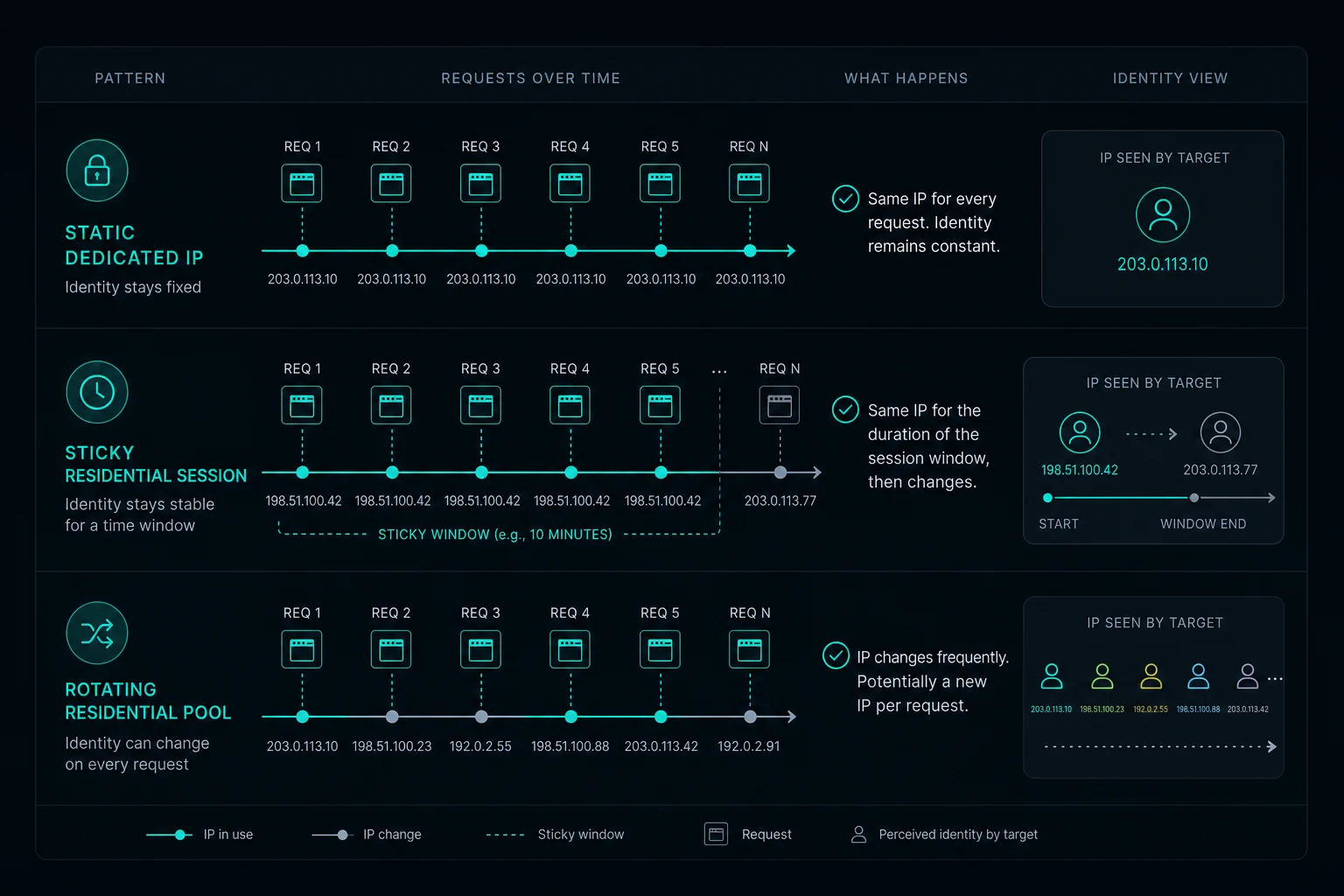
Sticky proxies keep the same exit IP for a session window. Instead of changing IPs on every request, the proxy provider maps a session identifier to one exit IP until that session expires, fails, or is intentionally changed.
Sticky sessions fit workflows where a website builds state over time:
- Login and account checks.
- Carts, checkout, and queue flows.
- Browser automation with cookies.
- Retail monitoring tied to accounts.
- Sneaker proxies and retail bots that run profile-level tasks.
- Multi-page research flows.
- Any workflow where changing IPs mid-session would look unnatural.
Sticky does not mean unlimited traffic through one identity. If you run too many requests through one sticky IP, you can still trigger HTTP 429 Too Many Requests, Cloudflare rate limits, or access checks.
What Are Rotating Proxies?
Rotating proxies change the exit IP frequently. With Unknown Proxies residential rotation, the exit IP changes on every request. Other providers may rotate on a timer, after a request count, or when a session is refreshed.
Rotating proxies fit workflows where requests are independent:
- Public web scraping.
- Search result checks.
- Price and catalog checks.
- Ad verification.
- Geo-targeted QA.
- Broad monitoring without login state.
- One-off lookups where cookies are not reused.
Rotation helps reduce request concentration, but it can also break sessions. If a site sets a cookie on the first request and the second request arrives from a different exit IP, the site may reset the session, challenge the browser, or return inconsistent content.
Sticky vs Rotating vs Static Proxies
Sticky vs rotating proxies describes how the session behaves. Static vs rotating proxy is a related product-level question.
A static proxy usually means the same dedicated IP stays assigned to you until you replace it. ISP proxies and many datacenter proxies are static in that sense. They are useful when you need speed, stability, and a fixed identity for repeated access. If you are comparing static ISP-style options, read what are ISP proxies and ISP data center proxies.
Rotating residential proxies use a broader pool. They are useful when the target is sensitive to hosting traffic, when you need location diversity, or when each request can use a different consumer-style IP.
If you are comparing static vs rotating proxy options because you are also choosing a proxy category, read datacenter proxies vs residential proxies. If the main question is scraping reliability, compare the best proxy for web scraping by target strictness, session needs, and cost.
When to Use Sticky Proxies
Use sticky proxies when the target expects one visitor identity.
Good sticky proxy use cases include:
- Logging into an account.
- Keeping a cart or checkout flow intact.
- Joining a queue.
- Running a browser profile for multiple pages.
- Preserving cookies during a workflow.
- Keeping one account mapped to one proxy session.
- Testing pages where location and account state must stay consistent.
For account workflows, use a stable mapping: one account, one browser profile, one cookie jar, one sticky proxy session. If you change the proxy identity, start a fresh session instead of mixing old cookies with a new IP. The Instagram proxy setup guide applies this mapping to authorized social account workflows and explains when a static ISP route is a better fit than a time-limited sticky session.
For account-specific route selection, the best social media proxies guide compares static ISP, sticky residential, mobile, and datacenter options without treating rotation as the default.
For a platform-specific example, the Discord proxies guide explains when stable routing helps and why rotation does not override account or API rules.
The TikTok proxies guide applies this mapping to social account sessions, regional QA, and IP-quality checks.
For sneaker proxies and retail automation, sticky sessions are usually the safer starting point for profile tasks. The residential proxy setup guide for sneaker bots explains how to assign sticky sessions to account tasks and rotating sessions to independent monitors. If you are running retail bot setup around Target-style workflows, the Refract Bot Target guide shows why stable proxy assignment and sane delays matter.
When to Use Rotating Proxies
Use rotating proxies when each request can be treated as a new visitor.
Good rotating proxy use cases include:
- Fetching many public product pages.
- Checking search result pages from different regions.
- Verifying ads and localized content.
- Scraping public pages without login.
- Monitoring pages where cookies do not need to persist.
- Running low-concurrency tests across a broad pool.
Rotating proxies are not a license to ignore rate limits. You still need delays, jitter, caching, retry limits, and respect for site terms, robots guidance, and applicable law. If every rotating IP starts failing, the problem is probably request behavior, fingerprinting, endpoint policy, account limits, or target-side blocking logic.
How Session Choice Affects Scraping
For scraping, match the proxy mode to the shape of the crawl.
Use rotating residential proxies for stateless scraping:
- URL A does not depend on URL B.
- No login is required.
- Cookies are disposable.
- The target responds consistently to independent requests.
- You need country, state, or city-level coverage.
Use sticky residential proxies for stateful scraping:
- The scrape starts with a search and follows result pages.
- The site uses cookies to maintain context.
- The crawler enters an account area.
- Region, cart, queue, or session state affects the result.
- The same browser profile will make multiple requests.
If the target is permissive and speed matters more than reputation, residential rotation may be unnecessary. The best proxy for web scraping guide explains when residential, ISP, or datacenter proxies fit better.
How to Test Sticky vs Rotating Proxies
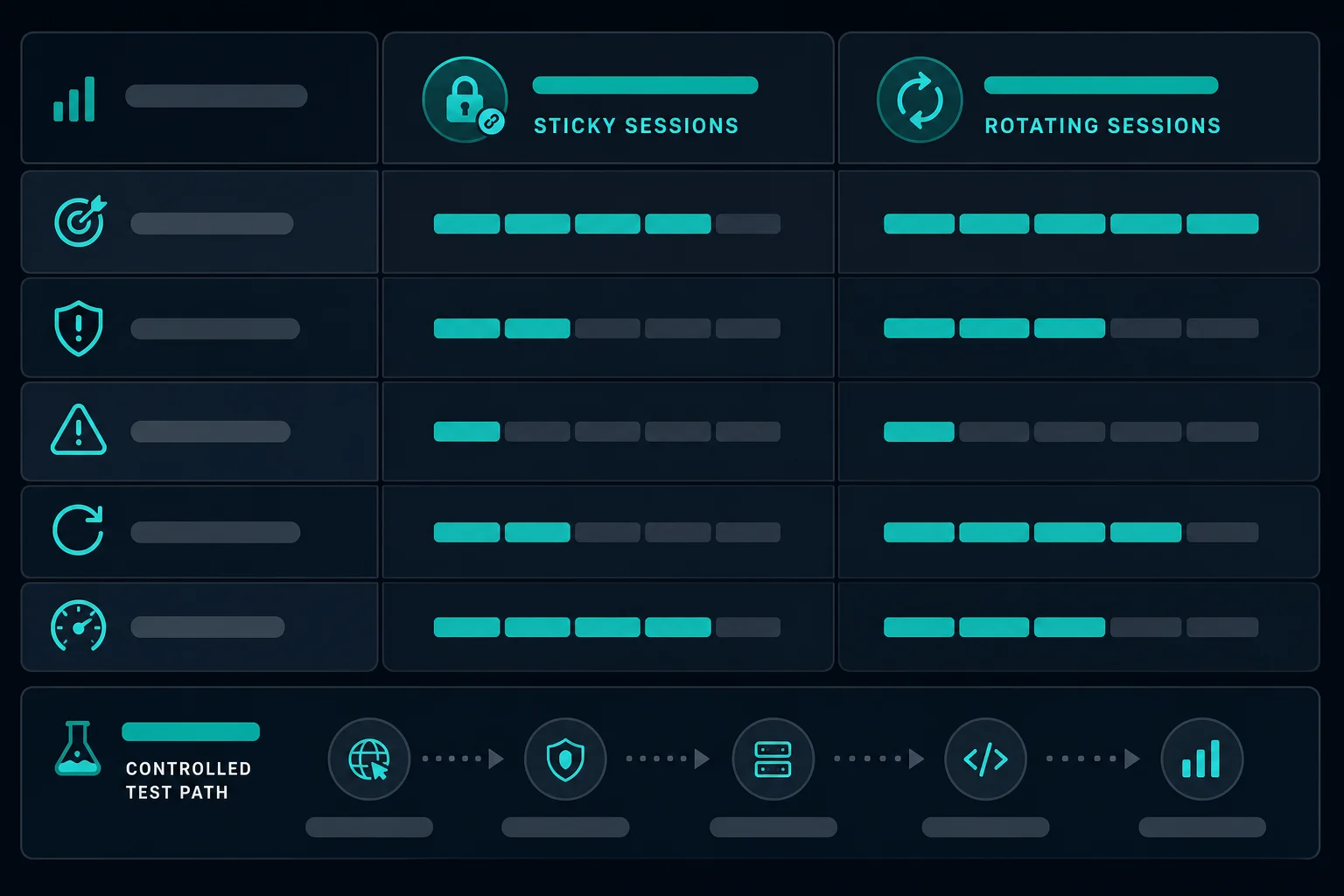
Run a controlled test before changing your whole setup.
- Pick one target page or workflow.
- Set a conservative delay and low concurrency.
- Run the workflow with sticky sessions.
- Run the same workflow with rotating sessions.
- Keep headers, browser profile, cookies, target region, and client code the same.
- Compare success rate, 403s, 407s, 429s, timeouts, session resets, and bandwidth.
- Change only one variable at a time.
If sticky works and rotating fails, the target probably expects continuity. If rotating works and sticky fails at scale, request concentration per IP may be too high. If both fail, do not keep buying more proxies until you check pacing, headers, authentication, cookies, fingerprinting, and target policy.
Common Session Mistakes
Avoid these patterns:
- Rotating IPs during login, queue, cart, or checkout.
- Reusing cookies after changing proxy identity.
- Sending every worker through one sticky session.
- Retrying immediately after 403, 429, timeout, or WAF responses.
- Switching proxy type, protocol, region, and delay at the same time.
- Using a city target when country-level routing is enough.
- Treating rotation as a fix for account-level or API-key limits.
- Ignoring site terms or robots guidance.
Most failures are easier to debug when you log the session ID, proxy endpoint, target URL, account, error code, timestamp, and retry count.
FAQ
Are sticky proxies better than rotating proxies?
Sticky proxies are better for workflows that need continuity. Rotating proxies are better for independent requests. Neither is universally better.
Should I use sticky or rotating residential proxies?
Use sticky residential proxies for login, carts, checkout, queues, account checks, and multi-step browser sessions. Use rotating residential proxies for public-page scraping, search checks, ad verification, and stateless monitoring.
What is the difference between sticky and static proxies?
Sticky proxies keep one exit IP for a session window, often inside a larger rotating pool. Static proxies are fixed dedicated IPs that usually stay assigned until you replace them.
Do rotating proxies prevent rate limits?
Not by themselves. Rotating proxies can reduce per-IP request concentration, but bad retry logic, high concurrency, account limits, and sensitive endpoints can still trigger rate limits.
Can I use sticky sessions for scraping?
Yes. Use sticky sessions when the scrape follows a stateful path, such as search to detail page, login to account area, or cart to checkout. Use rotating sessions for independent public pages.
Final Thoughts
Sticky vs rotating proxies comes down to session continuity. Use sticky proxies when cookies, browser profile, account, cart, queue, or checkout state should stay attached to one IP. Use rotating proxies when requests are independent and distribution matters more than continuity.
For residential workflows, start with residential proxies, review the residential proxy setup guide, and then choose sticky or rotating based on the task. For scraping-specific proxy selection, compare the best proxy for web scraping before scaling.
Technical references: MDN Proxy servers and tunneling, MDN HTTP cookies, and RFC 6265 HTTP State Management Mechanism.