The best proxy for web scraping depends on the target site, not a universal ranking. Use datacenter proxies when the target is permissive and speed or cost matters most. Use residential proxies when IP reputation, location diversity, and rotation matter. Use ISP proxies when you need stable dedicated IPs with stronger reputation than ordinary datacenter ranges.
Before buying a larger pool, test the workflow at low concurrency. Many scraping failures are caused by aggressive retries, broken sessions, bad headers, missing authentication, ignored rate limits, or target policy. A better proxy can help when IP reputation or request concentration is the bottleneck, but it will not fix bad scraping logic.
If the extraction workflow itself is not defined yet, start with the data scraping guide before evaluating routes. It covers source selection, schemas, extraction methods, validation, and monitoring independently of proxy choice.
If you already know you need broad rotation or country, state, and city targeting, start with residential proxies. If you are still choosing between proxy categories, compare datacenter proxies vs residential proxies first, then use this guide to choose the practical fit for scraping.
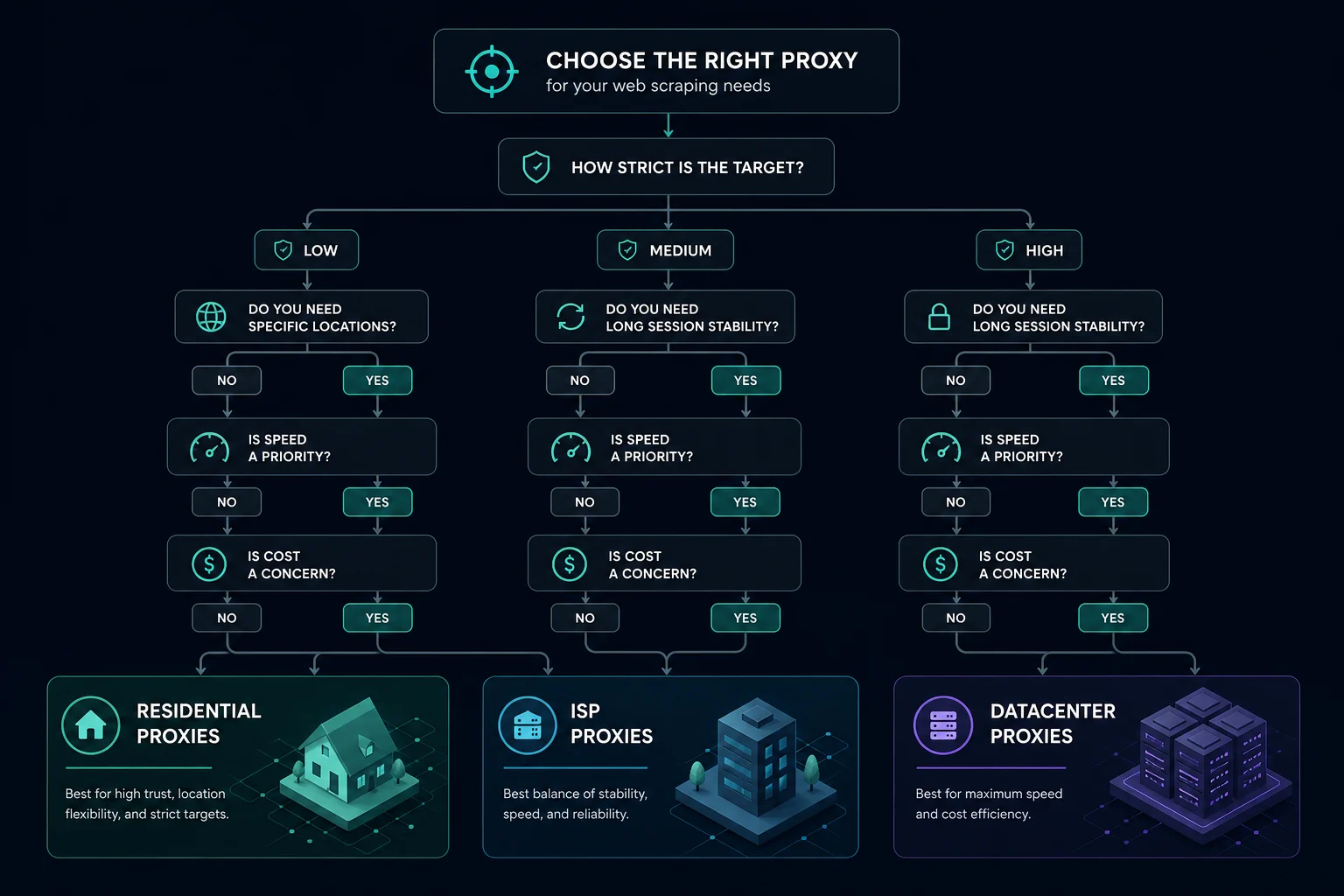
Best Proxy for Web Scraping: Quick Answer
Use the lightest proxy type that works reliably at your target request rate.
| Scraping situation | Usually choose | Why |
|---|---|---|
| Public pages on permissive sites | Datacenter proxies | Fast, cheap, and predictable |
| Strict targets that block hosting IPs | Residential proxies | Consumer-style IP reputation and broad rotation |
| Localized search, prices, ads, or inventory | Residential proxies | Country, state, and city routing help match local results |
| Account sessions or carts | ISP proxies or sticky residential | Stable identity matters more than constant rotation |
| Retail monitoring and repeated page checks | ISP proxies | Dedicated IPs and low latency are useful |
| High-volume scraping with low block rate | Datacenter proxies | Avoid paying for reputation you do not need |
| API access with account limits | Proxies may not help | Respect API limits, cache, and reduce concurrency |
If a small datacenter test works, datacenter proxies may be the best proxy for web scraping that target. If datacenter traffic gets blocked even at conservative rates, test residential or ISP proxies before scaling.
What Makes a Proxy Good for Scraping?
A good scraping proxy matches the target's risk signals and your workflow shape.
Evaluate these factors:
- IP reputation: whether the target distrusts the network or ASN.
- Rotation: whether each request can use a different IP.
- Session stability: whether cookies, login, cart, or browser state must persist.
- Location coverage: whether results vary by country, state, or city.
- Speed: whether latency affects monitoring or throughput.
- Cost model: per IP, per duration, or per GB.
- Protocol support: HTTP(S), SOCKS5, and the formats your tool expects.
- Error handling: how well your scraper backs off after 403, 407, 429, timeout, or WAF responses.
The proxy is only one part of scraping reliability. Request pacing, caching, user-agent consistency, cookie handling, retry limits, and legal/site-policy boundaries matter just as much.
Residential Proxies for Web Scraping
Residential proxies route requests through residential IP space associated with consumer networks. For scraping, their main advantage is reputation and location diversity.
Use residential proxies when:
- Datacenter IPs are blocked or challenged at low volume.
- You need localized search results, prices, ads, inventory, or content. For bounded implementations, see the guides to scraping Google search results and real estate scraping.
- The target is sensitive to hosting-network traffic.
- Each request can stand alone and benefits from rotation.
- You need country, state, or city-level routing.
- You are running browser-like workflows where consumer-style traffic matters.
Residential proxies are often the best proxy for web scraping higher-friction public pages, but they are not always the cheapest option. Because residential plans are commonly bandwidth-priced, heavy pages, browser sessions, images, and scripts can raise cost quickly. When the image files are the dataset rather than incidental page assets, the guide to scraping images from website pages shows how to discover, validate, and deduplicate them before scaling traffic.
For residential scraping, choose the right session mode. Rotating sessions fit independent requests. Sticky sessions fit multi-step browsing. The sticky vs rotating proxies guide explains that decision in detail.
ISP Proxies for Web Scraping
ISP proxies are stable dedicated IPs with stronger reputation than typical datacenter ranges. They often behave like fixed, high-performance proxies while avoiding some hosting-network drawbacks.
If the category is new to you, read what are ISP proxies. If you are deciding between stable ISP IPs and rotating residential pool access, compare ISP proxies vs residential proxies.
Use ISP proxies when:
- You need stable sessions.
- You monitor the same pages repeatedly.
- Speed and low latency matter.
- You map one task, account, or browser profile to one IP.
- Residential rotation breaks continuity.
- The target is stricter than a simple datacenter-friendly site, but constant rotation is not ideal.
ISP proxies are a strong fit for retail monitoring, account workflows, carts, queue-sensitive tasks, and repeated checks where the same proxy should stay attached to the same job. For a concrete data-pipeline example, the ecommerce scraping guide shows how routing fits alongside Amazon product identity, extraction, validation, and pacing.
They are not the best fit when you need thousands of independent locations or broad IP rotation. In those cases, residential proxies usually make more sense.
Datacenter Proxies for Web Scraping
Datacenter proxies are hosted in data centers, cloud networks, or similar infrastructure. Their strength is efficiency.
Use datacenter proxies when:
- The target allows your scraping pattern.
- The pages are public and low friction.
- Speed matters.
- Cost matters.
- You do not need consumer-style IP reputation.
- You can keep request volume low and cache results.
- Your tests do not trigger HTTP 403 Forbidden or HTTP 429 Too Many Requests.
Datacenter proxies are often the best first test because they are predictable and inexpensive. If they work, residential bandwidth may be unnecessary.
The downside is classification. Many websites, CDNs, and WAFs can identify hosting networks, overused subnets, and obvious proxy ranges. If the target blocks the whole category, adding more datacenter IPs may only spread the same problem.
If your comparison includes hosted static ISP-style options, read ISP data center proxies before treating all hosted proxy products as ordinary datacenter proxies.
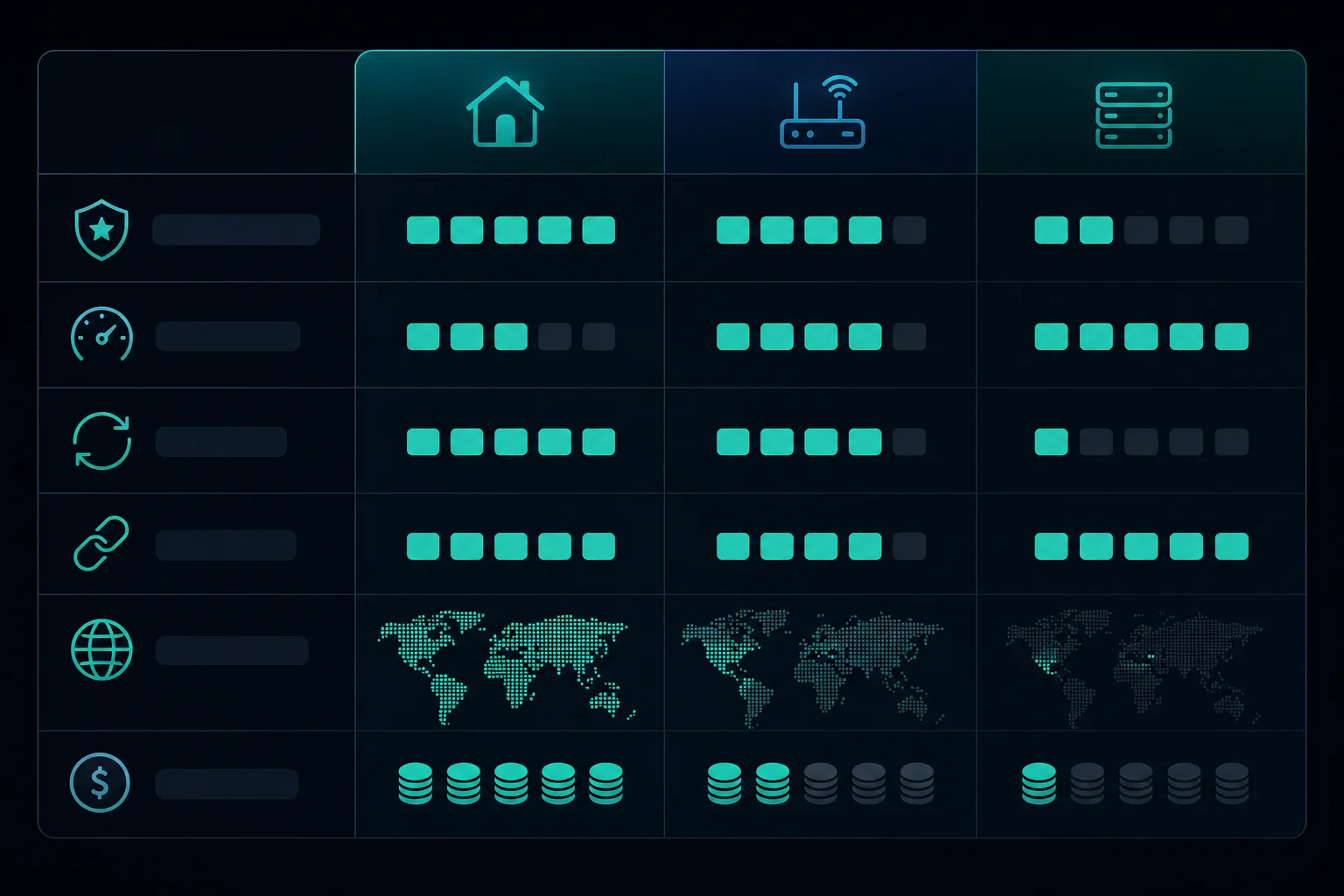
Residential vs ISP vs Datacenter for Scraping
Use this comparison when the target is not obvious:
| Factor | Residential proxies | ISP proxies | Datacenter proxies |
|---|---|---|---|
| Best for | Rotation, location diversity, strict targets | Stable sessions and repeated monitoring | Fast, cheap scraping on permissive sites |
| Typical cost model | Per GB of bandwidth | Per dedicated IP and duration | Per IP, subnet, or plan |
| Speed | Variable | Fast | Usually fastest |
| Rotation | Strong | Usually stable | Limited unless provider supports it |
| Session continuity | Sticky mode available | Strong | Strong if IP is fixed |
| Location targeting | Broad | More limited | Provider-region dependent |
| Main risk | Bandwidth waste and session churn | Smaller pool and less rotation | Hosting-network classification |
The best proxy for web scraping is the one that produces reliable results with the least complexity and cost. Do not choose the most expensive category by default.
Session Type Matters More Than People Think
Proxy type and session type are separate choices.
Rotating proxies are useful when:
- Requests are independent.
- Cookies are disposable.
- The target does not expect continuity.
- You need to distribute traffic across many IPs.
Sticky proxies are useful when:
- You log in.
- The site sets cookies that affect later pages.
- The workflow uses carts, queues, or checkout.
- A browser profile stays active across many requests.
If your scraper rotates IPs every request while reusing the same cookies, you can create avoidable blocks. If your scraper keeps all workers on one sticky IP, you can create avoidable rate limits. Match the mode to the workflow.
Rate Limits and Proxy Count
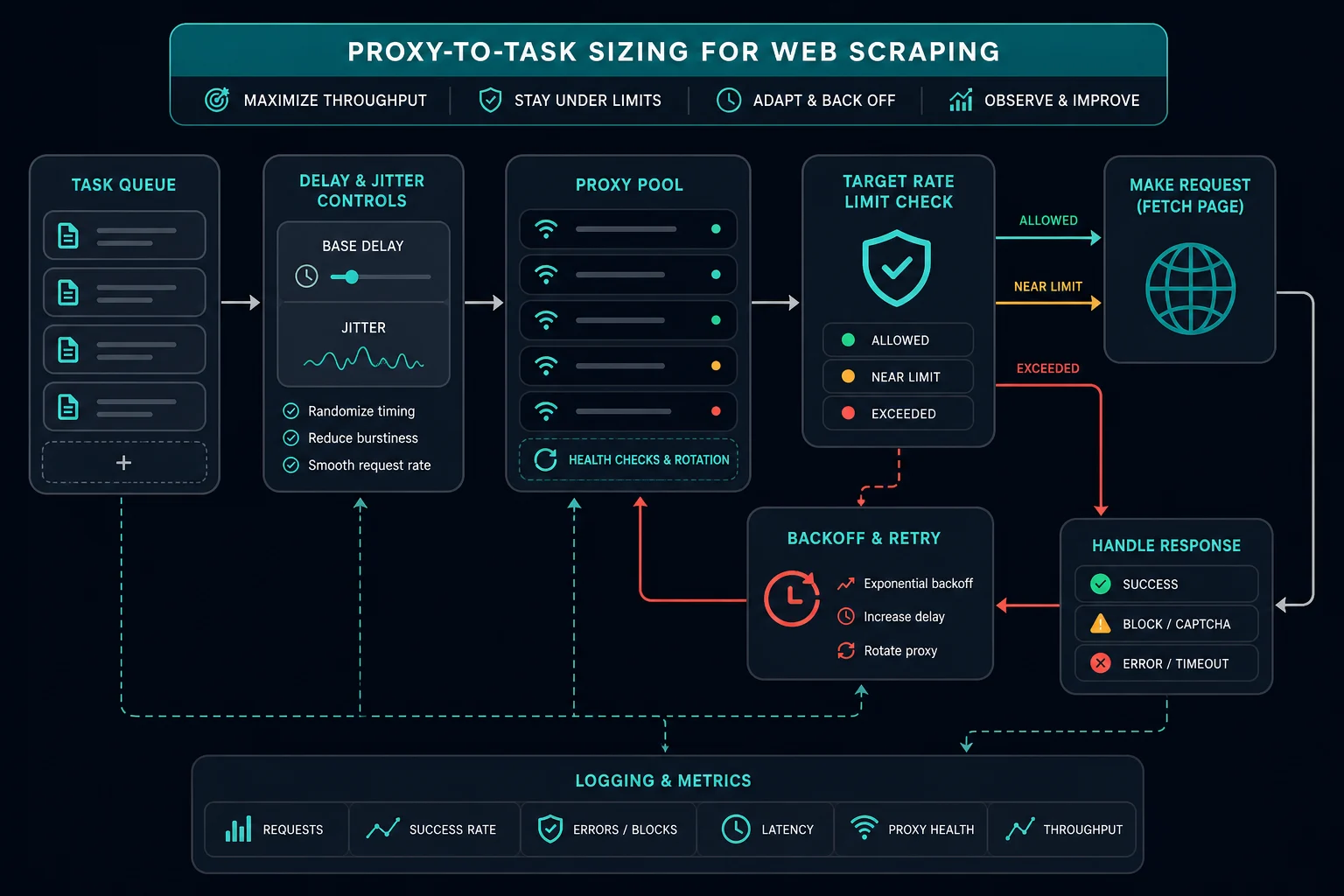
Rate limits decide whether a proxy pool is sized correctly.
Before increasing task count:
- Estimate requests per minute per proxy.
- Add jitter so workers do not all fire at the same time.
- Back off after 429, 403, timeout, and WAF responses.
- Split sensitive endpoints into slower queues.
- Cache unchanged pages and API responses.
- Log failures by proxy, URL, endpoint, account, session, and status code.
For monitoring workflows, use the delay calculator before buying more proxies. It helps estimate whether your task count and delay are likely to overload the number of proxies you plan to use. For the full operational design around URL queues, per-host pacing, response classes, and cooldowns, use the guide to crawling a website without getting blocked.
More proxies help only when the limit is tied to IP, subnet, ASN, or per-IP request concentration. If the limit is tied to account, API key, endpoint, or session cookie, lower volume and better caching are the fix.
How to Test Proxy Types Safely
Run a small comparison before scaling.
Use this process:
- Pick a representative URL set.
- Set a conservative delay.
- Use the same scraper, headers, browser profile, cookies, and region.
- Test datacenter proxies at low concurrency.
- Test ISP proxies if stability and speed matter.
- Test residential proxies if reputation, rotation, or location matters.
- Compare success rate, latency, 403s, 407s, 429s, timeouts, bandwidth, and cost.
- Scale slowly only after the lowest-risk setup works.
If all proxy types fail, do not assume the target needs a bigger pool. Review authentication, request format, headers, JavaScript requirements, robots guidance, terms, fingerprinting, and whether automated access is allowed.
Common Proxy Selection Mistakes
Avoid these mistakes:
- Using residential proxies for a target that works with datacenter proxies.
- Using datacenter proxies on a target that blocks hosting networks immediately.
- Rotating IPs during login or checkout.
- Running too many concurrent tasks per IP.
- Retrying immediately after rate limits.
- Ignoring
Retry-Afterheaders. - Treating proxies as a way around account or API limits.
- Using browser automation for pages that a lightweight HTTP client can fetch.
- Loading images, scripts, and assets when the scrape only needs HTML or JSON.
Cost comes from retries, bandwidth, failures, and engineering time. A cheaper proxy that fails 70 percent of the time is not cheap. A premium proxy used with wasteful browser sessions can also become expensive quickly.
FAQ
What is the best proxy for web scraping?
The best proxy for web scraping depends on the target. Use datacenter proxies for permissive sites, residential proxies for reputation-sensitive or location-sensitive targets, and ISP proxies for stable repeated workflows.
Are residential proxies best for scraping?
Residential proxies are often best for strict public targets, localized results, and broad rotation. They are not always necessary for permissive sites where datacenter proxies work reliably.
Are ISP proxies good for scraping?
Yes. ISP proxies are good for scraping workflows that need stable sessions, speed, repeated monitoring, or one task mapped to one dedicated IP.
Are datacenter proxies bad for scraping?
No. Datacenter proxies are efficient for permissive targets and high-speed public scraping. They become a poor fit when the target blocks hosting networks or overused subnets.
How many proxies do I need for scraping?
It depends on request rate, delay, concurrency, endpoint sensitivity, retries, and whether limits are per IP, account, session, or API key. Start small, measure, then use the delay calculator for monitoring-style sizing.
Should scraping proxies be rotating or sticky?
Use rotating proxies for independent public-page requests. Use sticky proxies for login, account areas, carts, queues, checkout, and multi-step browsing.
Final Thoughts
The best proxy for web scraping is not always residential, ISP, or datacenter by default. It is the proxy type that matches the target's sensitivity, your session needs, your location requirements, and your cost constraints.
Start with the simplest setup that can work. Compare datacenter proxies vs residential proxies, choose sticky vs rotating proxies based on the workflow, and use Unknown Proxies pricing to compare residential and ISP options before scaling.
Technical references: MDN Proxy servers and tunneling, RFC 9110 HTTP Semantics, and MDN HTTP response status codes.