Real estate scraping is the collection of permitted property listing data from websites, feeds, or APIs into structured records for analysis. A reliable workflow identifies each property and listing, preserves source and observation time, normalizes prices and addresses, and detects changes without turning a temporary parsing failure into a false market event.
Start with an authorized MLS feed, official API, licensed dataset, or partner export when one covers the project. If public-page collection is permitted, restrict the crawler to approved URLs and fields, review the site's terms and robots.txt, avoid personal or restricted data, and use conservative request rates. Web scraping real estate pages is a collection method, not permission to access them.
This guide shows how to design a bounded real estate data scraping pipeline: choose sources, define a useful schema, discover listing URLs, extract and validate observations, track listing history, and decide when a proxy route actually improves the measurement.
What real estate scraping is used for
Teams scrape property data for five jobs. Investors track new listings, price cuts, and days on market to find deals earlier. Analysts compare asking prices and rents across neighborhoods. Agents and brokers keep client lead lists and comps current. Aggregators combine listings from several sources into one search. Property managers watch rental rates near their units.
Each job needs a different slice of data and a different refresh rate. Investors need fresh listing events, while neighborhood analysis can run on a weekly or monthly snapshot. Pick the job first, because it decides which source is worth the effort.
Real estate scraping: the core workflow
Treat a listing page as a time-stamped observation of a property, not as the property itself. The same building can be listed more than once, one listing can change price or status, and several sources can disagree without any of them being a duplicate.
A practical pipeline has nine stages:
- Define the business question, approved markets, fields, and refresh interval.
- Choose the lowest-complexity permitted source.
- Discover canonical listing URLs or source listing IDs within the approved scope.
- Fetch with source-specific pacing, caching, and response classification.
- Extract one source-specific listing observation.
- Normalize addresses, money, areas, dates, and enumerated values.
- Validate identity, required fields, ranges, and page type.
- Append the valid observation and derive changes from history.
- Quarantine suspicious records for review instead of silently publishing them.
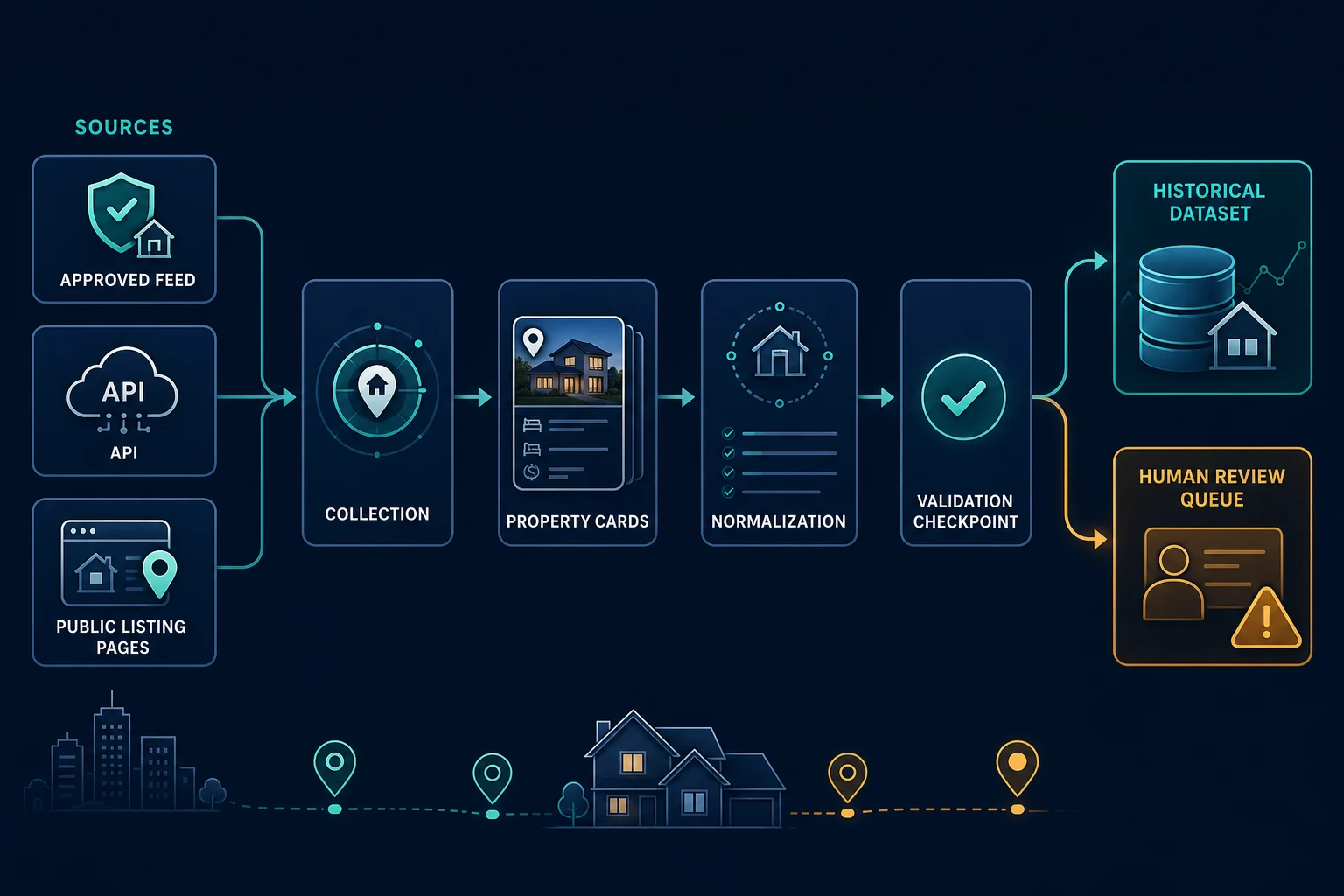
The validation boundary is the most important part. An HTTP 200 response may be a consent page, an empty search result, an expired listing, or a changed template. If extraction writes those responses as valid null values, downstream users see invented price drops, missing inventory, or homes that appear to leave the market.
Define the dataset before choosing selectors
Real estate data becomes useful when every field has a specific meaning. Decide whether the project measures active asking prices, rental availability, days on market, new inventory, historical sales, or property attributes. Combining all of those goals into one crawler usually produces an ambiguous schema and unnecessary collection.
Separate three entities:
| Entity | What it represents | Stable key candidate |
|---|---|---|
| Property | The physical parcel, building, or unit | Authorized property ID, parcel ID, or normalized address plus unit |
| Listing | One offer to sell or rent that property | Source listing ID plus source |
| Observation | What the listing showed at one time | Listing key plus collection timestamp |
Do not use a page URL as the only identity. URLs can gain tracking parameters, change slugs, redirect after a listing expires, or be reused for a new offer. Preserve the canonical URL for audit, but join records with a source listing ID where available.
A compact observation can look like this:
{
  "source": "authorized-example",
  "source_listing_id": "L-48291",
  "property_key": "US-OR-PORTLAND-0412-EXAMPLE-ST-4B",
  "status": "active",
  "transaction_type": "sale",
  "property_type": "condominium",
  "price": "525000.00",
  "currency": "USD",
  "bedrooms": 2,
  "bathrooms": "2.0",
  "living_area": "1180",
  "living_area_unit": "sqft",
  "address": {
    "locality": "Portland",
    "region": "OR",
    "postal_code": "97205"
  },
  "observed_at": "2026-07-11T12:00:00Z",
  "source_url": "https://listings.example/property/L-48291",
  "parser_version": "authorized-example-v3"
}
Store money and fractional measurements as decimals rather than binary floating-point values. Keep the raw display text alongside normalized fields when parsing qualifiers such as "from," "per week," "price on request," or an area range.
For field naming, the RESO Data Dictionary is a useful real estate industry reference for standard resources, fields, and lookups. Your project does not need to implement the entire standard, but borrowing established concepts can prevent names such as date, price, or area from carrying several meanings.
Choose the lowest-complexity permitted source
Source choice affects rights, stability, freshness, and engineering cost more than the parsing library does.
| Source | Best fit | Main constraints |
|---|---|---|
| Authorized MLS or partner feed | Operational listing data with defined fields | License, market coverage, update rules, and redistribution rights |
| Official or approved API | Structured access for a supported use case | Authentication, quotas, field coverage, and terms |
| Licensed bulk dataset | Research, enrichment, and backfills | Update lag, permitted uses, and record matching |
| Public server-rendered page | A small permitted set of public listings | Template changes, source policy, and regional variation |
| Browser-rendered page | Required permitted fields exist only after rendering | Higher bandwidth, session state, and more failure modes |
Use the simplest source that answers the question. A browser is unnecessary if an approved API returns the required listing IDs and fields. A public page should not be collected merely because it is visible if the data or method falls outside the site's rules.
Check published datasets before you write a scraper. Zillow publishes free research downloads such as its home value index, updated monthly, and asks for clear attribution to Zillow in its Real Estate Metrics terms (as of October 2026). Redfin's Data Center offers weekly, monthly, and quarterly market trackers, such as its Housing Market Tracker and price drop reports (as of October 2026). Aggregate market data like this often answers a trend question without collecting a single listing page.
No-code tools such as Octoparse and Browse AI let non-developers build listing monitors with templates and scheduled runs. They speed up setup, but they do not change whose terms apply or whether you may collect the page.
For a source-specific example, the guide to scraping Zillow data compares Zillow's published research downloads and request-based APIs with the consumer site's automation restrictions. For rental listings on classifieds, the Craigslist proxies guide covers local IP matching and saved-search alerts.
The Robots Exclusion Protocol standardizes how crawlers retrieve and interpret robots.txt. Robots rules are one input to the preflight review; they do not replace terms, authentication requirements, privacy obligations, contracts, or applicable law.
Real estate records can include occupant, owner, tenant, agent, and contact details. Collect only fields necessary for the approved purpose, avoid sensitive or personal data, define retention and deletion rules, and obtain legal review when the source, jurisdiction, or intended use creates uncertainty.
Discover listing URLs without open-ended crawling
Start from a controlled frontier. Good inputs include API result IDs, an approved sitemap, a licensed feed, or bounded market result pages that the source permits you to traverse.
For every queued URL:
- Allowlist the scheme, host, and expected path pattern.
- Remove analytics and referral parameters.
- Resolve relative links against the approved origin.
- Reject redirects to another host or unexpected page type.
- Deduplicate by canonical URL and source listing ID.
- Record how the URL was discovered.
- Cap pagination and stop when the expected market boundary ends.
Do not guess sequential listing IDs or expand into agent profiles, account pages, contact forms, mortgage applications, or other paths outside the dataset. A strict frontier reduces legal and operational risk while making runs reproducible.
Pagination needs explicit termination rules. Stop when the source returns no new listing IDs, repeats a page, reaches a documented page limit, or leaves the approved date or geography window. Track the count of new, repeated, and invalid IDs per page; a sudden all-duplicate page is a signal to stop, not to keep incrementing forever.
Build a source adapter, not a universal real estate scraper
Each source represents prices, status, units, addresses, and missing values differently. Keep discovery, extraction, normalization, and validation separate so one template change does not corrupt every stage.
This Python example shows the boundary for a permitted server-rendered source. The selectors are placeholders and must be replaced with selectors documented and tested for the approved site:
from dataclasses import dataclass
from decimal import Decimal
from urllib.parse import urljoin, urlparse

import requests
from bs4 import BeautifulSoup


@dataclass(frozen=True)
class RawListing:
    listing_id: str
    title: str
    price_text: str
    status_text: str
    address_text: str
    canonical_url: str


ALLOWED_HOST = "listings.example"


def fetch_listing(session: requests.Session, url: str) -> RawListing:
    if urlparse(url).hostname != ALLOWED_HOST:
        raise ValueError("URL is outside the approved source")

    response = session.get(url, timeout=(5, 20))
    response.raise_for_status()
    if "text/html" not in response.headers.get("Content-Type", ""):
        raise ValueError("Expected an HTML listing page")

    page = BeautifulSoup(response.text, "html.parser")
    listing = page.select_one("[data-listing-id]")
    if listing is None:
        raise ValueError("Response is not a recognized listing page")

    canonical = page.select_one('link[rel="canonical"]')
    canonical_url = urljoin(response.url, canonical["href"] if canonical else response.url)
    if urlparse(canonical_url).hostname != ALLOWED_HOST:
        raise ValueError("Canonical URL left the approved source")

    return RawListing(
        listing_id=listing["data-listing-id"],
        title=listing.select_one("[data-field='title']").get_text(" ", strip=True),
        price_text=listing.select_one("[data-field='price']").get_text(" ", strip=True),
        status_text=listing.select_one("[data-field='status']").get_text(" ", strip=True),
        address_text=listing.select_one("[data-field='address']").get_text(" ", strip=True),
        canonical_url=canonical_url,
    )
Before writing selectors, check the initial HTML for embedded application/ld+json or script-tag JSON. A permitted page that exposes its listing as structured data is usually steadier to parse than its visual markup, though the data can still lag the visible price.
Use a stable, truthful request profile and let the HTTP library handle transport headers. The web scraping headers guide explains how User-Agent, Accept, locale, cookies, and cache validators fit together without copying a random browser request.
An adapter should return either a typed record or a classified failure such as not_listing, expired_listing, consent_page, access_denied, rate_limited, or template_changed. Returning an empty dictionary hides the difference between those states.
Test each adapter against a small policy-approved fixture set: active sale, active rental, pending, sold or removed, price unavailable, multi-unit property, consent page, empty result, and unexpected template. Keep the parser version with every observation so a bad deployment can be identified and replayed.
Normalize real estate data without inventing precision
Normalization should make source values comparable while preserving uncertainty.
Prices and transaction types
Keep sale and rental listings separate. A rental price needs a period such as week or month; a sale price does not. Preserve currency and qualifiers, and never convert "contact agent" into zero.
Areas and units
Store the numeric value and the source unit. Convert square feet and square meters into a chosen analysis unit only after preserving the original. Do not combine lot area with living area, and do not treat a range as an exact measurement.
Addresses and units
Normalize casing, whitespace, common street suffixes, region codes, and postal-code formatting. Keep apartment or unit identifiers because two listings at the same street address can represent different properties. Do not overwrite the source address with a geocoder result; store the submitted and matched forms separately.
For U.S. projects, the Census Geocoding Services can return coordinates and Census geographies for submitted addresses. Census explains that its coordinates are calculated along address ranges, so treat them as approximate enrichment rather than proof of a building's exact entrance or parcel boundary.
Dates and time zones
Distinguish source events from collection time. listed_at, price_changed_at, and observed_at answer different questions. Preserve the source time zone when known, convert stored timestamps consistently, and do not infer a listing date from the first time your crawler happened to see the page.
Validate every listing observation
Validation should run before an observation can update inventory counts, price models, alerts, or dashboards.
Check at least these conditions:
- The response is the expected listing page or API resource.
- Source listing ID and canonical URL are present and consistent.
- Transaction type, status, and property type use known values.
- Currency and rental period are attached to the relevant price.
- Bedrooms, bathrooms, prices, and areas fall within plausible configured bounds.
- Address, unit, and market agree with the discovery scope.
- Required fields did not all disappear after a template change.
- Collection time, source, parser version, and route region are recorded.

Use source-specific bounds instead of universal ones. A valid luxury property price in one market might be an extraction error in another. Compare suspicious values with the previous valid observation, but do not reject a real change solely because it is large.
Quarantine records when identity is uncertain, critical fields vanish, the currency changes unexpectedly, or a value jumps beyond a review threshold. Rejected transport and page-class failures should remain operational events, not listing observations.
Track listing changes as events
Never overwrite the only copy of a listing. Append observations, compare each valid record with the last comparable valid record, and derive events such as:
- New listing first observed.
- Asking price increased or decreased.
- Status changed from active to pending, sold, rented, or removed.
- Material property attributes changed.
- Listing returned after a period of absence.
- Source stopped returning the record.
Absence is not automatically a removal. A failed crawl, pagination bug, policy denial, or changed template can make every listing disappear at once. Require a healthy source run and, when appropriate, more than one missed observation before emitting a removal event.
Deduplicate alerts by listing, event type, and source event time. If the same price is observed every hour, store it according to the retention policy but do not emit 24 identical "change" events.
Monitor source health alongside market metrics. Useful operational signals include discovery count, recognized-page rate, required-field completeness, duplicate rate, status distribution, parser failures, 403 and 429 rates, latency, and bytes per valid observation.
Pace collection and cache unchanged pages
Set a refresh schedule from how quickly the business decision changes, not from the maximum throughput the crawler can achieve. Active listings in a fast-moving market may need more frequent permitted checks than long-term property attributes.
Use these controls:
- Give each source its own concurrency cap and retry budget.
- Add jitter so all markets do not start simultaneously.
- Honor documented quotas and
Retry-Afterresponses. - Store and reuse
ETagorLast-Modifiedvalidators when supplied. - Back off on timeouts, 429 responses, and server errors.
- Stop automatic retries on repeated access denials or unrecognized pages.
- Run a small canary batch before a full scheduled collection.
When proxies fit real estate data scraping
Proxies are relevant when the permitted measurement genuinely depends on network location, or when distributed workers need controlled outbound routing. Real estate sites may vary listing availability, language, map defaults, or regional content by market, but a proxy does not grant data rights, repair a parser, or make aggressive crawling acceptable.
Match the route to the observation:
| Workflow | Practical route |
|---|---|
| Approved API or feed | Direct connection or provider-required network setup |
| Repeated checks that need one stable identity | ISP proxy or sticky residential session |
| Independent, permitted region checks | Residential route targeted to the required market |
| Browser-rendered listing with cookies and subrequests | One sticky route for the full browser context |
| Permissive public source with no location variation | Direct connection or datacenter proxy may be enough |
Keep locale, cookies, browser context, and route region together. Rotating the IP halfway through a stateful search or map session can create inconsistent results. For independent listing URLs, rotation can be appropriate only after low-volume direct tests show that routing is the actual limitation, and not source policy, request rate, or broken extraction.
The best proxy for web scraping guide compares residential, ISP, and datacenter routes. If state or city targeting is required for legitimate localized checks, residential proxies provide rotating and sticky options; test only the minimum geographic precision the dataset needs.
FAQ
Is real estate scraping legal?
It depends on the source, access method, data, jurisdiction, contracts, and intended use. Prefer authorized APIs, feeds, or licensed datasets; review terms and robots.txt; avoid restricted and personal data; and get legal advice for the specific project. Public visibility alone does not settle those questions.
Can you scrape MLS data?
MLS listing data is licensed to brokers and agents who are MLS participants. The usual routes are an IDX or VOW data feed, or an API that follows the RESO Web API standard, approved by the MLS (Zillow's Bridge Listing Output is one example). Scraping an MLS portal with a member login usually breaks the participant agreement, and a proxy does not change that. To track market trends across several MLS markets, use each MLS's licensed feed or a licensed aggregate dataset.
What real estate data should a scraper collect?
Collect only fields required by the defined use case. A market-monitoring dataset might need source listing ID, property key, status, transaction type, asking price, currency, bedrooms, bathrooms, living area, coarse location, canonical URL, and observation time. Contact or occupant details are usually unnecessary and create additional risk.
How often should property listings be scraped?
Use the slowest permitted interval that still supports the decision. Schedule active-listing observations more often only when freshness changes the outcome, and use caching, conditional requests, source-specific concurrency, and backoff to avoid unnecessary downloads.
How do I avoid duplicate real estate listings?
Separate property identity from listing identity. Prefer authorized property and listing IDs, normalize canonical URLs and addresses, keep unit numbers, and use probabilistic address matching only as a review signal. Two listings at one address may be separate units or separate offers, so do not merge on street address alone.
Do I need a browser for real estate web scraping?
Only when required permitted fields are absent from an approved API, feed, and initial HTML response. Browser rendering costs more bandwidth and introduces cookies, subrequests, and session state. Prove that it improves field coverage before making it the default.
Do proxies prevent real estate scraping blocks?
No. Proxies change the network route. They cannot grant permission, fix a forbidden endpoint, correct excessive request rates, or detect a changed listing template. Classify the response and correct scope, pacing, session, or parser problems before changing routes.
Final thoughts
Real estate scraping succeeds when the pipeline produces traceable listing observations rather than a pile of page snapshots. Define one market question, use the most authoritative permitted source available, separate properties from listings, normalize without inventing precision, and validate every observation before deriving a change.
For public-page workflows that are allowed, keep discovery bounded, cache unchanged responses, pace requests conservatively, and treat proxies as optional routing infrastructure. Those controls make real estate data scraping more accurate, auditable, and useful long after the first successful request.