Anonymous proxy detected means a website or its security provider classified your current connection as a proxy, VPN, relay, Tor exit, hosting network, or other shared route. The message comes from the destination's access controls; it is not proof that your device has malware or that the proxy exposed your real IP address.
If you did not choose a proxy, first compare the same site on a different trusted network, such as mobile data. If only one network fails, inspect its VPN, proxy, privacy relay, router, and public IP. If you intentionally use a proxy, confirm that the site permits it, test the endpoint independently, and keep the IP, location, and browser session consistent.
Do not repeatedly rotate addresses to force access. A false positive can be fixed, but an explicit service policy, account restriction, or denied automation use case is a reason to stop and contact the site.
Anonymous Proxy Detected: Quick Fix
Use this order so each test tells you something:
- Confirm that the warning is on the real website domain. Do not install software or enter credentials through an unfamiliar “click here” page.
- Pause retries and note the URL, time, response status, request ID, and whether other sites work.
- Turn off any VPN, browser proxy extension, privacy relay, or manually configured proxy that you do not need.
- Test the same page once in a private window, then once on another trusted network.
- If the alternate network works, restart the affected router and check whether its public IP changes. A restart does not guarantee a new IP.
- If you intentionally use a proxy, verify its exit IP on a neutral IP-check endpoint before testing the target at low volume.
- Keep the country and IP stable for logged-in or multi-step sessions.
- Contact the website, network administrator, proxy provider, or ISP if a legitimate connection remains incorrectly classified.
| Result | Most likely layer | Next useful action |
|---|---|---|
| Every device on one Wi-Fi network is blocked | Shared public IP, router, ISP, or network proxy | Compare mobile data; check the router and ask the ISP |
| Only one device or browser is blocked | Local VPN, proxy, extension, profile, cookies, or app | Inspect that device; retry with a clean browser session |
| Direct traffic works but one proxy fails | Proxy IP classification, location, reputation, or configuration | Test another approved endpoint while holding other variables fixed |
| Several routes fail for one account | Account, site policy, session, or request behavior | Stop rotating and contact the site or review the workflow |
| Many sites fail through the proxy | Proxy connectivity, authentication, DNS, or endpoint failure | Test the proxy independently before debugging a target block |
What Does “Anonymous Proxy Detected” Mean?
The site received a request and assigned the visible exit IP or request pattern to a category it restricts. “Anonymous” is the detector's label; it does not tell you which signal matched or whether the classification is correct.
The response may be a full block, a verification challenge, a login refusal, a generic 403, or a page that literally says “Anonymous Proxy detected, click here.” Unlike a 407 Proxy Authentication Required response, the message usually comes from the target side after the proxy route is already working. If the proxy itself asks for credentials, use the 407 troubleshooting guide instead.
Commercial IP intelligence can separately flag public proxies, VPNs, hosting providers, Tor exits, and suspected residential proxy networks. For example, the MaxMind Anonymous IP database exposes distinct indicators for several of those categories. A site can combine that data with its own history and rules, so two websites may treat the same address differently.
The message also does not prove that the site discovered your original address. It normally means the exit connection was recognizable or the request did not fit the site's risk rules.
How Websites Detect Proxy Traffic
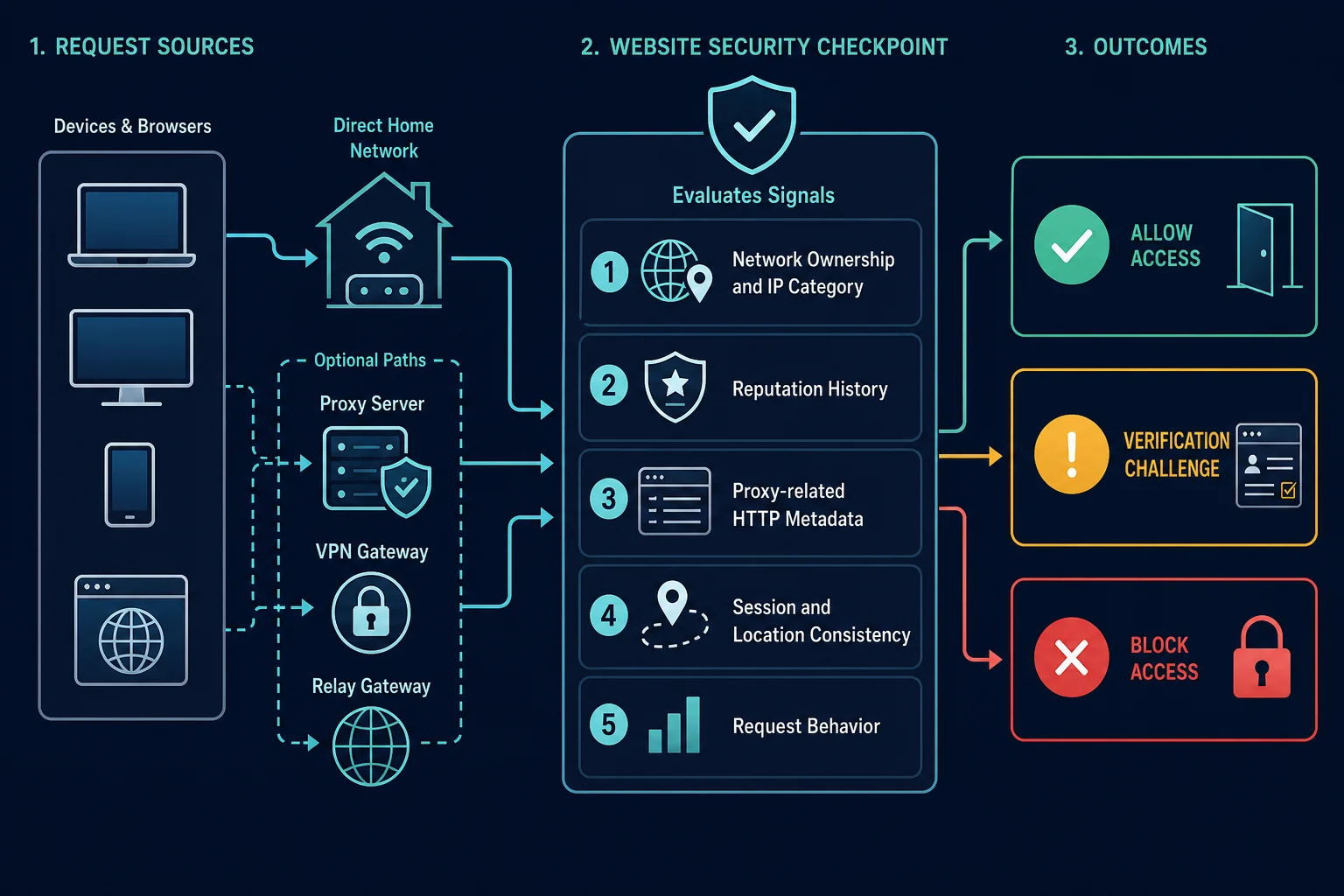
Most detection systems combine signals. Changing one header or using a fresh IP therefore cannot guarantee a different result.
IP ownership and network category
The destination sees the source IP that opens the connection. It can look up the IP's network owner, Autonomous System Number (ASN), location, hosting status, and known use as a VPN, relay, public proxy, or Tor exit.
Datacenter ranges are often easier to classify because their network ownership points to hosting infrastructure. Residential and ISP addresses can still be classified or blocked; no IP type is inherently undetectable.
Reputation and shared history
An address may have a poor history because many unrelated users shared it, a previous user generated abuse, or automated traffic was concentrated on the same IP or subnet. This explains why you can see the warning even when your current request is ordinary.
Carrier-grade NAT can also put many ISP customers behind one public address. That is not an anonymous proxy, but a coarse rule can still produce a false positive when it relies too heavily on shared-IP reputation.
Proxy-related HTTP metadata
Some intermediaries add standard forwarding metadata. The HTTP Via header, for example, is used by proxies to track message forwarding and protocol capabilities. The standardized Forwarded header can disclose information altered or lost while proxying.
Do not delete or forge headers blindly. Managed networks and reverse proxies may require them, applications must not trust client-supplied forwarding headers, and a destination can classify the connection without either header.
Session, location, and client consistency
A login that jumps between countries or IPs, cookies created on a different route, and rapid changes inside one browser session can look risky. A browser's protocol and TLS behavior can also be inconsistent with the declared client.
Consistency matters more than stuffing the request with browser-like fields. For legitimate automated access, keep one session on one stable route unless the workflow is genuinely stateless.
Request rate and behavior
Burst traffic, parallel retries, repeated login attempts, and identical navigation patterns can turn a neutral IP into a suspicious session. Modern bot systems can combine heuristics, JavaScript signals, known fingerprints, machine learning, and behavioral analysis, as described in Cloudflare's bot detection overview.
That is why rotating immediately after every block can make diagnosis worse. It changes the network identity while preserving the behavior that triggered the rule.
How to Fix Anonymous Proxy Detected When You Are Not Using a Proxy
Start by proving which layer is involved. Avoid factory resets, random command-line “fixes,” and untrusted IP-cleaning tools.
1. Verify the page and the scope
Check the address bar and certificate indicator. A real block should be served on the domain you intended to visit or a recognizable security-provider flow. If an unrelated page asks you to download something, close it.
Test another reputable site. Then test the affected site once in another browser or private window. If every website fails, you likely have a connection or device problem rather than one site's proxy rule.
2. Find unexpected routing software
Check for an active VPN, security product, browser proxy extension, privacy relay, work profile, or DNS/security app that routes web traffic. On Windows, proxy settings can be automatic, script-based, manual, or attached to a VPN; Microsoft's Windows proxy settings guide shows where each mode lives.
On a managed work, school, or filtered network, do not remove organization-supplied settings. Ask the administrator whether traffic exits through a secure web gateway or shared proxy.
3. Compare another network
Turn off Wi-Fi and load the page once through trusted mobile data, or test another trusted connection. Do not log into a sensitive account over unknown public Wi-Fi.
If mobile data works but home Wi-Fi does not, the browser is probably not the main cause. The home public IP, router configuration, ISP sharing, or a network-wide proxy is the stronger lead. If neither works on one device, return to device-level VPN and proxy settings.
4. Reset only the affected state
After correcting the route, close and reopen the browser. Clear cookies for the affected site if it may have stored a challenge or risk session; clearing the entire browser history is rarely necessary.
Restarting a home router may obtain a different dynamic public IP, but many ISPs retain the same lease. Record the public IP before and after rather than assuming it changed. If the address stays flagged, ask the ISP whether the connection uses shared addressing, then contact the website with the block time and any request or reference ID.
How to Fix Anonymous Proxy Detected When You Use a Proxy or VPN
First check the site's rules. Streaming, banking, gaming, marketplace, account, and purchase flows may prohibit anonymizing services or require a particular region. A different proxy does not create permission to bypass that policy.
For an allowed business, testing, or data-collection workflow:
- Test the proxy on a neutral endpoint and record the exit IP, country, and connection result. The proxy address testing guide shows simple
curlchecks. - Make one low-rate request to the target with the approved proxy and one through the approved direct or control route.
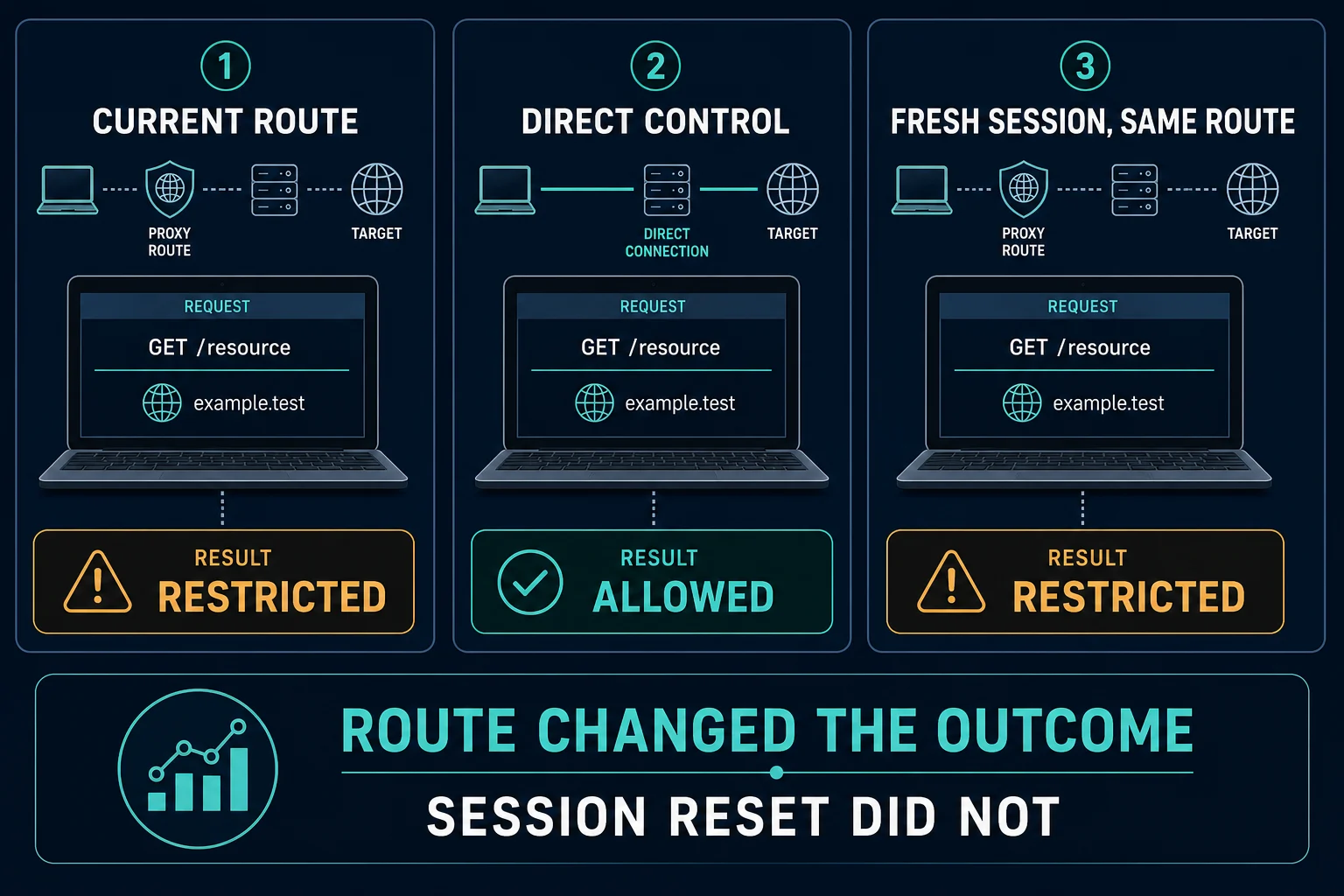
- Keep the URL, method, authorization, cookies, headers, client, and request timing the same. Change only the route.
- If one proxy fails and the control works, replace or report that endpoint. Do not keep it in production rotation.
- If every route fails, investigate account permissions, target policy, session state, and request behavior instead of buying more IPs.
- Use a sticky session for login, cart, account, or multi-step flows. Match the proxy location to the account and task context.
- Lower concurrency and stop automatic retries after blocks or challenges.
If legitimate traffic is repeatedly misclassified because a target broadly distrusts hosting networks, a residential or ISP route may be a better technical fit than a datacenter proxy. Compare datacenter, residential, and ISP proxies before changing pools. Residential IPs are not invisible, and the target's terms still apply.
Run a Controlled Proxy Detection Test
A controlled test prevents a common mistake: changing the IP, cookies, headers, browser, and rate at once, then guessing which change mattered.
| Test | Keep fixed | Change | What a different result suggests |
|---|---|---|---|
| A: current setup | URL, account, client, low request rate | Nothing | Establishes the failing baseline |
| B: direct control | Everything possible | Network route only | The proxy or its exit network is implicated |
| C: alternate trusted network | Device and browser | Public network only | The original ISP or shared public IP is implicated |
| D: approved replacement proxy | Client, session type, country, rate | Proxy endpoint only | One endpoint or pool has a classification issue |
| E: fresh site session | Network and client | Site cookies only | Stored session state contributes to the warning |
Record the HTTP status, final URL, response title, request ID, exit IP, region, proxy endpoint identifier, and timestamp. Do not store passwords, authentication headers, or full sensitive cookies in logs.
If the target returns a standard access denial rather than this exact message, follow the HTTP 403 Forbidden guide. If it returns a rate response, solve the HTTP 429 problem with pacing and backoff rather than IP churn.
What Website Owners Should Check
If your site shows this warning to legitimate users, identify the rule that made the decision before allowlisting broad networks.
- Log the decision source, rule version, coarse IP category, request ID, and action without collecting unnecessary personal data.
- Separate known abuse, rate anomalies, hosting networks, public proxies, VPNs, and uncertain classifications instead of treating them as one boolean.
- Compare false-positive rates by rule and customer workflow.
- Prefer an appropriate verification challenge or step-up authentication when risk is uncertain.
- Trust
ForwardedorX-Forwarded-Foronly when it was set and sanitized by a reverse proxy you control. - Give blocked users a safe support path and a reference ID.
- Expire temporary reputation decisions and review third-party intelligence updates.
Do not allow every request merely because a client supplies a “clean” forwarded IP header. Client-provided forwarding fields can be spoofed unless your own edge removes them and writes trusted values.
Fixes That Usually Do Not Work
- Clearing cache by itself: cached files do not change the public exit IP. Site cookies matter only when session state is part of the decision.
- Changing the user agent repeatedly: the IP classification remains, and inconsistent client signals can create more risk.
- Rotating after every blocked request: this destroys session continuity and can multiply unwanted traffic.
- Switching DNS resolvers: DNS normally does not change the source IP the website sees, although a routing or security app bundled with DNS software might.
- Choosing a proxy labeled “anonymous” or “elite”: those labels describe intended behavior, not how every destination will classify an address.
- Disabling security controls permanently: turn off only the route you are testing, then restore protections you need.
FAQ
Is “anonymous proxy detected” a virus?
No. The message itself is a website-side classification or block. An unexpected redirect can still be unsafe, so confirm the real domain and do not download a supposed fix from the warning page.
Why do I see anonymous proxy detected when I do not use a VPN?
Your device may use an unnoticed proxy, privacy relay, work profile, or security gateway. The website may also have misclassified a shared ISP address, carrier-grade NAT exit, or network with poor reputation. Compare the same site from another trusted network to isolate the cause.
Does anonymous proxy detected mean my real IP leaked?
Not necessarily. Usually it means the visible exit address or request pattern was classified as anonymized. Test the route and inspect proxy-added metadata separately if leakage is your concern.
Will restarting my router fix anonymous proxy detected?
Only if the problem is tied to the home network's public IP and the restart results in a different address. Many ISPs return the same address, so compare the public IP before and after.
Can a residential proxy still be detected?
Yes. Detection may use network intelligence, prior reputation, session consistency, client fingerprints, and behavior. Residential routing can reduce hosting-network false positives for permitted use cases, but it does not guarantee access.
Should I keep changing proxies until the page opens?
No. Run one controlled comparison. If the site prohibits proxies, the account is restricted, or the workflow lacks permission, stop. If one approved endpoint alone is misclassified, remove it from rotation and report it to the provider.
Conclusion
Anonymous proxy detected means the destination classified your connection or request as coming through an anonymizing or risky route. It does not identify the cause by itself. Compare one variable at a time: device, network, exit IP, site session, and request behavior.
Visitors should remove unexpected routing, test another trusted network, and contact the site or ISP when a normal connection is falsely flagged. Legitimate proxy users should verify the route, preserve session consistency, slow retries, and respect the target's access rules. When IP type is the demonstrated issue, review Unknown Proxies plans for an appropriate residential or ISP option rather than assuming more rotation is the answer.