Price monitoring is the repeated collection and comparison of product prices so you can detect meaningful changes over time. A reliable system does more than scrape a number: it identifies the same product and offer on every run, normalizes currency and shipping costs, validates the result, and alerts only when the change is real.
The safest starting point is an official API, licensed feed, or your own merchant export. If those sources do not cover a legitimate monitoring need and public-page collection is permitted, use a small, paced scraper with a defined product list. Review applicable terms, robots.txt, and legal requirements before collecting data.
This guide focuses on one job: building an accurate price monitoring pipeline. It covers the data model, collection schedule, change detection, proxy decisions, and operational checks needed to turn page observations into useful alerts. If the collection layer itself is still undecided, use the ecommerce scraping tool guide to choose between APIs, HTTP clients, crawler frameworks, and browser automation.
If the source data comes from competitor product pages, start with the competitor price scraping guide to define scope, offer matching, and responsible collection before those observations enter this pipeline.
If the monitored offer is a hotel stay, use the hotel price scraping guide to keep dates, occupancy, room identity, booking terms, taxes, and fees attached to each quote before it reaches this pipeline.
Price Monitoring Pipeline: The Core Workflow
Treat each price check as a data observation, not as an overwrite of the last value. Keeping the observation history makes changes auditable and lets you repair alert logic without fetching the page again.
- Maintain a canonical catalog of products and offers to monitor.
- Schedule checks according to business value and expected change frequency.
- Apply policy, scope, cache, and rate checks before fetching.
- Retrieve the permitted page or API response.
- Classify the response before extracting data.
- Extract product identity, offer, price, currency, shipping, and availability.
- Normalize and validate the observation.
- Compare it with the last valid comparable observation.
- Store the observation, then send a deduplicated alert if a rule matches.
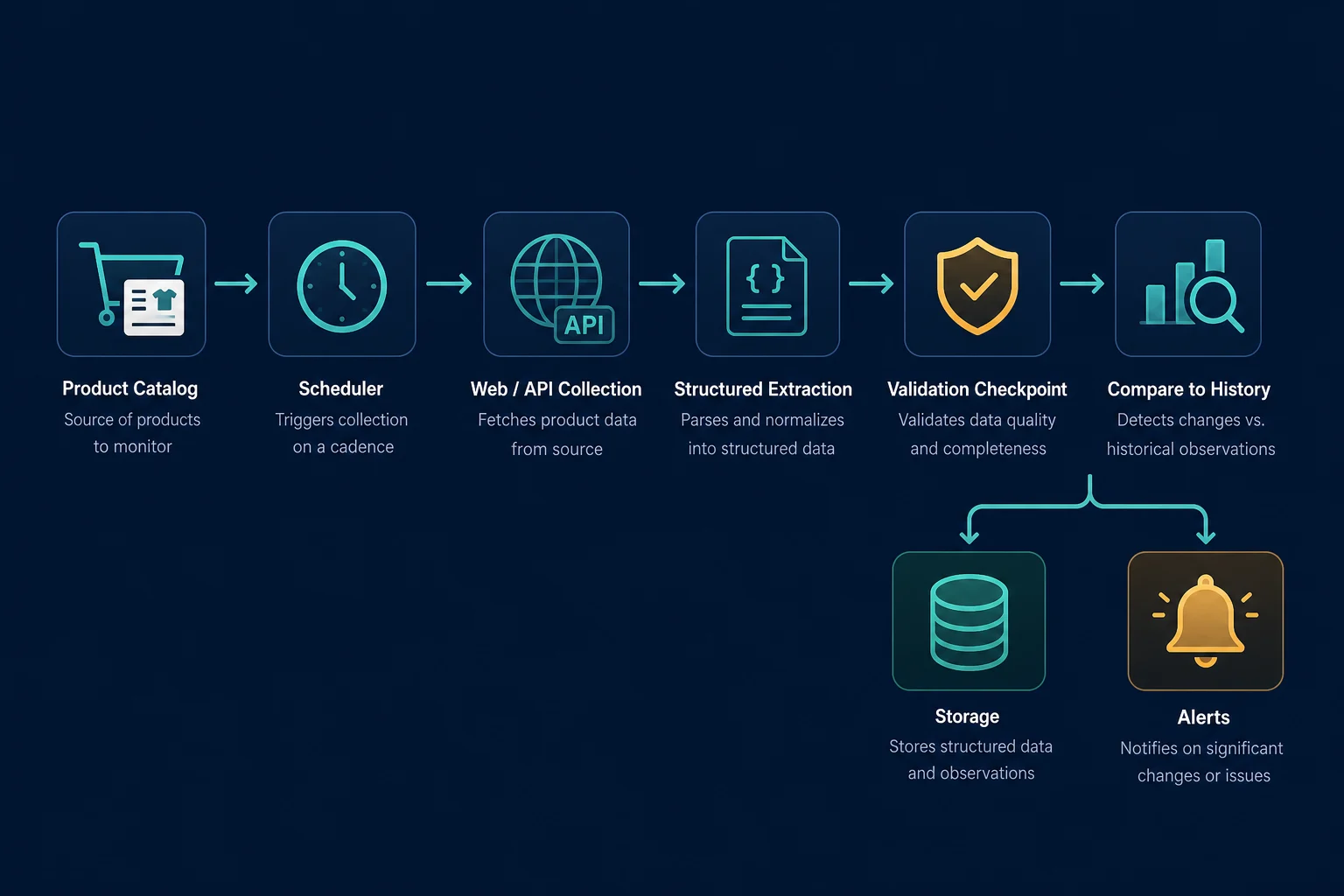
The validation step is the boundary between collection and monitoring. A request can succeed while the observation is wrong—for example, a consent page may return HTTP 200, or the parser may capture a crossed-out list price instead of the current offer.
Define What “Price” Means First
One product page can show several valid numbers:
- List or manufacturer suggested price.
- Current single-purchase price.
- Member, subscription, or loyalty price.
- Coupon price that requires an extra action.
- New, used, marketplace, or third-party offer.
- Unit price, price range, or “from” price.
- Shipping, tax, deposit, or other mandatory charges.
Choose one price definition for each monitor. If the goal is competitor shelf-price tracking, you might capture the current generally available offer and keep coupons in a separate field. If the goal is customer checkout cost, the monitor may need shipping and other mandatory charges as well.
Do not silently substitute one type for another. A missing current price should become a classified null observation, not the list price. Store the raw display text alongside the normalized value so an operator can audit unusual changes.
A practical observation schema looks like this:
{
  "product_id": "catalog-1842",
  "source": "shop.example",
  "source_product_id": "SKU-492",
  "offer_type": "standard",
  "seller": "Example Retailer",
  "amount": "49.95",
  "currency": "USD",
  "shipping_amount": "0.00",
  "availability": "in_stock",
  "observed_at": "2026-07-01T12:00:00Z",
  "parser_version": "shop-example-v3",
  "source_url": "https://shop.example/products/SKU-492"
}
Use a decimal type for money in application code and storage. Binary floating-point arithmetic can introduce rounding errors that make threshold comparisons unreliable.
Build a Stable Product and Offer Identity
Price history is useful only when every observation refers to the same thing. Titles and URLs alone are weak identifiers: titles change, tracking parameters create duplicate URLs, and one page may contain several sizes or sellers.
Create an internal product ID, then map each source to a stable source ID such as a SKU, GTIN, model number, or marketplace listing ID. Add variant attributes—size, color, quantity, condition, seller, and fulfillment method—when they affect the offer.
Before enqueueing a page:
- Restrict the hostname and path to an approved allowlist.
- Remove tracking and affiliate parameters.
- Normalize equivalent URL forms.
- Deduplicate by source, product ID, variant, and offer.
- Reject redirects that leave the approved host or change the product unexpectedly.
Keep product matching separate from price extraction. If a monitor cannot prove that the page still represents the expected product and variant, quarantine the observation instead of adding it to the price series.
Choose the Least Complex Data Source
Use the most stable authorized source available:
| Source | Best fit | Main tradeoff |
|---|---|---|
| Official API or licensed feed | Structured commercial integrations | Access, quotas, field coverage, and license terms |
| Merchant or seller export | Monitoring your own catalog | Does not cover external sellers |
| Server-rendered public HTML | Small permitted page sets | Markup and offer placement can change |
| Browser-rendered page | Permitted fields that require JavaScript | More compute, bandwidth, and page-state complexity |
Start with a normal HTTP client if the required fields exist in the initial response. A browser should be an evidence-based choice, not the default. It loads more resources, costs more to operate, and creates additional failure modes around cookies, rendering, and sessions.
For a concrete HTTP implementation, the Python Requests proxy guide shows connection setup and bounded retries. If a permitted field genuinely depends on rendering, use an isolated context as described in the Playwright proxy guide.
The Robots Exclusion Protocol defines how crawlers retrieve and interpret robots.txt. Robots directives are only one input: they do not replace permission, site terms, privacy review, or applicable law.
Schedule Checks Without Wasting Requests
More frequent checks do not automatically produce better data. Set the interval according to how often a product changes, how quickly the business needs to react, and what request volume the source permits.
Use a tiered schedule:
- High-priority products with frequent changes get the shortest permitted interval.
- Stable catalog items move to a slower interval.
- Out-of-stock items use a separate restock cadence.
- Repeated unchanged observations gradually reduce check frequency.
- Recent changes temporarily increase frequency if the source policy allows it.
Add deterministic jitter so thousands of products do not fire at the top of the hour. Cache responses where appropriate, honor validators such as ETag and Last-Modified, and avoid fetching unchanged assets that are not needed for extraction.
Estimate load before deployment. For 12,000 products checked every six hours, the baseline is 48,000 requests per day, or roughly 0.56 requests per second averaged across the full day. The delay calculator helps translate task counts and delays into request pacing, but source-specific limits still control the final schedule.
Extract and Normalize Comparable Prices
Prefer structured fields and semantic containers over brittle presentation selectors when they accurately represent the intended offer. Use a source-specific adapter rather than one universal selector set.
Each adapter should return either a typed observation or a classified failure:
from dataclasses import dataclass
from decimal import Decimal

@dataclass(frozen=True)
class PriceObservation:
    product_id: str
    offer_type: str
    amount: Decimal
    currency: str
    available: bool

def comparable_total(observation: PriceObservation, shipping: Decimal) -> Decimal:
    return observation.amount + shipping
Normalize:
- Decimal and thousands separators according to the confirmed locale.
- ISO 4217 currency codes rather than ambiguous symbols.
- Included and excluded shipping according to one documented rule.
- Unit quantities when packages contain different counts or weights.
- Availability into a small controlled set of states.
- Timestamps to UTC while retaining the monitored market.
Do not compare €39,99 with $39.99 as though they were the same value. Either keep each market and currency in a separate series or convert using a recorded exchange rate and timestamp. If you convert, retain both the source amount and the converted amount.
Validate Observations Before Detecting Changes
Validation prevents parser failures from becoming business alerts. Check that:
- The response is the expected page type, not a login, consent, challenge, or error page.
- The source product ID and selected variant match the catalog.
- The intended seller and offer type are present.
- The amount is positive and parses into the expected currency.
- Required components such as shipping are present or explicitly unknown.
- Availability is a recognized state.
- The parser version and observation timestamp are recorded.
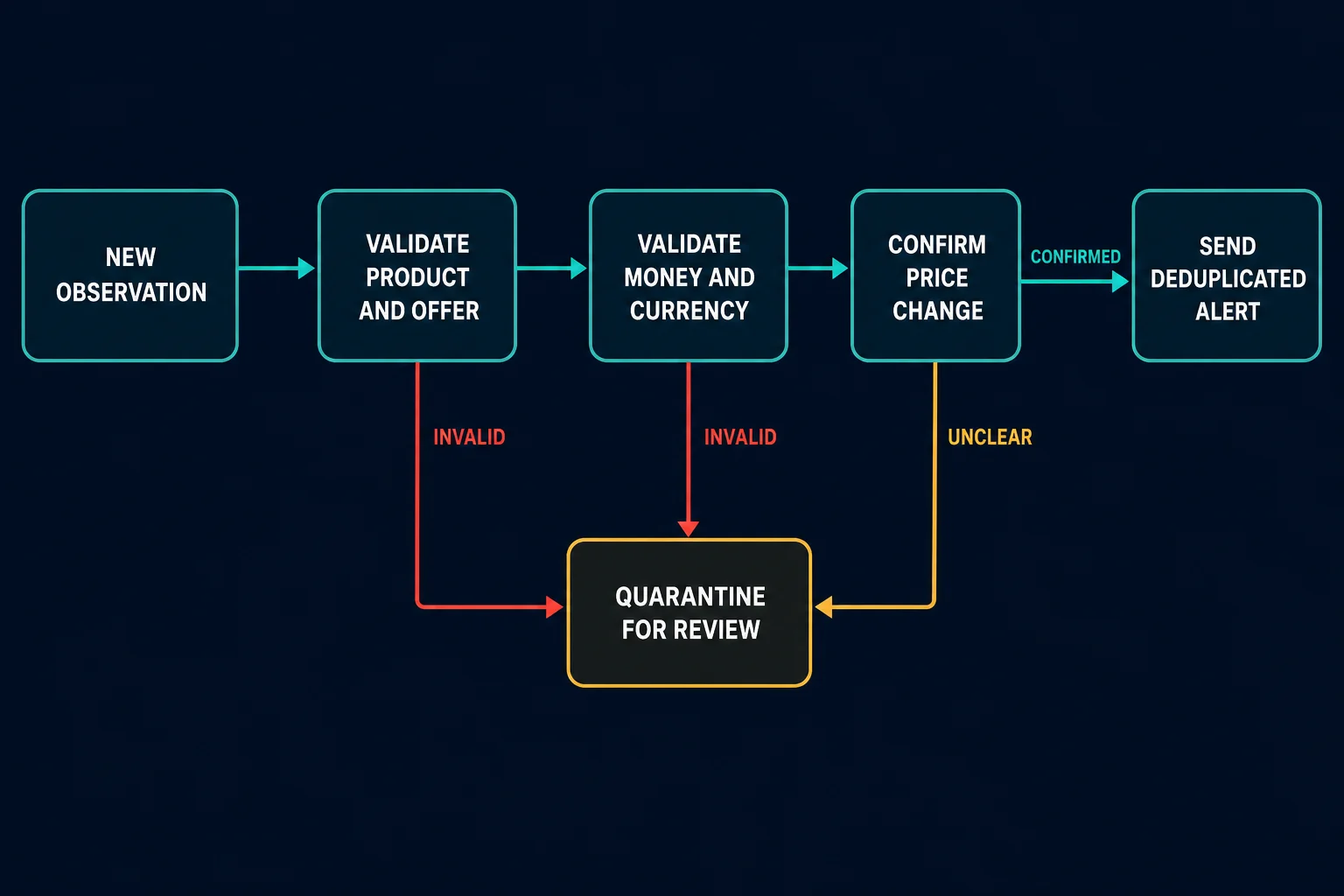
Add range checks, but do not use them to erase legitimate changes. A 90% drop may be a flash sale, a unit mismatch, a monthly payment, or a parser error. Store it as quarantined, collect supporting evidence allowed by your retention policy, and require confirmation before alerting.
Measure data quality independently from transport success. Track valid observation rate, missing-price rate, unexpected-page rate, product-mismatch rate, parser error rate, and alert confirmation rate. A 99% HTTP success rate is meaningless if half the accepted prices refer to the wrong offer.
Detect Meaningful Price Changes
Compare the new result with the last valid observation for the same product, market, variant, seller, offer type, and currency. Comparing unlike offers is a common source of false alerts.
Useful rules include:
- Any absolute change greater than a fixed amount.
- A percentage decrease or increase beyond a threshold.
- A new historical low within a defined lookback period.
- A move below a target price.
- A return to stock with a valid price.
- A competitor gap that persists for two or more observations.
Calculate percentage change against the previous valid price:
percentage change = ((new price - old price) / old price) × 100
Use confirmation rules for noisy sources. Two matching observations several minutes apart can prevent a transient partial render from triggering an alert. The tradeoff is slower detection, so reserve confirmation for changes where false positives are costly.
Design Alerts for Action, Not Volume
An alert should explain what changed and why it matters. Include:
- Product and monitored variant.
- Previous and current comparable price.
- Absolute and percentage change.
- Currency, market, seller, and offer type.
- Observation time and source URL.
- The rule that triggered the alert.
- A stable event ID for deduplication.
Deduplicate on product, offer, rule, and change event. Do not send the same alert on every unchanged run after a threshold is crossed. Close or update an event when the price returns above the target, the item becomes unavailable, or a newer valid change replaces it.
Keep quarantined observations out of customer-facing channels. Route them to an operations queue with the parser version and failure reason so the team can distinguish a real price event from a source change.
Handle Failures and Backoff
Classify responses before retrying:
| Result | Likely meaning | Action |
|---|---|---|
| 200 with wrong content | Consent, challenge, redirect, or parser mismatch | Quarantine; inspect the page class |
| 403 | Access, authorization, or policy denial | Stop automatic retries and review access |
| 429 | Request rate is too high | Honor Retry-After, reduce concurrency, and cool down |
| 5xx | Temporary source or upstream failure | Retry a limited number of times with backoff and jitter |
| Timeout | Network, proxy, source, or rendering delay | Identify the slow layer before retrying |
The HTTP definition of 429 Too Many Requests explains that a server may include Retry-After. Treat it as a minimum wait, not a suggestion to resume every worker simultaneously.
Put retries back into the scheduler with an attempt count and next-run time. Sleeping inside a worker wastes capacity and makes shutdowns harder. Cap retries, add jitter, and use a circuit breaker when one source begins failing broadly.
When Proxies Fit Price Monitoring
Proxies can support legitimate price monitoring when observations genuinely vary by region, cloud workers need controlled outbound routing, or independent jobs need isolated network identities. They do not grant permission, repair a broken parser, or justify ignoring access controls.
Match routing to the job:
- Use a stable ISP proxy for repeated checks where predictable latency and one consistent route matter.
- Use a sticky residential session for a permitted multi-step regional page flow.
- Use rotating residential proxies for independent location checks when each observation can stand alone.
- Test datacenter proxies first when the source permits them and cost efficiency matters.
- Keep one browser page load on one identity; do not rotate midway through its subrequests.
The best proxy for web scraping guide compares these options by target strictness, session needs, speed, and cost. If broad location coverage is central to the monitor, residential proxies provide country, state, and city targeting options.
Before increasing proxy pool size, reduce duplicate work, slow the scheduler, cache stable pages, and fix synchronized retries. A larger pool can hide poor request discipline without improving data accuracy.
Test the Complete Monitoring System
Use saved, redacted fixtures when your policy permits them. Your test set should cover:
- A normal in-stock offer.
- A sale with both list and current prices.
- A coupon or member-only price.
- An unavailable product.
- Multiple sellers or variants.
- Locale-specific decimal and currency formats.
- Consent, challenge, and error pages.
- A large legitimate increase and decrease.
- Missing shipping or incomplete rendering.
Run parser tests on every adapter change. Then replay observations through normalization, comparison, deduplication, and alert rules. A selector unit test alone cannot catch an alert that compares a standard offer with a subscription offer.
Deploy source adapters independently. Canary a new parser on a small product subset, compare valid observation rates with the previous version, and keep a rollback path. Alert on sudden shifts in missing fields or page classifications before users report bad data.
Price Monitoring FAQ
How often should prices be monitored?
Use the slowest interval that still supports the business decision. Fast-changing, high-value products may need frequent permitted checks, while stable items can be checked daily or less often. Adapt the interval from observed change frequency and source limits.
Is price monitoring legal?
It depends on the source, data, jurisdiction, access method, and intended use. Prefer authorized APIs and feeds, review terms and robots.txt, avoid personal or restricted data, and obtain legal advice for your specific project.
Should a price monitor use a browser?
Only when a permitted required field is not present in the initial HTML or an approved API. HTTP clients are usually simpler, faster, and cheaper. Prove that rendering is necessary before adding a browser.
Should price monitoring include shipping?
Include shipping when the monitored metric is total customer cost, and keep it separate when the metric is shelf price. Whichever rule you choose, apply it consistently to every comparable observation.
Can proxies prevent price monitoring blocks?
No. Proxies change routing, but they do not fix excessive request rates, invalid sessions, forbidden access, or broken extraction. First verify scope, pacing, caching, response classification, and source policy.
Conclusion
Reliable price monitoring depends on consistent identity and validation, not raw scraping speed. Define the exact offer, collect paced observations, normalize money and locale, compare only like-for-like records, and quarantine suspicious changes before they become alerts.
Start with a small catalog and an authorized structured source where possible. Once the data and alert rules are trustworthy, scale the schedule gradually and add proxy routing only where regional measurement or workload isolation creates a clear operational need.