Scraping hotel prices means collecting rate quotes for a precisely defined stay, then checking that every quote refers to the same dates, occupancy, room, meal plan, cancellation policy, currency, and fee basis. A number without that context is not a comparable hotel price.
Start with an official API, affiliate feed, channel-manager export, or data license when one covers your use case. If collection from public pages is permitted, keep it limited to approved properties and markets, follow site terms and robots.txt, avoid personal or account data, and use conservative request rates. This guide focuses on building an auditable hotel-rate monitor, not automating bookings or circumventing access controls.
The practical workflow is: define a stay tuple, request an approved source, classify the returned page, extract complete rate plans, normalize totals, validate comparability, and append observations to history. Never alert on a price until the quote survives those checks.
Scraping Hotel Prices Starts with a Comparable Stay
Hotel inventory is perishable and query-dependent. The same property can return different valid prices when any part of the search changes. Treat the search inputs as part of the observation's identity rather than incidental URL parameters.
Define these fields before collecting anything:
| Dimension | Example | Why it changes the result |
|---|---|---|
| Property | Stable source property ID | Names and URLs can change or collide |
| Stay dates | 2026-10-12 to 2026-10-15 | Rates and minimum stays vary by night |
| Occupancy | 2 adults, 0 children, 1 room | Occupancy limits and extra-person charges apply |
| Guest ages | Child ages when requested | Many sources price children by age band |
| Market | US point of sale, English locale | Inventory, promotions, and disclosures can differ |
| Currency | USD | Display currency and conversion assumptions matter |
| Room | King room, exact source room ID | Similar room names can hide different capacity or amenities |
| Rate plan | Flexible, room-only | Meals, payment timing, and changes affect value |
| Cancellation | Free until a stated deadline | A non-refundable rate is not equivalent to a flexible rate |
| Price basis | Full stay, taxes and mandatory fees included | Nightly base rates can understate checkout cost |
Keep separate series for materially different searches. A three-night flexible rate for two adults should not be compared with a one-night member rate for one adult, even if both appear on the same property page.

Choose the Lowest-Complexity Permitted Source
Source choice determines data quality, rights, and maintenance cost. Prefer sources in this order when they meet the project requirements:
- An official hotel, booking, affiliate, or distribution API.
- A licensed rate feed, partner export, or channel-manager integration.
- Server-rendered public HTML within an approved collection scope.
- A browser-rendered page only when the permitted quote is unavailable without JavaScript.
An API or feed usually supplies stable property, room, and rate-plan identifiers. HTML often exposes only presentation labels, and those labels can be localized or revised. Browser automation adds cookies, consent state, subrequests, rendering time, and more failure modes, so prove it is necessary with a captured response before adopting it.
For public-page collection, the Robots Exclusion Protocol defines how crawlers retrieve and interpret robots.txt. Robots rules are one part of preflight review; they do not replace terms, licenses, authentication requirements, privacy obligations, or applicable law. The broader data scraping legality guide explains the questions to review with counsel for a particular source and use.
Create a source register that records the owner, allowed property set, approved endpoints, permitted fields, refresh ceiling, retention rules, and contact path for every connector. That makes the crawler's frontier reproducible and prevents a small monitor from expanding into unapproved discovery.
Model a Hotel Rate as a Quote, Not a Number
A useful observation preserves both the search and the returned offer. Stable source IDs are better join keys than display names.
{
  "source": "approved-example",
  "property_id": "hotel-1842",
  "check_in": "2026-10-12",
  "check_out": "2026-10-15",
  "rooms_requested": 1,
  "adults": 2,
  "children_ages": [],
  "point_of_sale": "US",
  "display_currency": "USD",
  "room_id": "king-city-view",
  "rate_plan_id": "flex-room-only",
  "room_name_raw": "King Room, City View",
  "meal_plan": "room_only",
  "cancellation_type": "free_until_deadline",
  "cancellation_deadline": "2026-10-10T18:00:00-04:00",
  "payment_timing": "pay_at_property",
  "base_amount": "642.00",
  "tax_amount": "91.48",
  "mandatory_fee_amount": "35.00",
  "total_amount": "768.48",
  "currency": "USD",
  "availability": "available",
  "observed_at": "2026-09-07T12:00:00Z",
  "parser_version": "approved-example-v3",
  "source_url": "https://rates.example/property/hotel-1842"
}
Store monetary values as decimals, not binary floating-point numbers. Preserve raw room, rate, tax, and cancellation text beside normalized fields so an operator can reconstruct how the parser reached its result.
The Schema.org HotelRoom type illustrates why room identity and occupancy deserve their own fields. It distinguishes the accommodation from the offer and defines occupancy as the permitted use of that accommodation. Page metadata can help identify candidates, but do not assume structured data contains the date-specific, occupancy-specific quote shown after a search.
Extract Complete Rate Plans Before Normalizing
Build one adapter per approved source. Its job is to return either a list of typed rate quotes or a classified state such as no_availability, consent_page, rate_limited, access_denied, template_changed, or unexpected_page. An HTTP 200 response alone is not evidence that hotel rates were returned.
For an HTML source, inspect the original response before reaching for a browser. If the required permitted data appears in server-rendered markup or embedded structured data, a small HTTP client is easier to test. If it appears only after an approved JavaScript request, document that dependency and use the supported endpoint or an isolated browser context as permitted.
This Python skeleton keeps transport, extraction, and validation separate. Its host and selectors are placeholders for a source you are authorized to collect. It returns rate quotes and raises exceptions for other outcomes. Before production use, add source-specific response classification and map recognized outcomes to the states above. Do not interpret an empty result or an exception as proof of no availability:
from dataclasses import dataclass
from urllib.parse import urlparse

import requests
from bs4 import BeautifulSoup


@dataclass(frozen=True)
class RawRate:
    room_id: str
    rate_plan_id: str
    room_name: str
    cancellation_text: str
    total_text: str
    currency: str


ALLOWED_HOST = "rates.example"


def fetch_rates(session: requests.Session, search_url: str) -> list[RawRate]:
    if urlparse(search_url).hostname != ALLOWED_HOST:
        raise ValueError("Search URL is outside the approved source")

    response = session.get(search_url, timeout=(5, 20), allow_redirects=False)
    if response.is_redirect:
        raise ValueError("Review the redirect before changing the approved source URL")
    response.raise_for_status()
    if "text/html" not in response.headers.get("Content-Type", ""):
        raise ValueError("Expected an HTML hotel search response")

    page = BeautifulSoup(response.text, "html.parser")
    result = page.select_one("[data-search-result]")
    if result is None:
        raise ValueError("Response is not a recognized rate result")

    rates = []
    for card in result.select("[data-rate-plan-id]"):
        rates.append(
            RawRate(
                room_id=card["data-room-id"],
                rate_plan_id=card["data-rate-plan-id"],
                room_name=card.select_one("[data-field='room']").get_text(" ", strip=True),
                cancellation_text=card.select_one("[data-field='cancellation']").get_text(" ", strip=True),
                total_text=card.select_one("[data-field='total']").get_text(" ", strip=True),
                currency=card["data-currency"],
            )
        )

    if not rates:
        raise ValueError("Recognized result contained no complete rate plans")
    return rates
The example stops on redirects. Review a changed source URL before adding it to the approved scope.
Do not copy these placeholder selectors into production. Write fixtures from policy-approved responses for normal availability, sold-out dates, one-night and multi-night stays, mobile and desktop layouts, promotions, consent pages, and template changes. A parser should fail closed when an identity or price component disappears.
Normalize Totals Without Hiding Hotel Fees
Keep the source's full-stay total as the primary amount. You can derive a nightly equivalent for analysis, but label it as calculated and never present it as the source's nightly quote.
stay_nights = check_out_date - check_in_date
derived_nightly_total = full_stay_total / stay_nights
The number of calendar nights must come from local stay dates, not hours between UTC timestamps. Daylight-saving changes do not turn a three-night stay into 2.96 or 3.04 nights.
Separate these components when the source provides them:
- Base room amount for the whole stay.
- Taxes.
- Mandatory property, destination, or resort fees.
- Optional add-ons such as parking, breakfast, or an extra bed.
- Amount due now and amount due at the property.
- Refundable deposit or hold, which may not be a charge.
Google's hotel price documentation describes tax and fee data by basis, period, and calculation type and emphasizes including applicable taxes and fees. Even if your source uses a different schema, that separation is a useful model: a per-person, per-night tax cannot be normalized correctly unless occupancy and stay length are attached.
Never fill a missing total by silently adding fields with uncertain scope. Mark the quote total_incomplete, retain the visible components, and exclude it from total-price alerts until the source adapter is repaired.
Match Rooms and Booking Terms Conservatively
Room names are weak identifiers. “Deluxe King,” “King Deluxe,” and “Deluxe Room with King Bed” may be the same physical category—or different views, floors, sizes, or benefit bundles. Prefer a stable room ID from an approved structured source. When no ID exists, use a versioned, source-specific mapping based on multiple attributes.
Compare at least:
- Bed type and bed count.
- Maximum and requested occupancy.
- Room or unit size when available.
- View, balcony, kitchen, accessibility, and smoking attributes.
- Meal plan.
- Refundability and exact cancellation deadline.
- Payment timing and card requirements.
- Membership, mobile-only, residency, or package eligibility.
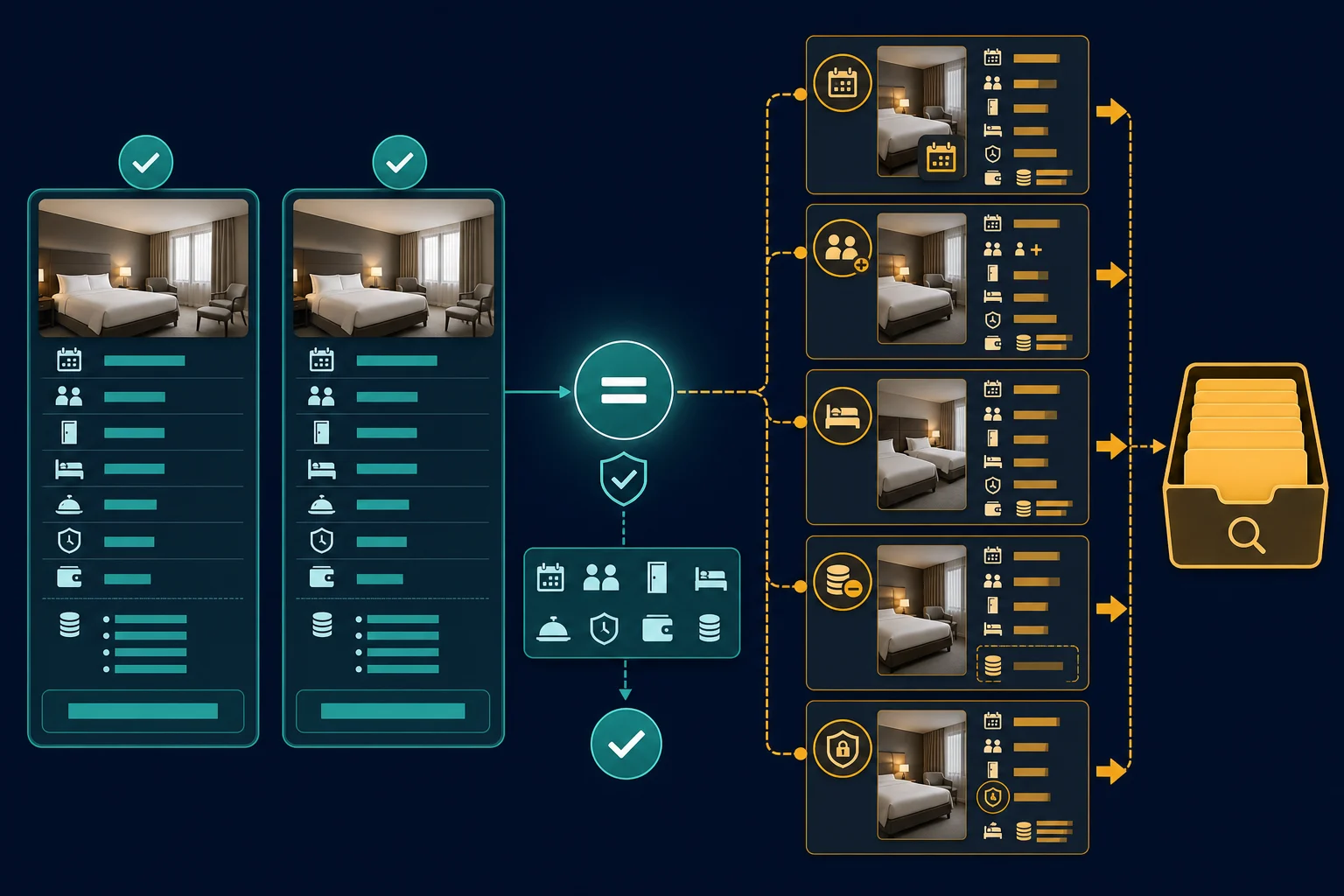
Use explicit match outcomes: same_offer, different_offer, or needs_review. Fuzzy room-name similarity can suggest candidates for review, but it should not automatically merge rate histories. The costliest monitor failure is a believable price change caused by switching to a cheaper non-refundable plan or a room with different occupancy.
Control Dates, Locale, and Session State
Run comparisons as controlled experiments. Change one input at a time and record it with the observation.
- Use ISO dates in your scheduler and retain the property's local time zone.
- Keep one locale, point of sale, and currency per series.
- Store the requested occupancy even when the page ignores it.
- Start from a clean, documented cookie state for independent measurements.
- Keep one browser context and network route for all subrequests in a single permitted search session.
- Record redirects, consent state, and the final canonical property ID.
Do not mix prices learned through account login, membership, or personalized cookies with generally available public rates. If a project is authorized to measure those offers, store them as separate eligibility classes and never leak account data into logs or fixtures.
Pace Hotel Price Checks Around the Decision
Hotel rate monitoring is repeated observation, not an invitation to crawl as fast as possible. Choose the slowest schedule that can still change the business decision. Near-term inventory may justify more frequent approved checks than stays six months away, but every source needs its own concurrency cap and daily request budget.
Add deterministic jitter so all properties are not requested at once. Cache static property metadata separately from dynamic rates. Stop retrying when repeated responses show denial, a challenge, or a changed template; route those states to review instead of cycling identities.
When a server sends Retry-After, HTTP Semantics defines it as guidance for how long the client should wait before a follow-up request. Treat that as a minimum delay, reduce concurrency, and resume gradually. The delay calculator helps convert a property count and per-request delay into a baseline schedule, while the HTTP 429 guide covers retry and backoff behavior.
Use Proxies Only When Route Location Is a Test Variable
Proxies are relevant when an approved study compares public hotel availability, currency, or offers across markets, or when a controlled outbound route is required for your infrastructure. They do not grant collection rights, remove rate limits, repair an incomplete total, or make different room plans comparable.
Use one stable session for a complete search and its dependent requests. Rotating in the middle of a browser flow can split locale, cookies, currency, and inventory context across routes. For independent market checks, create a separate series for each region and verify the exit location before collection.
The best proxy for web scraping guide compares route types and session behavior. If country, state, or city targeting is a legitimate measurement requirement, residential proxies can provide regional routing; direct or datacenter access may be sufficient for permissive sources that return the same data everywhere.
Validate Observations Before Sending Price Alerts
Run validation before a quote enters history or triggers a change:
- Search dates, room count, adults, and child ages match the requested stay.
- The source property ID and room ID match the configured property.
- The rate plan, meals, cancellation terms, and payment timing are known.
- Currency and point of sale match the series.
- Full-stay total is present, or the observation is explicitly excluded from total comparison.
- Taxes and mandatory fees have a known inclusion state.
- Availability and page class are recognized.
- Source URL, observed time, parser version, route region, and response fixture version are recorded.
Reject impossible or suspicious changes, such as a zero total, a currency switch without a market change, a three-night total lower than every component, or every property becoming unavailable at once. Quarantine large movements and confirm them with a second permitted observation before alerting.
For monitoring architecture beyond hotel-specific quote identity, the price monitoring pipeline guide covers append-only history, thresholds, confirmation windows, alert deduplication, and operational metrics. The competitor price scraping guide goes deeper on source adapters and comparable-offer validation across retail categories.
Track metrics by source and parser version: recognized results, no availability, incomplete totals, unknown rooms, request failures, rate limits, consent pages, and validation rejects. A sudden distribution change is usually a connector problem, not a real market event.
Scraping Hotel Prices FAQ
Is scraping hotel prices legal?
It depends on the source, method, data, jurisdiction, contract terms, and intended use. Prefer authorized APIs or licensed feeds, review site terms and robots.txt, avoid restricted, account, or personal data, and get legal advice for the specific project.
What is the best field to compare across hotel sites?
Compare the full-stay total for the same property, dates, occupancy, room, rate plan, cancellation terms, payment timing, market, currency, and fee basis. A nightly headline price is useful only when those dimensions match and its calculation is documented.
Can structured data replace hotel-page parsing?
Sometimes it supplies property or room metadata, but it may omit the live quote for the requested dates and occupancy. Validate structured data against the rendered result and keep its extraction path versioned like any other source adapter.
Do I need a browser to scrape hotel rates?
Only when the required permitted quote cannot be obtained from an official source or the initial response. Inspect network and HTML responses first. A browser is slower and creates more session-state failure modes, so use it deliberately.
How often should hotel prices be checked?
Use the slowest interval that still supports the decision and stays within source rules. Segment by check-in horizon and business value, add jitter, cap concurrency, and back off on errors instead of checking every property at one fixed high frequency.
Will proxies prevent hotel scraping blocks?
No. A proxy changes the network route. It does not fix excessive request rates, denied access, inconsistent cookies, invalid search inputs, or faulty extraction. Stop on repeated denials and review permission, pacing, and session design.
Conclusion
Scraping hotel prices reliably is an offer-matching problem before it is an extraction problem. Define the complete stay, choose the simplest permitted source, preserve room and rate-plan identity, normalize full-stay totals without hiding fees, and validate each observation before comparing it.
Once those controls are in place, schedule conservative checks, separate regional series, and send alerts only for confirmed changes between genuinely comparable hotel rates.