Proxies for YouTube route a browser or approved application through another public IP before it reaches YouTube. They are useful when an authorized team needs to compare public video availability across countries, sample location-sensitive surfaces, or keep a business channel workflow on a controlled network route.
Use a stable ISP proxy for a recurring YouTube Studio session. Use a sticky residential route for a time-bounded regional test, or rotate between fresh, logged-out test sessions when each country is an independent observation. Do not rotate during a login, upload, live stream, or other stateful workflow.
A proxy changes only part of the context YouTube sees. YouTube may also use its own location setting, device location, Google Account data, browser state, and watch or search history. A clean test controls those variables instead of treating the proxy IP as a complete viewer identity.
Proxies for YouTube: Quick Decision
Choose the simplest route that matches the authorized job.
| Workflow | Usually choose | Session rule |
|---|---|---|
| Managing an owned channel from a repeatable environment | Direct business connection or static ISP proxy | Keep the operator, profile, cookies, and route consistent |
| Checking a public video's availability in one market | Sticky residential proxy | Use a fresh, logged-out profile and hold the exit for the test |
| Comparing several countries | Residential routes, rotated between tests | Start a new browser context for every country |
| Reviewing public Charts, News, or localization behavior | Sticky residential route plus an explicit YouTube location setting | Record both the observed IP country and selected YouTube location |
| Reading or updating channel data in software | YouTube Data API, with an API key for public reads or OAuth for private data and writes | Treat API authorization and quota separately from IP routing |
| Normal personal viewing | Direct connection | A proxy usually adds cost and latency without improving the workflow |
If one step depends on state created by an earlier step, keep the same exit. The sticky vs rotating proxies guide explains why rotation belongs between independent jobs, not inside a stateful browser session.
What a YouTube Proxy Can—and Cannot—Change
A proxy changes the public source IP and network path. That can make a browser request appear to originate from the proxy's country, provide a fixed egress point for a remote team, or separate a regional QA session from a normal business connection.
It does not override every location signal. YouTube explains that its location selector affects videos surfaced in Recommendations, Charts, and News. Its separate location controls documentation says current location can be estimated from sources including the IP address, saved home or work addresses, and device location.
Keep these inputs distinct:
- Proxy country: the country associated with the proxy's public IP.
- YouTube location: the country selected inside YouTube's interface.
- Device location: approximate or precise location supplied by the operating system or browser when permitted.
- Account context: watch history, searches, subscriptions, saved addresses, and other Google Account activity.
- Language: the display and metadata language selected in YouTube, plus browser and device language preferences.
For a reproducible test, record each input. Simply connecting to a proxy in France does not prove that every viewer in France sees the same Home feed. YouTube's explanation of its recommendation system describes watch time, clicks, likes, dislikes, surveys, and other feedback as personalization signals.
The channel's country setting is different again. It belongs to channel configuration and Partner Program eligibility; YouTube says changing a channel location does not make videos more likely to be recommended in that country. Do not edit the production channel setting merely to simulate a viewer market.
How to Test YouTube Locations Without Polluting the Result
Start with one narrow question. Good examples are:
- Is an owned or licensed public video available from the selected country?
- Which public title, description language, or audio option appears in a clean browser?
- Does a campaign link resolve to the intended public video and landing context?
- What appears on a location-sensitive public surface at a recorded time?
- Does playback fail only on one tested route, or on every connection?
Do not combine availability, recommendation ranking, ad delivery, account security, and playback performance into one pass/fail result. They depend on different systems.
Use this controlled sequence:
- Define the expected observation. Save the exact video URL, query, country, language, viewport, and test time.
- Establish a direct baseline. Open the page from the normal approved connection and capture the response.
- Create a clean browser context. For public QA, stay logged out and use a new profile or private context for each country.
- Connect one regional proxy. Verify its observed IP and country on a neutral HTTPS endpoint before opening YouTube.
- Set YouTube's location deliberately. Open the profile menu, select the intended location and language, and record both values instead of assuming the IP changed them.
- Keep the route stable while the page loads. A video page fetches scripts, media, thumbnails, and supporting requests; changing exits midway creates an invalid test.
- Capture evidence. Record the final URL, availability message, visible metadata language, selected location, observed IP country, timestamp, and screenshot.
- Close the context before changing countries. Begin the next region with new cookies and storage.
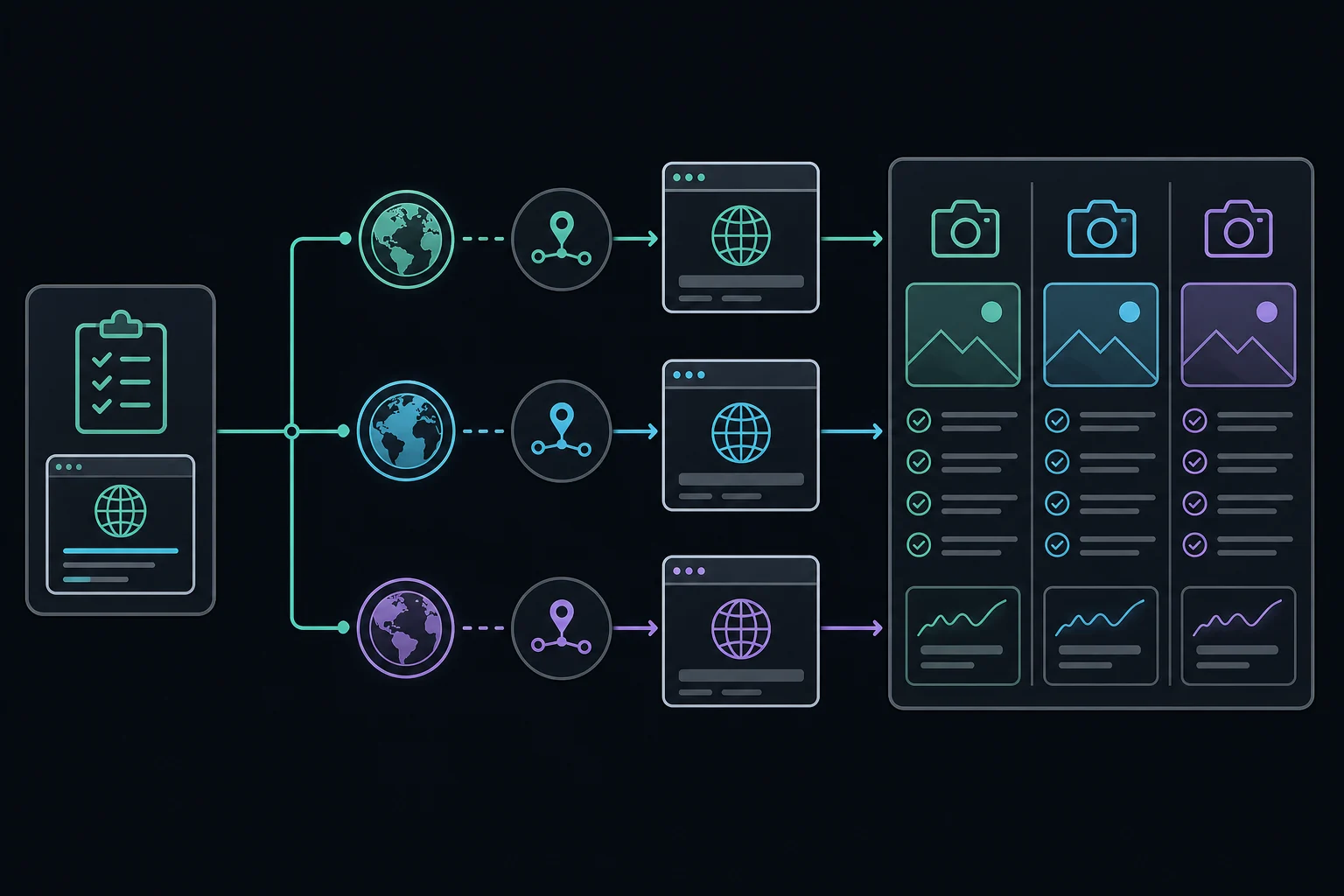
Repeat the same case if a result matters. Recommendations and other dynamic surfaces change over time, so one screenshot is a sample, not a ranking guarantee. For an availability check, YouTube notes that a video may be unavailable in a country because the owner limited its territories, often for licensing, or because local law requires a block. A proxy is a diagnostic viewpoint, not permission to watch or redistribute territory-restricted content.
A result matrix worth keeping
| Field | Example value to record | Why it matters |
|---|---|---|
| Test case ID | launch-video-public-page |
Keeps repeated runs comparable |
| Browser state | Logged out, fresh profile | Reduces history and cookie carryover |
| Proxy assignment | Provider ID and observed IP | Identifies the route without exposing credentials |
| Expected / observed country | Canada / Canada | Catches geolocation mismatch |
| YouTube location and language | Canada / English | Separates interface settings from IP location |
| Result | Available, English metadata | Captures the actual observation |
| Timestamp and screenshot | UTC time plus evidence path | Makes a changing surface auditable |
Never put proxy usernames, passwords, session tokens, or Google credentials in the report.
Keep Channel Access Stable and Permissioned
For YouTube Studio, stability matters more than rotation. Uploads, metadata edits, moderation, live controls, and analytics are authenticated workflows. Switching countries or IPs in the middle of a session can trigger extra verification, break an upload, or make an incident harder to investigate.
The safer team model is:
- Give each operator their own Google Account.
- Grant the minimum required role with YouTube channel permissions.
- Use a separate managed browser profile for channel work.
- Assign that profile to the normal approved connection or one stable proxy.
- Keep two-step verification, recovery details, and security-alert ownership current.
- Record operator, role, profile, route, and approved region in an access-controlled runbook.
YouTube's channel permissions guide explains how to invite other people to help manage a channel. Use role-based access instead of sharing the owner's password through a team profile. These delegated channel permissions do not grant YouTube API access; check API authorization separately before building an integration.
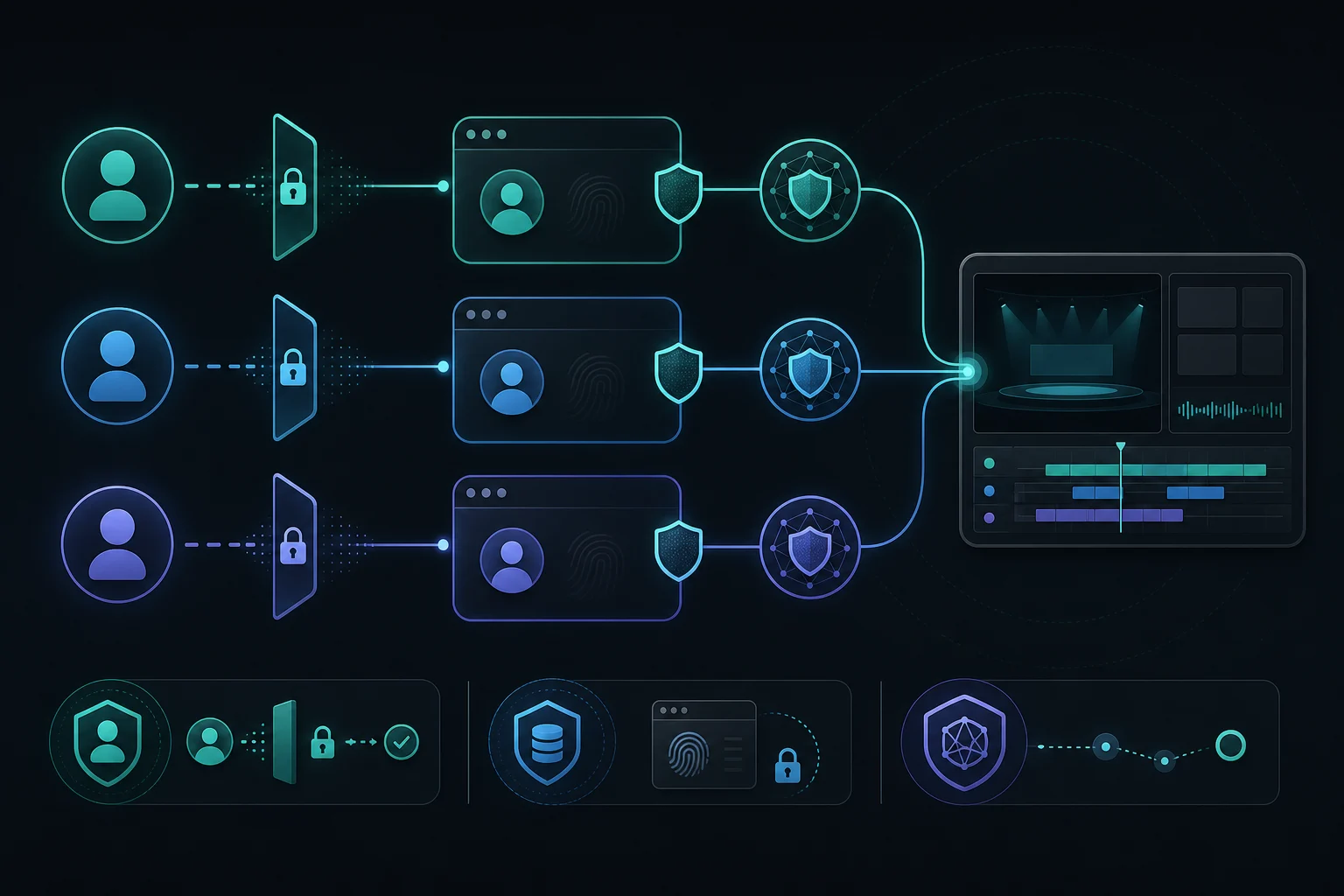
Google security alerts include device, time, and location details. If an alert is unfamiliar, follow the account-security process; do not keep swapping proxies until a login succeeds. A familiar browser and stable route make legitimate activity easier for the operator to recognize.
Do not move a live cookie jar from one country to another. When a route genuinely must be replaced, stop channel work, finish or cancel active uploads, verify the new proxy without account credentials, and then begin a controlled sign-in. If Google or YouTube restricts the account, use the supported recovery or appeal path rather than another proxy.
Which Proxy Type Is Best for YouTube?
The right option depends on continuity, location coverage, and bandwidth.
Static ISP proxies for ongoing channel work
A static ISP proxy provides a dedicated IP that stays assigned across sessions. It is the clearest proxy option when an authorized remote operator needs repeatable egress for YouTube Studio over days or weeks.
Use it when the required country is available, the route has reliable bandwidth, and there is a real reason not to use the team's direct connection. Keep the assignment stable. A dedicated IP can still trigger security checks or develop a poor history; “static” is an operational property, not a guarantee of trust.
Sticky residential proxies for one regional session
A sticky residential proxy holds one residential exit for a defined period. It fits a bounded location test where a page, video, and supporting requests must remain on the same regional route.
Confirm the provider's sticky duration before starting a long playback or review session. Video consumes substantial bandwidth, and a residential plan billed by data can become expensive if every test streams at high quality. Test page behavior at the lowest useful playback duration and quality, then measure actual consumption.
Rotating residential proxies between independent tests
Rotation is useful for a country comparison only when each observation starts clean. Rotate the proxy, create a new browser context, verify the new country, set the YouTube location, and run the same test specification.
Do not attach a rotating-per-request route to YouTube Studio or an active viewer account. The same cookies arriving through changing networks make the session less coherent and do not create a representative regional sample.
Datacenter proxies and direct API egress
Datacenter proxies can be fast and inexpensive for tolerant public checks, but hosted IP ranges may not represent consumer network conditions. For an approved server-side YouTube Data API integration, a normal fixed cloud egress address is usually simpler than a residential pool.
HTTP(S) proxies are the straightforward choice for browser traffic. SOCKS5 can work when the browser or profile manager supports it correctly, but the protocol does not improve an IP's reputation or make a test more representative. See SOCKS5 vs HTTP proxies for the client and DNS differences.
Do Not Use Proxies to Work Around YouTube API Quotas
For public searches and public resource reads, the YouTube Data API can use an API key linked to the appropriate project. Private channel data and write operations, such as metadata updates and uploads, require OAuth authorization. The API applies quota costs to requests, including invalid requests.
Proxy rotation does not add quota to a Google Cloud project or OAuth client. YouTube's developer policy guidance specifically warns against spreading one use case across projects to obtain extra quota. Monitor usage, cache safe responses, reduce unnecessary calls, and request an official quota extension when needed.
The API also has explicit geographic parameters that are easy to misunderstand:
regionCodeaskssearch.listto return videos viewable in a specified country.relevanceLanguageprefers results relevant to a language but may still return other languages.locationpluslocationRadiusfinds videos whose metadata includes a geographic location near coordinates.
These documented search.list parameters do not simulate a viewer's personalized Home feed. Use them for the API question they answer; use a controlled browser test only when the question is genuinely about the public browser experience.
Troubleshoot YouTube Proxy Problems One Layer at a Time
| Symptom | First check | Do not assume |
|---|---|---|
| Browser cannot connect | Proxy host, port, protocol, credentials, and provider status on a neutral HTTPS page | YouTube blocked the account |
| Observed country is wrong | Proxy geolocation, DNS path, and provider assignment | Changing YouTube's location selector will fix the route |
| Video is unavailable in one country | Rights-holder territory settings and local availability | Another proxy makes access permitted |
| Home or search results differ between runs | Login state, cookies, history, YouTube location, language, time, and device location | The IP alone controls recommendations |
| Google requests verification | Account security alert, operator, device, profile, and route continuity | Rapid proxy replacement is the recovery path |
| Upload stalls or restarts | Proxy latency, packet loss, bandwidth, session stability, and direct baseline | A larger rotating pool improves uploads |
| API returns a quota error | Project quota, method cost, credentials, and reset period | A new source IP resets API quota |
Change one variable at a time. If the proxy fails before YouTube loads, fix routing first. If the same account problem appears on both a healthy proxy and the normal approved connection, follow the account or platform support path. If only one regional route fails, compare its observed location, latency, and network quality with another verified route in the same country.
A Safe Setup Checklist
Before using proxies for YouTube, confirm:
- The channel owner authorized the operator and intended work.
- Public location tests respect content rights, local law, and YouTube's current terms.
- Automated channel or data operations use the supported API when required.
- The proxy is dedicated, sticky, or rotating in the way the test plan expects.
- The observed proxy country matches the assigned market.
- Logged-out regional tests use a fresh context for every country.
- Authenticated channel work stays on a stable profile and route.
- Team access uses channel permissions rather than a shared owner password.
- Two-step verification and recovery ownership are current.
- The test log excludes passwords, tokens, cookies, and full proxy credentials.
- Playback and upload bandwidth have been measured on a small test.
- Operators know when to stop and escalate a security or policy warning.
When Unknown Proxies Fits
Unknown Proxies offers two practical routes for authorized YouTube work:
- ISP proxy plans for fixed, dedicated egress when channel and browser continuity matter.
- Residential proxies for controlled regional QA, using sticky sessions within one test or rotation between independent tests.
Choose ISP when the session must return to the same IP. Choose residential when country coverage is the actual requirement. If the work does not need either, use the normal direct connection or official YouTube API instead.
FAQ
What are proxies for YouTube used for?
Proxies for YouTube are used for legitimate regional QA, public availability checks, controlled business egress, and stable authorized channel environments. They change network routing; they do not grant content rights, platform permission, or extra API quota.
Should I use residential or ISP proxies for YouTube?
Use a static ISP proxy for recurring YouTube Studio work that needs one stable IP. Use a sticky residential proxy for a time-bounded country test. Rotate residential exits only between independent, fresh, logged-out tests.
Does changing a proxy change my YouTube recommendations?
It may change one location input, but it does not control the entire result. YouTube may also use its location setting, device location, account information, watch and search history, subscriptions, and feedback. Treat the result as a controlled sample, not proof of what every user in that country sees.
Can a YouTube proxy unlock a country-restricted video?
A different route may reveal that availability varies by country, but it does not grant viewing or distribution rights. YouTube says territory restrictions may come from the content owner or local law. Respect those restrictions and use proxies only for authorized testing.
Can proxies prevent YouTube or Google login verification?
No. Google may request verification based on device, location, account activity, and other security context. A stable route can avoid unnecessary IP changes, but it cannot guarantee that a login will be accepted.
Can I rotate proxies to get more YouTube API quota?
No. YouTube Data API quota belongs to the API project and request methods, not the public source IP. Optimize requests and use the official quota-extension process instead of rotating routes or splitting one use case across projects.
Final Thoughts
Proxies for YouTube work best as controlled network infrastructure: a stable ISP route for authorized channel work, a sticky residential route for one regional session, or fresh residential exits between independent location tests. Keep YouTube's location selector, device location, language, browser state, and account history visible in the test record.
Use channel permissions instead of shared passwords, keep authenticated sessions stable, and use the YouTube Data API for supported software workflows. Once the question, session model, and country coverage are clear, compare ISP and residential proxy options without buying rotation the workflow should not use.