A Scrapy 403 error means the target received your request but refused to fulfill it. The cause may be missing permission, authentication, a blocked endpoint, inconsistent cookies or headers, excessive traffic, a WAF rule, or the request's network route. It is not proof that Scrapy itself is broken or that you simply need more proxies.
The quickest responsible fix is to let one 403 reach a diagnostic callback, record the response class without secrets, and compare controlled low-rate requests. Keep the URL, method, headers, cookies, and timing constant while testing one variable at a time. Do not automatically retry a denial: confirm that the access and collection method are permitted before changing your crawler.
This guide shows how Scrapy handles 403 responses, provides a small diagnostic spider, and turns the result into a specific fix instead of a random cycle of headers and IPs.
Scrapy 403 Quick Diagnosis
Start by matching the evidence to the likely layer:
| What you observe | Likely cause | First action |
|---|---|---|
| Browser and Scrapy both return 403 | Permission, account, endpoint, or site policy | Confirm access and use the supported API, feed, login, or permission path |
| Browser succeeds, a minimal Scrapy request fails | Request profile, cookies, rendering, or WAF classification | Inspect the exact response and compare one request field at a time |
| Direct Scrapy succeeds, the same request through a proxy fails | Proxy region, ASN, reputation, or session route | Keep every other variable fixed and test an approved route |
| The proxy replies with 407 | Proxy credentials or allowlist | Fix proxy authentication; this is not a target-site 403 |
| Responses change from 200 to 403 as load rises | Rate or abuse control returning 403 | Stop, cool down, lower concurrency, and review the site's limits |
| Scrapy logs that the response was ignored | HttpErrorMiddleware filtered the 403 before parse() |
Allow 403 temporarily for diagnosis; this does not grant access |
HTTP defines 403 as a refusal after the server understood the request. It may include an explanation, but it does not have to. The standard also says a client should not automatically repeat the same request with the same credentials, which is why blind retry loops are the wrong starting point. See RFC 9110, Section 15.5.4 for the protocol definition.
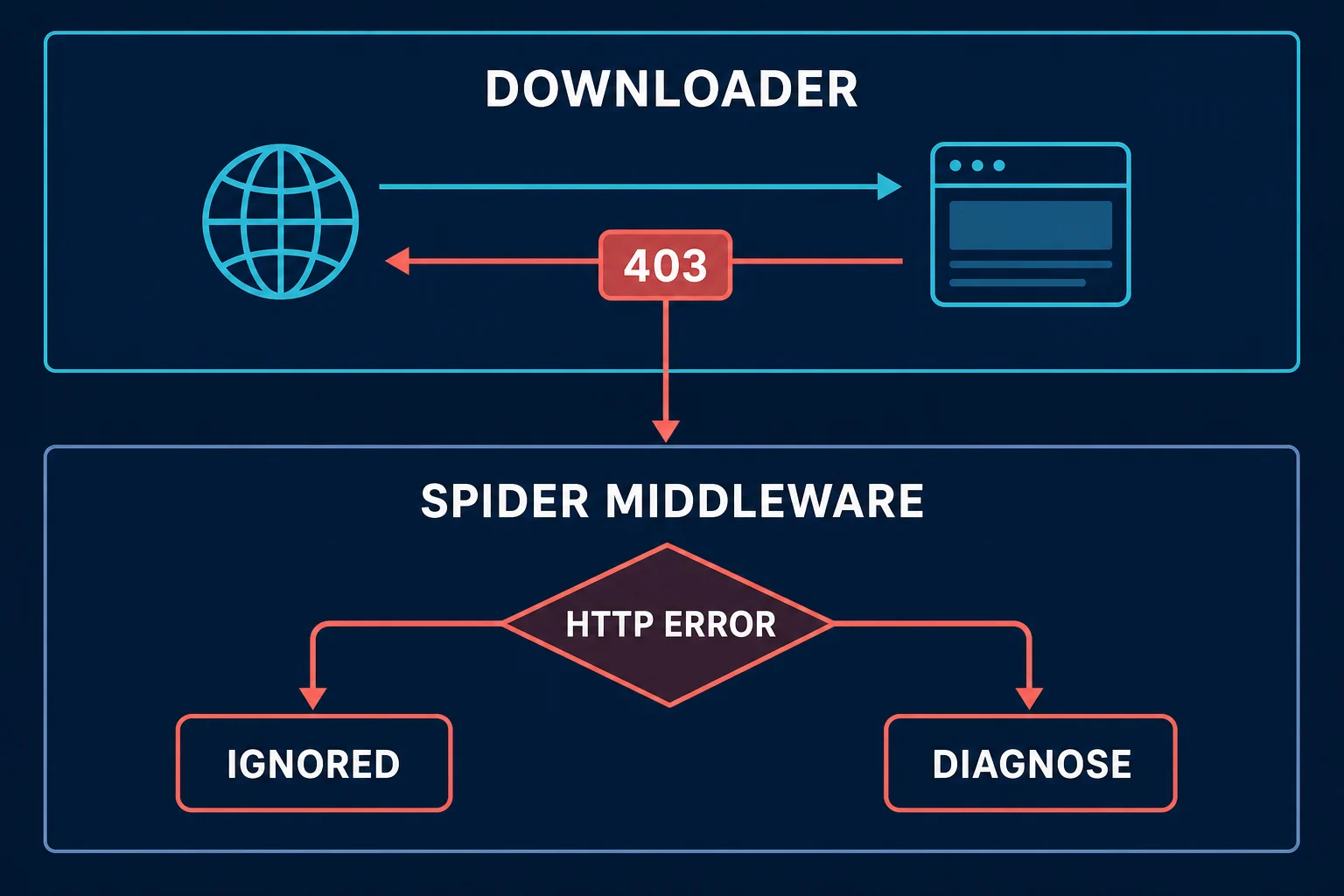
Why Scrapy Does Not Call parse() for a 403
Scrapy downloads the response before its spider middleware decides whether your callback should receive it. By default, HttpErrorMiddleware filters unsuccessful responses, so a 403 can appear in the crawl log and statistics without reaching parse().
These examples use async def start(), which requires Scrapy 2.13 or later. Save each spider in the spiders/ directory of an existing Scrapy project.
For a short diagnostic run, allow that status on the spider:
import hashlib
import os

import scrapy


class ForbiddenProbeSpider(scrapy.Spider):
    name = "forbidden_probe"
    handle_httpstatus_list = [403]

    custom_settings = {
        "CONCURRENT_REQUESTS_PER_DOMAIN": 1,
        "DOWNLOAD_DELAY": 2.0,
        "ROBOTSTXT_OBEY": True,
        "USER_AGENT": (
            "ExampleResearchBot/1.0 "
            "(+https://example.org/crawler-info)"
        ),
    }

    async def start(self):
        yield scrapy.Request(
            os.environ["TARGET_URL"],
            callback=self.parse_probe,
            errback=self.on_download_error,
            meta={"proxy": None},
        )

    def parse_probe(self, response):
        body_hash = hashlib.sha256(response.body).hexdigest()[:12]
        content_type = response.headers.get(
            b"Content-Type", b""
        ).decode(errors="replace")
        title = response.css("title::text").get()

        self.logger.warning(
            "status=%s url=%s type=%r title=%r body_sha256=%s",
            response.status,
            response.url,
            content_type,
            title,
            body_hash,
        )

    def on_download_error(self, failure):
        self.logger.error("download failed: %r", failure.value)
Run it against a URL you are authorized to test:
TARGET_URL="https://example.com/public-page" \
  scrapy crawl forbidden_probe
Scrapy documents handle_httpstatus_list and the project-wide HTTPERROR_ALLOWED_CODES setting in its HttpErrorMiddleware reference. Prefer the spider or per-request scope for diagnosis; allowing every error globally can hide failures that other spiders should reject.
The probe sets meta={"proxy": None} so Scrapy does not inherit an environment proxy. Run it only where direct access is allowed.
This code does not bypass or fix the 403. It only makes the response available for classification. It logs a short body hash instead of dumping the page, cookies, authorization header, or proxy credentials. During an approved local investigation, you can save the body privately or inspect a short redacted sample to identify a login page, WAF template, consent screen, or application error.
Check the Crawl Stats Before Changing Anything
At shutdown, review Scrapy's stats for keys such as:
downloader/response_status_count/403
httperror/response_ignored_status_count/403
retry/count
The first tells you how many 403 responses the downloader received. The second indicates how many were filtered by HttpErrorMiddleware. If retry counts rise but 403 is not in your retry list, you may have timeouts, 429 responses, or server errors mixed into the same run. Scrapy's stats collector is also available through crawler.stats when you need per-spider metrics.
Track response classes by endpoint family, not just across the whole crawl. A site may allow public category pages while denying search, account, checkout, or API routes. One aggregate 403 percentage can hide that distinction.
Fix Scrapy 403 Errors One Layer at a Time
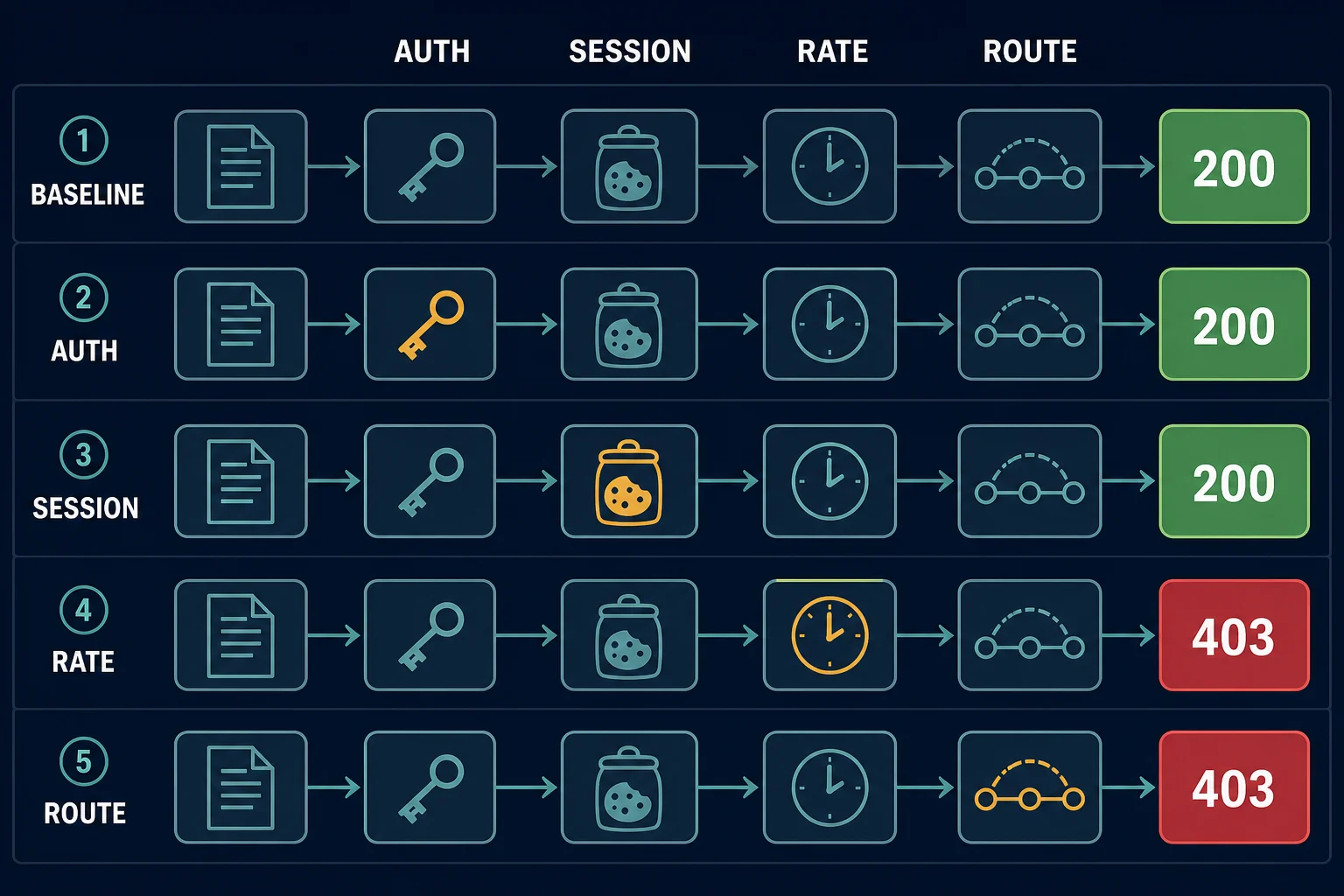
Randomly changing the user agent, proxy, cookie jar, delay, and retry policy at once can produce a successful request without explaining why. Use the following order so each test has a clear interpretation.
1. Confirm the Resource and Method Are Allowed
Check the site's terms, API documentation, account permissions, and robots.txt before debugging access. The Robots Exclusion Protocol standardizes crawler instructions, but robots rules are not authorization and do not replace other legal or contractual requirements.
If the resource requires an account, use credentials issued for that purpose and the documented authentication flow. If an API token lacks a scope or a plan does not include the endpoint, headers and proxies cannot add that permission.
2. Identify Who Generated the 403
Inspect the final URL after redirects, Content-Type, a redacted body sample, and useful response headers. A JSON authorization error suggests the application or API. A branded block page may identify a CDN or WAF. A plain web-server page can point to server configuration. A 407 with Proxy-Authenticate comes from the forward proxy, not the destination.
Do not classify by status alone. Some sites return 200 OK with a login or challenge page, while some rate controls use 403 instead of 429. Validate page type before parsing fields.
3. Reduce the Spider to One Known URL
Temporarily remove pagination, broad link extraction, and concurrency. Test one permitted URL with one request. Record:
- Effective Scrapy settings and release
- Request method and final URL
- Non-secret request headers
- Cookie-jar and logical-session identifiers
- Whether the request used a proxy
- Response status,
Content-Type, body hash, and elapsed time
If this canary fails, scaling the same request only adds noise. If it succeeds, reintroduce one production behavior at a time: session state, next-page navigation, proxy route, then concurrency.
4. Use a Deliberate Scrapy User Agent
Set USER_AGENT once at project or spider scope. A transparent crawler can identify its application and contact page. An authorized browser-compatibility test should use a real browser rather than claiming browser behavior through one copied string.
Changing only User-Agent cannot reproduce browser JavaScript, TLS behavior, cookie state, client hints, or navigation context. The Scrapy user agent guide explains configuration precedence and how to verify the value that Scrapy actually sent.
Keep the rest of the request minimal. The web scraping headers guide covers Accept, language, authentication, cookies, and why copying a full browser request often creates contradictions.
5. Preserve Cookies and Route Within a Session
Scrapy's CookiesMiddleware keeps a default cookie jar, and a request can select another jar with meta={"cookiejar": session_id}. That cookiejar key is not automatically sticky when you build a new request, so pass it to each request in the same logical session.
Keep the same user-agent profile, locale, cookie jar, and proxy route throughout a stateful flow. Rotating the IP midway through login, consent, pagination, or a cart while retaining the cookies can look like a broken session even when each component works independently.
Do not paste a browser's Cookie header into DEFAULT_REQUEST_HEADERS. Let the cookie middleware process Set-Cookie updates, and never emit cookies or auth values in normal logs.
6. Lower Concurrency and Stop Retry Storms
Use a conservative diagnostic configuration:
CONCURRENT_REQUESTS_PER_DOMAIN = 1
DOWNLOAD_DELAY = 2.0
RANDOMIZE_DOWNLOAD_DELAY = True

AUTOTHROTTLE_ENABLED = True
AUTOTHROTTLE_START_DELAY = 2.0
AUTOTHROTTLE_MAX_DELAY = 30.0
AUTOTHROTTLE_TARGET_CONCURRENCY = 0.5

RETRY_TIMES = 2
RETRY_HTTP_CODES = [408, 429, 500, 502, 503, 504, 522, 524]
These are starting values, not a universal safe rate. A published limit or explicit agreement should take precedence. Scrapy's AutoThrottle documentation explains that the extension respects normal concurrency and minimum-delay settings and does not let fast non-200 responses reduce the delay.
Scrapy's default retry status list includes transient server errors, timeout-related codes, and 429, but not 403. Preserve that principle. Adding 403 to RETRY_HTTP_CODES repeats an access denial without changing its cause and may make the block worse. The RetryMiddleware settings document the current defaults and per-request controls.
If the response supplies Retry-After, treat it as a minimum pause for that route. For broader pacing logic, the HTTP 429 guide separates retryable rate limits from forbidden access.
When a Proxy Can Help a Scrapy 403
A proxy can help only when an authorized test shows that network location, IP reputation, ASN, or per-IP request concentration is the constraint. It will not fix missing access, invalid credentials, a disallowed endpoint, lost cookies, incorrect request semantics, or a page that genuinely requires browser execution.
Scrapy's HttpProxyMiddleware reads the proxy URL from request metadata:
import os

import scrapy


class RegionalProbeSpider(scrapy.Spider):
    name = "regional_probe"
    handle_httpstatus_list = [403, 407]

    async def start(self):
        yield scrapy.Request(
            os.environ["TARGET_URL"],
            callback=self.parse,
            meta={
                "proxy": os.environ["PROXY_URL"],
                "cookiejar": "approved-region-test-1",
            },
        )

    def parse(self, response):
        yield {
            "status": response.status,
            "url": response.url,
            "content_type": response.headers.get(
                b"Content-Type", b""
            ).decode(errors="replace"),
        }
Allowing 407 lets the callback inspect a proxy-authentication response when Scrapy exposes it as an HTTP response. For HTTPS destinations, a failed CONNECT tunnel can instead appear as a downloader error before parse() runs.
Keep PROXY_URL in an environment variable or secret manager. Do not log it, because a URL can contain the proxy username and password.
For a useful direct-versus-proxy comparison, keep the target URL, user agent, headers, cookie state, and request timing identical. Run the probes separately at low frequency. If only the proxy path receives the 403, test an approved region or cleaner pool while holding the request constant. If both paths fail, return to permission, request, and session diagnosis.
Use a sticky route for multi-page sessions and rotation only for independent requests. If measured route quality is the issue, compare residential proxy infrastructure for location-aware rotation with the stable options described in the best proxy for web scraping guide. Neither option is a substitute for permission or pacing.
When Scrapy Is the Wrong Client
Some permitted pages require JavaScript to render public data or complete a supported browser flow. In that case, an HTTP response body may be only an app shell, login handoff, or challenge that Scrapy alone cannot execute.
Do not approximate a browser by pasting browser-only headers into Scrapy. Use an actual browser when rendering is a real requirement, keep the workflow within the site's rules, and re-check whether an API or feed is simpler. The Playwright proxy guide explains browser-context routing when an authorized browser workflow also needs a proxy.
A browser still does not grant access. If the resource is private, the account lacks permission, or the site prohibits the collection method, changing clients is not a fix.
Production Prevention Checklist
Before scaling the repaired spider:
- Start from an approved URL set and enforce page, depth, and time limits.
- Keep
ROBOTSTXT_OBEYenabled when appropriate and review site requirements separately. - Version the user-agent and header policy used by each deployment.
- Keep cookies, locale, and proxy route aligned per logical session.
- Bound concurrency per host or download slot, not only per worker.
- Cache unchanged pages and avoid duplicate fetches.
- Do not automatically retry 403 responses.
- Track 403, 407, 429, timeout, challenge-page, and parser failures separately.
- Alert on changes by endpoint and route before increasing traffic.
- Run a small canary after code, header, auth, or proxy changes.
For the wider crawler design—scope control, URL normalization, caching, backoff, and stop conditions—use the guide to crawling a website without getting blocked.
Frequently Asked Questions
Why does Scrapy return 403 but my browser works?
The browser may have an authenticated session, consent state, JavaScript execution, different request metadata, or a different network route. Compare a permitted low-rate request one variable at a time. Do not assume the user agent alone is the cause.
How do I make Scrapy parse a 403 response?
Add handle_httpstatus_list = [403] to the diagnostic spider, use meta={"handle_httpstatus_list": [403]} on one request, or configure HTTPERROR_ALLOWED_CODES = [403]. This only lets your callback inspect the response; it does not resolve the denial.
Should I add 403 to RETRY_HTTP_CODES?
Usually no. A repeated identical request does not change a permission, policy, session, or reputation decision. Keep 403 out of automatic retry rules, classify the response, and require a specific approved change before another probe.
Will rotating Scrapy user agents fix 403?
Only if controlled testing proves the user-agent value caused the denial. Random rotation can conflict with cookies, client capabilities, and a stable proxy session. Use one deliberate identity per logical session.
Will a proxy fix a Scrapy 403?
It may help when the request is permitted and the measured problem is IP location, reputation, ASN, or traffic concentration. It cannot fix missing permissions, invalid authentication, a broken session, or an unsupported collection method.
What is the difference between Scrapy 403 and 407?
A 403 normally comes from the destination site, CDN, WAF, or application after it receives the request. A 407 comes from an authenticating forward proxy. Fix the proxy URL, credentials, or IP allowlist for 407; investigate destination access for 403.
Conclusion
The reliable way to fix a Scrapy 403 is to expose one denied response for diagnosis, identify which layer produced it, and change one approved variable at a time. Start with permission and authentication, then test request consistency, session continuity, pacing, and finally the network route when the evidence points there.
Keep 403 out of automatic retries, measure status and page classes by endpoint, and use proxies only for a demonstrated routing constraint. That workflow turns a vague forbidden error into a reproducible result without creating retry storms or hiding the real access decision.