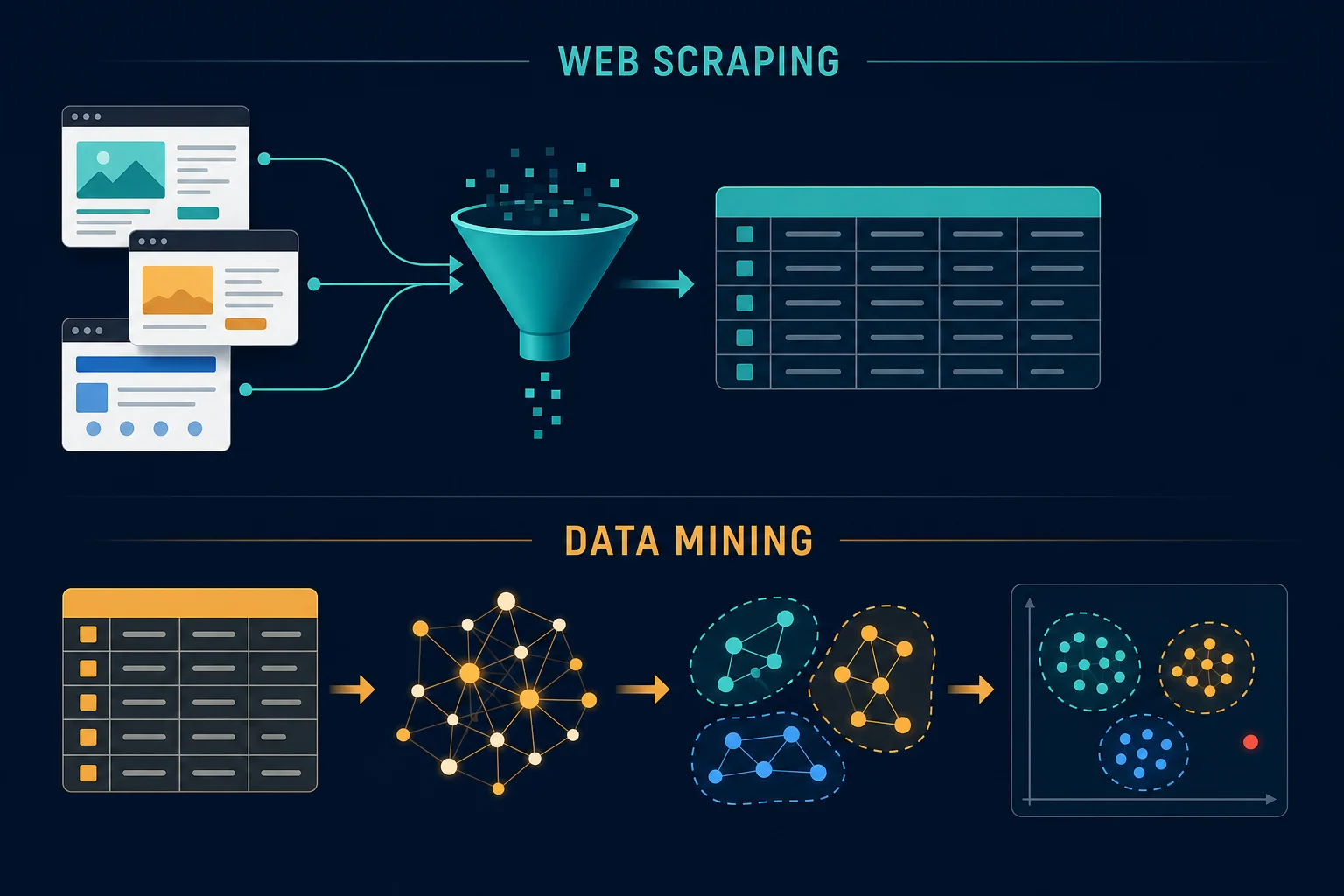
Data mining vs web scraping is a difference of purpose: web scraping collects data from websites, while data mining analyzes an existing dataset to discover patterns, relationships, anomalies, or predictions. Scraping might turn product pages into a table of prices. Mining might use that table to identify pricing segments or predict which products will go out of stock.
The two methods can be stages of the same project, but neither requires the other. You can scrape a website and use simple rules without mining the results. You can also mine sales, sensor, or customer-support data that never came from the web.
Data Mining vs Web Scraping at a Glance
| Question | Web scraping | Data mining |
|---|---|---|
| Main purpose | Collect selected web data | Find useful structure in existing data |
| Typical input | HTML, rendered pages, or embedded page data | Tables, databases, logs, documents, or prepared datasets |
| Typical output | Structured records plus source metadata | Patterns, segments, rules, anomaly scores, or predictive models |
| Common methods | HTTP requests, browser automation, HTML parsing | Statistics, clustering, classification, association analysis, anomaly detection |
| Primary quality test | Did we collect the correct fields from the correct page? | Does the discovered pattern hold and help answer the objective? |
| Main failure mode | Missing, stale, duplicated, or misidentified records | Misleading patterns caused by weak data, leakage, bias, or overfitting |
Web scraping moves approved data from a web source into a usable dataset. Data mining operates on a dataset to produce knowledge or a decision signal.
The Key Data Mining vs Web Scraping Difference
The key difference is where each method begins and ends. Web scraping begins with a web resource and ends with data. Data mining begins with data and ends with a finding, model, or decision aid.
That boundary matters because the engineering questions are different:
- A scraping team asks which sources and fields are permitted, how pages are fetched, how records are identified, and how extraction failures are detected.
- A data mining team asks whether the dataset represents the population of interest, which variables are meaningful, how patterns will be evaluated, and whether results generalize.
IBM's data mining overview describes data mining as using machine learning and statistical analysis to uncover patterns and other valuable information in large datasets. Web scraping is not that analytical process. It is one possible way to acquire part of the input.
What Web Scraping Does
Web scraping converts selected website content into structured records. An official API is an alternative collection method: it returns data through a documented interface instead of requiring page extraction. A basic scraper fetches a permitted page, confirms it received the expected page type, extracts defined fields, validates each record, and stores the result with its source URL and observation time.
For example, a price scraper might produce:
{
  "product_id": "SKU-1842",
  "price": "49.95",
  "currency": "USD",
  "availability": "in_stock",
  "source_url": "https://shop.example/products/SKU-1842",
  "observed_at": "2026-08-01T12:00:00Z"
}
Nothing in that record is a mined insight yet. The scraper has observed and normalized one product offer. A separate analysis could later compare thousands of observations, identify unusual price movements, or group products by discount behavior.
Scrapers commonly use HTTP clients for server-rendered pages, parsers for HTML or embedded structured data, and browser automation when permitted content genuinely requires JavaScript. The Python scraping guide shows the full fetch, classify, parse, validate, and store sequence.
What Data Mining Does
Data mining looks for useful structure in prepared data. Depending on the objective, that might mean:
- Classification: assign records to known categories, such as likely fraud or normal activity.
- Clustering: discover groups without predefined labels, such as products with similar demand patterns.
- Association analysis: find events or items that frequently occur together.
- Anomaly detection: flag observations that differ sharply from an established baseline.
- Regression: estimate a numeric outcome from relevant variables.
The work starts before an algorithm runs. You need a defined business question, suitable records, consistent units, documented missing values, and a test that distinguishes a useful pattern from noise. A large dataset does not automatically make a mining result reliable.
Suppose a retailer already has five years of transaction records in its own warehouse. It can mine seasonal demand patterns without scraping anything. Likewise, a security team can mine internal event logs for anomalies, and a manufacturer can mine sensor readings for maintenance signals.
When Web Scraping and Data Mining Work Together
Some projects need both methods in sequence:
- Define the question and the minimum data needed to answer it.
- Choose an authorized source, preferring an official API, licensed feed, first-party export, or existing internal dataset.
- If permitted web pages are the appropriate source, scrape only the required pages and fields.
- Normalize identifiers, units, time zones, categories, and missing values.
- Validate coverage and record accuracy before analysis.
- Mine the prepared dataset for the specific pattern or outcome.
- Evaluate the result against held-out data or a documented decision rule.
Consider competitor pricing. Scraping can collect product, seller, price, currency, availability, market, and timestamp. Data mining can then group pricing strategies, detect unusual changes, or estimate how often discounts occur. The competitor price scraping guide explains why the collection layer must preserve product and offer context before downstream analysis can be trusted.
The order is important. Mining cannot recover a product ID that the scraper never captured, distinguish a challenge page that was stored as a product page, or correct prices collected under mixed currency assumptions. Collection quality sets the ceiling for analysis quality.
Which Method Does Your Project Need?
Ask what is missing from the project today:
| Current situation | Method to start with | Reason |
|---|---|---|
| Required web data is not yet in a dataset | Web scraping or an approved API | You need a collection step before analysis |
| A suitable dataset already exists and you need patterns | Data mining | More collection does not answer the analytical question |
| You need to copy a few fields into another system | Web scraping or integration, without mining | Extraction and transformation may be sufficient |
| You need to predict an outcome from collected history | Data mining | Prediction is an analysis task |
| The source is web-based and the goal is pattern discovery | Both, in sequence | Collection creates the input; mining creates the finding |
| An official dataset already covers the web source | Data mining on that dataset | Avoid unnecessary collection and maintenance |
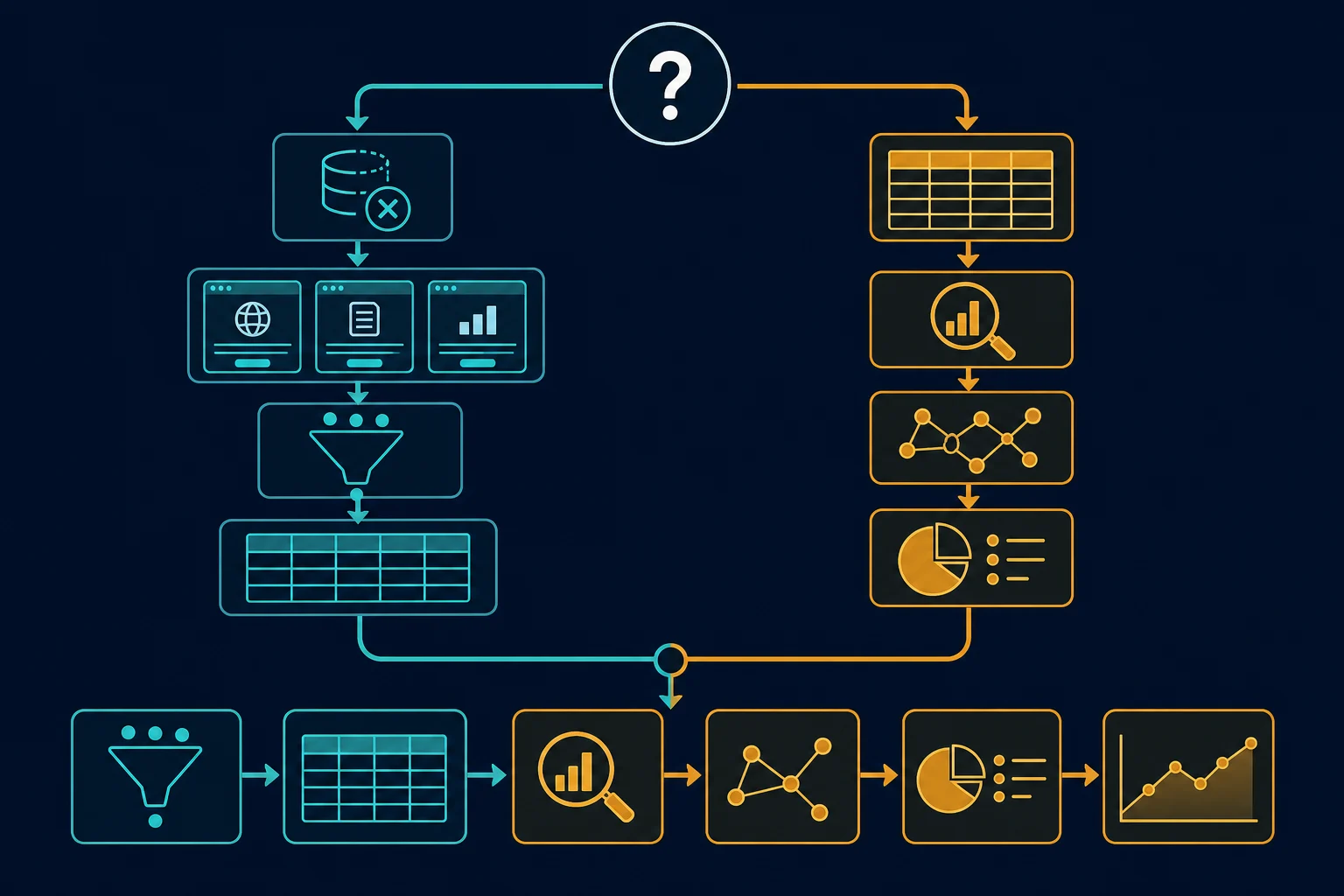
If the objective can be met with an existing API, export, or licensed dataset, start there. A scraper adds source monitoring, parser maintenance, request controls, and policy review. It should solve a real acquisition gap, not become the default simply because the data is visible in a browser.
Web Scraping vs Data Mining Examples
Ecommerce price intelligence
Web scraping collects product identity, seller, price, availability, and region from approved sources. Data mining identifies price clusters, promotion cycles, or outlier changes. A dashboard that only displays the latest collected prices uses scraping but may not use data mining.
Job market research
Web scraping collects permitted job-title, employer, location, publication date, and status fields. Data mining can cluster similar titles, measure skills associations, or identify changes in hiring demand. Deduplicating identical listings is data preparation, not necessarily data mining.
Search result monitoring
Web scraping records result positions, URLs, snippets, locations, and timestamps when collection is allowed. Data mining can detect sustained ranking shifts or group queries with similar result behavior. A one-time rank check is collection; a trend model uses the historical dataset.
Customer behavior analysis
An organization can mine its own transaction and support data to segment customers or detect churn signals. No web scraping is involved because the source data already exists internally.
Tools and Skills Are Different
The software stacks overlap around storage and data preparation, but the core tools serve different jobs.
| Layer | Typical web scraping tools | Typical data mining tools |
|---|---|---|
| Access | requests, Scrapy, Playwright |
Database connectors, file readers, warehouse clients |
| Processing | Beautiful Soup, XPath/CSS selectors, JSON parsing | pandas, SQL, scikit-learn, R, statistical packages |
| Quality checks | Status and page classification, selector tests, record validation | Sampling checks, feature validation, leakage tests, model evaluation |
| Operations | Crawl queues, pacing, retries, change detection | Reproducible experiments, model/version tracking, drift monitoring |
A web scraping engineer needs to understand HTTP, page structure, pagination, browser behavior, and extraction reliability. A data mining practitioner needs stronger grounding in statistics, experimental design, feature construction, and evaluation. Both need domain knowledge and careful data-quality controls.
Data Quality Connects the Two
Web data is rarely analysis-ready. Pages can change layout, show localized values, repeat products under multiple URLs, omit fields, or return a consent or denial page with a successful HTTP status. Store provenance so every record can be traced to a source URL, observation time, parser version, and relevant market or session context.
Before mining scraped data, check:
- Coverage: did the collector observe the intended sources and time periods?
- Identity: do repeated records refer to the same product, listing, or entity?
- Units: are currency, quantities, dates, and time zones consistent?
- Page state: was each response really the expected content rather than an error or interstitial?
- Missingness: are absent values random, source-specific, or caused by extraction failures?
- Selection bias: does the collectible subset differ from the population you want to describe?
These checks prevent an extraction artifact from being presented as a business pattern. If one source changes markup and stops exposing sale prices, a mining system might report an apparent market-wide price increase unless collection health is monitored separately.
Rules, Privacy, and Responsible Collection
Data mining and web scraping create different operational risks, but the full project must be reviewed end to end. Scraping raises questions about authorized access, source terms, request load, copyright, and privacy. Mining raises additional questions about purpose, bias, sensitive inferences, retention, and how results affect people.
Public visibility is not blanket permission to collect or reuse information. Start with the data scraping legality guide, then review the source's current rules and obtain qualified advice for the actual jurisdiction and use case. The privacy regulators' concluding joint statement on data scraping emphasizes that commercial scrapers should account for privacy laws even when personal information is publicly accessible.
For crawlers, robots.txt is standardized by RFC 9309. The specification explicitly says those rules are not access authorization. Treat them as one machine-readable input alongside terms, permissions, technical controls, data rights, and applicable law.
Where Proxies Fit
Proxies can support a permitted web scraping collection step when the data genuinely varies by location, when each customer job needs controlled egress, or when a stable route is needed for an approved session. They have no role in mining a dataset that is already stored unless the analysis system separately needs network access.
Use proxies only after proving that routing is the relevant variable. They do not improve a weak mining model, repair incorrect selectors, grant access, or make excessive collection acceptable. If legitimate regional collection requires residential routing, residential proxies provide location targeting and rotating or sticky sessions. The best proxy for web scraping guide compares residential, ISP, and datacenter options by target and workflow.
Data Mining vs Web Scraping FAQ
Is web scraping a type of data mining?
No. Web scraping is a data collection technique, while data mining is an analytical process. A project may scrape web data and then mine it, which is why the terms are sometimes incorrectly used as synonyms.
Is data extraction the same as data mining?
No. Extraction selects and copies data from a source into a usable structure. Mining examines a dataset for patterns or predictive relationships. Extraction can prepare an input for mining, but it does not by itself discover a pattern.
Can data mining be done without web scraping?
Yes. Data mining can use internal databases, transaction histories, application logs, surveys, sensor data, licensed datasets, and many other non-web sources.
Can web scraping be done without data mining?
Yes. A scraper might populate a catalog, monitor a small set of public prices, archive permitted records, or feed a search index without running clustering, classification, association analysis, or prediction.
Do data mining and web scraping require coding?
Not always, but production workflows usually benefit from code because it makes collection, cleaning, evaluation, and monitoring reproducible. Low-code tools still require clear source permissions, field definitions, quality checks, and analytical objectives.
Which comes first, data mining or web scraping?
Define the business question first. If approved web data is necessary and not already available, web scraping or an API creates the dataset; data preparation and mining follow. If a suitable dataset already exists, begin with validation and analysis rather than scraping more data.
Conclusion
Data mining vs web scraping comes down to analysis versus acquisition. Web scraping collects selected information from permitted web sources and turns it into structured records. Data mining examines prepared records to find patterns, anomalies, groups, or predictive relationships.
Choose the method from the missing step: collect only when the project lacks necessary data, mine only when there is a defined analytical question, and use both in sequence when web observations are truly required. Keep source rules, privacy, provenance, and data-quality checks attached to the workflow from collection through the final decision.