Data scraping is the process of extracting selected information from websites, documents, applications, or other digital sources and turning it into structured records. Instead of copying a whole page, a scraper might collect only the product name, current price, currency, availability, source URL, and observation time needed for a specific task.
A reliable scraper does more than retrieve content. It works from an approved source and defined schema, classifies the response, extracts fields, normalizes values, validates the result, and preserves enough provenance to audit each record. If an official API, licensed feed, or first-party export meets the need, use it before building a page scraper.
This guide explains how data scraping works, how it differs from web crawling and data mining, which extraction method fits each source, and how to build a dependable pipeline without treating proxies as a shortcut around access rules.
What Is Data Scraping?
Data scraping converts information designed for one context into a dataset that another system can query, compare, or analyze. The source can be a server-rendered HTML page, a browser-rendered application, a PDF, a spreadsheet, a permitted API response, or a system you control.
The defining step is extraction: selecting useful fields from the source and mapping them into a stable schema. A price string such as $1,249.00 might become a decimal amount, an ISO currency code, a seller identifier, and a timestamp. That structure makes the observation suitable for price monitoring, inventory analysis, research, testing, or another documented purpose.
Data scraping is a broad term. Web scraping is data scraping from web resources; screen scraping reads rendered interface output when a structured source is unavailable; and document extraction reads formats such as PDF or scanned images. These methods share a pipeline, but they require different collection and parsing tools.
How Data Scraping Works: The Core Pipeline
Treat scraping as a data pipeline rather than a single selector or download command:
- Define the question and fields. State the decision the dataset supports, then list only the fields required for it.
- Approve the source and access method. Prefer your own export, an official API, a licensed feed, or written permission. Review applicable terms, access controls, privacy obligations, and crawler rules.
- Discover bounded inputs. Maintain an allowlist of URLs, record IDs, files, or endpoints instead of following arbitrary links indefinitely.
- Retrieve and classify. Record the status, final location, content type, retrieval time, and page type before parsing.
- Extract fields. Use structured responses, embedded metadata, semantic HTML, or source-specific selectors in that order when possible.
- Normalize values. Convert dates, money, units, identifiers, whitespace, and enumerated values into one documented representation.
- Validate the record. Check required fields, types, ranges, identity, uniqueness, and source-specific relationships.
- Store with provenance. Keep the source, retrieval time, parser version, and validation result with the record.
- Monitor and maintain. Alert on unexpected templates, empty parses, error spikes, schema drift, and changes to source rules.
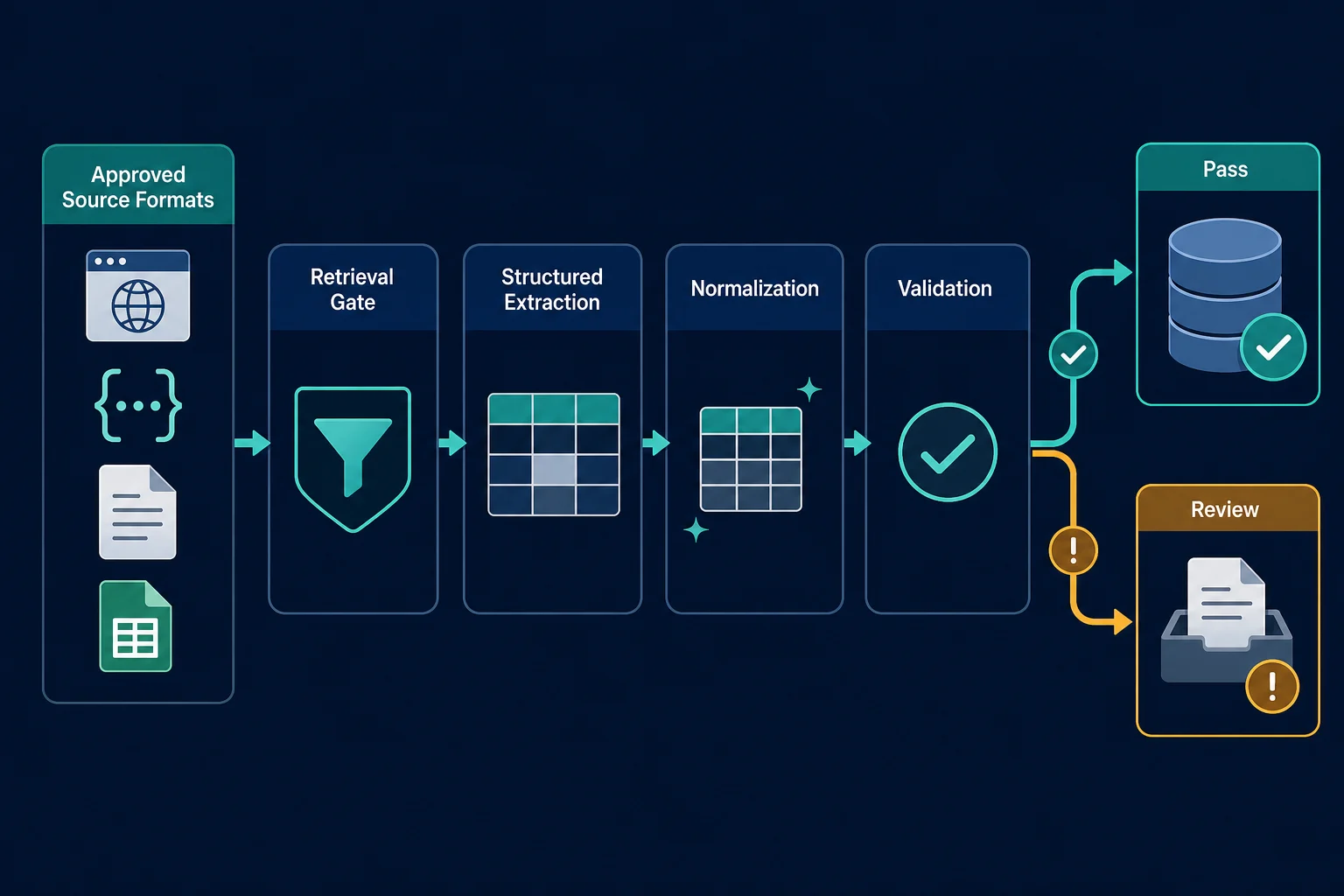
The validation boundary matters most. A request can return 200 OK while delivering a login page, consent screen, empty state, or changed template. If the pipeline treats every successful HTTP response as a valid record, it can silently replace good data with nulls or attach values to the wrong entity.
Choose a Scraping Method That Matches the Source
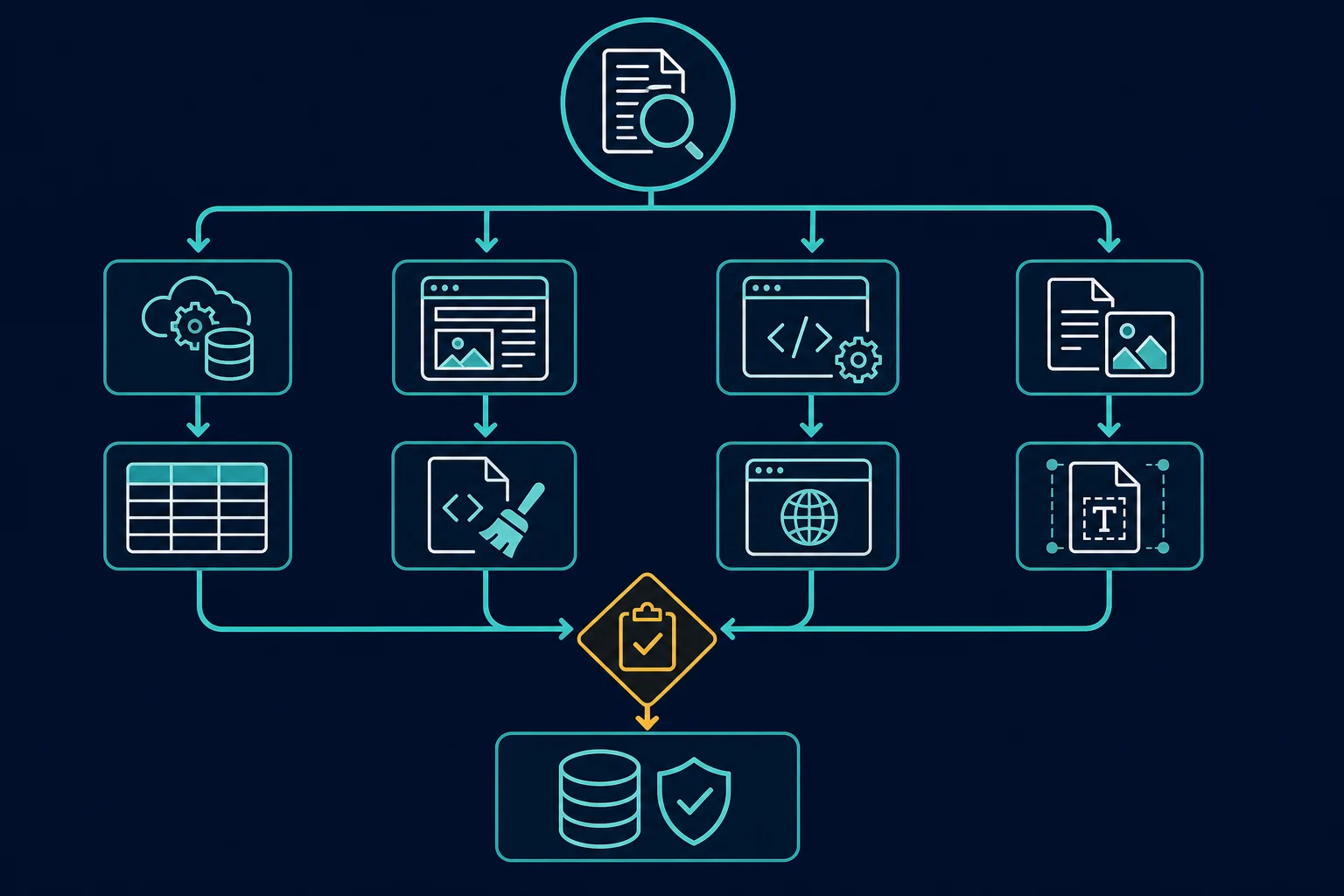
Do not begin with a browser just because the source has a website. First inspect how the required, permitted fields are delivered.
| Source condition | Best starting method | Why | Escalate when |
|---|---|---|---|
| Official API, export, or feed exists | Supported client or scheduled import | Stable schema, identifiers, and access rules | Required fields or freshness are unavailable |
| Required fields are in initial HTML | HTTP client plus HTML parser | Fast, testable, and bandwidth-efficient | JavaScript creates the required data |
| Page exposes valid JSON-LD or embedded JSON | Parse the structured object | Less brittle than layout selectors | Metadata is stale or does not match visible content |
| Required fields appear only after rendering | Browser automation | Executes the permitted client-side flow | An approved structured endpoint can replace it |
| Text is in a digital PDF | PDF text and table extractor | Preserves document structure where possible | The file is scanned or has broken reading order |
| Source is a scan or image | OCR plus human-reviewed validation | Converts pixels into candidate text | Accuracy is too low for the intended decision |
For static HTML, a parser such as Beautiful Soup can query the document tree with CSS selectors; its official documentation explains parsing and search behavior. For larger crawls, Scrapy separates scheduling, downloading, spider logic, and item processing in its documented architecture, which is useful when each stage needs independent limits and monitoring.
Browser automation should be an evidence-based escalation. Confirm that the field is absent from the initial response before accepting the extra CPU, bandwidth, cookie state, and failure modes. The Playwright network documentation shows how browser sessions expose requests and responses; the local Playwright proxy guide covers routing a permitted browser workflow without mixing proxy logic into extraction.
If you are deciding among parsers, crawler frameworks, browsers, managed APIs, and no-code platforms, use the web data scraping tools comparison to narrow the options before building a pilot.
Define the Record Before Writing Selectors
A scraper is easier to test when the output contract exists first. Suppose the goal is to observe product offers. A compact record might be:
{
  "source": "catalog.example",
  "source_product_id": "SKU-4821",
  "name": "Example Desk Lamp",
  "amount": "49.95",
  "currency": "USD",
  "availability": "in_stock",
  "observed_at": "2026-08-27T12:00:00Z",
  "source_url": "https://catalog.example/products/SKU-4821",
  "parser_version": "catalog-example-v2"
}
This schema answers several questions before code exists. Money needs a decimal representation rather than binary floating point. Availability needs a controlled vocabulary. The source product ID identifies the offer more reliably than a mutable title. The observation time and parser version make later corrections auditable.
Define three layers for each field:
- Raw value: the exact permitted source text or machine value used by the parser.
- Normalized value: the canonical representation used by downstream systems.
- Validation rule: the type, range, allowed values, and cross-field checks that decide whether to accept it.
Do not store entire pages, unrestricted text, or extra personal data "just in case." Narrow schemas reduce legal, privacy, security, and quality risk while making changes easier to review.
A Small Static HTML Data Scraping Example
The function below parses a saved, permitted HTML fixture. Keeping extraction separate from live retrieval makes parser tests fast and prevents each test run from sending another request.
from decimal import Decimal, InvalidOperation
from urllib.parse import urljoin

from bs4 import BeautifulSoup


def extract_products(html: str, page_url: str) -> list[dict]:
    soup = BeautifulSoup(html, "html.parser")
    records = []

    for card in soup.select("article.product[data-product-id]"):
        name_node = card.select_one("h2")
        price_node = card.select_one("[data-price][data-currency]")
        link_node = card.select_one("a[href]")

        if not (name_node and price_node and link_node):
            continue

        try:
            amount = Decimal(price_node["data-price"])
        except (InvalidOperation, KeyError):
            continue

        currency = price_node.get("data-currency", "").upper()
        if amount < 0 or len(currency) != 3:
            continue

        records.append(
            {
                "source_product_id": card["data-product-id"],
                "name": name_node.get_text(" ", strip=True),
                "amount": str(amount),
                "currency": currency,
                "source_url": urljoin(page_url, link_node["href"]),
            }
        )

    return records
Production retrieval needs additional controls: explicit timeouts, a truthful client identity, redirect and hostname checks, response-size limits, content-type validation, conservative concurrency, bounded retries, and classified error handling. The Python website scraping guide builds those pieces into a complete request-and-parse workflow.
Test the parser with normal, missing-field, empty, duplicated, and changed-template fixtures. A live canary can separately confirm access and response shape, but most parser tests should run without a network connection.
Data Scraping vs Web Scraping, Crawling, APIs, and Data Mining
These terms describe different parts of a data workflow:
| Term | Primary job | Typical output |
|---|---|---|
| Data scraping | Extract selected fields from a digital source | Structured records |
| Web scraping | Perform data scraping on web resources | Records derived from pages or web responses |
| Web crawling | Discover and retrieve URLs by following a policy | URL frontier, pages, or response archive |
| API integration | Request supported structured data through a defined interface | Schema-defined responses |
| Data mining | Find patterns, relationships, or predictions in existing data | Analysis, segments, rules, or models |
A crawler may discover product pages, a scraper may extract offer observations, and a mining or analytics process may identify pricing trends. One system can include all three, but separating their responsibilities makes scope, failures, and data lineage clearer. The data mining vs web scraping comparison explains where collection ends and analysis begins.
An API is usually preferable when it supplies the necessary data under suitable terms. Using an API is data acquisition rather than page scraping, but it can feed the same normalization, validation, storage, and monitoring stages.
Keep Scraped Data Accurate Over Time
The first successful extraction is only a prototype. Reliable data scraping measures both transport health and record health.
Track at least:
- HTTP status, final URL, media type, bytes, and latency.
- Page or response classification, not just the status code.
- Records discovered, accepted, rejected, duplicated, and changed.
- Missing-field and invalid-value rates by source and parser version.
- Identity conflicts, unexpected categories, and range violations.
- Staleness, last successful observation, and source coverage.
Alert on ratios and changes, not only total failures. If accepted records fall from 500 to 40 while every request still returns 200, the extraction is unhealthy. Quarantine suspicious output and preserve the last known-good dataset instead of publishing a destructive empty update.
Parser maintenance also needs versioned fixtures. When a source changes, add the new response shape as a fixture, update the parser, compare old and new outputs, then deploy a small canary. This makes selector changes reviewable and protects unaffected sources from a global rewrite.
Responsible Collection and Access Boundaries
Public visibility is not blanket permission to collect or reuse data. Before data scraping, review the exact interface, applicable terms, authentication and technical controls, copyright or database rights, privacy obligations, jurisdiction, and intended use. The data scraping legality guide provides a fuller preflight and explains when qualified legal review is needed.
The Robots Exclusion Protocol standardizes how crawlers discover and interpret robots.txt. Treat it as one crawler-policy signal, not as access authorization or a substitute for terms, privacy review, and permission.
Use technical limits that reflect the approved scope:
- Allowlist domains, paths, endpoints, files, and fields.
- Reject unexpected redirects and newly discovered hosts.
- Apply a source-specific request budget, delay, and concurrency ceiling.
- Cache unchanged responses and avoid duplicate retrieval.
- Pause on repeated
401,403,429, CAPTCHA, login, or policy responses. - Remove secrets and unapproved personal data before logging.
- Define retention, correction, deletion, and stop procedures.
Do not route around a login, paywall, block, or revoked access. A more complex scraper or larger proxy pool does not grant permission.
When Proxies Help a Data Scraping Pipeline
Many scraping jobs should begin without a proxy. Direct, low-rate requests are easier to debug, and an approved API or feed may eliminate page retrieval entirely.
Proxies can be appropriate for authorized regional measurement, stable egress, environment separation, or distributing an approved workload that would otherwise concentrate on one route. They do not fix broken selectors, invalid credentials, account-level quotas, excessive retries, or missing authorization.
Choose routing only after identifying the bottleneck. Rotating residential proxies can fit independent, permitted observations that genuinely require location coverage. Sticky residential or ISP routes can fit stateful sessions. Datacenter routes can be the efficient choice for permissive sources. The best proxy for web scraping guide compares those options.
Keep cookies, browser identity, and route stable for a multi-step session. Rotating the IP on every request while reusing the same state creates inconsistency; keeping every worker on one route can concentrate traffic and trigger rate limits.
Data Scraping FAQ
Is data scraping the same as web scraping?
Web scraping is a type of data scraping focused on web pages and responses. Data scraping is broader and can also cover applications, files, PDFs, spreadsheets, and other digital sources.
Is data scraping legal?
It can be, but there is no universal answer. Authorization, access controls, contracts, copyright, privacy, database rights, jurisdiction, source policies, collection behavior, and intended use can all matter. Review the specific project and seek qualified advice where necessary.
Do I need a proxy for data scraping?
Usually not at the start. Build and test the extraction at a conservative rate first. Use a proxy only when an approved workflow has a legitimate routing need, such as regional testing, stable egress, or avoiding accidental concentration from shared infrastructure.
Should I scrape with an HTTP client or a browser?
Use an HTTP client when the required data is present in an approved API response or initial HTML. Use browser automation only when permitted, required fields genuinely depend on rendering or browser state, and a supported structured source is unavailable.
How do I know whether scraped data is correct?
Validate identity, required fields, types, ranges, enumerated values, and cross-field relationships. Track accepted and rejected record rates, compare against versioned fixtures, quarantine anomalies, and retain source provenance for audits.
What is the biggest data scraping mistake?
Writing selectors before defining the purpose, approved sources, schema, and validation rules. That approach can produce a large dataset whose records are ambiguous, inaccurate, excessive, or unusable.
Conclusion
Data scraping is a controlled process for converting permitted source content into structured, validated, and auditable records. Start with one business question, the least complex authorized source, and a precise schema. Separate retrieval from extraction, validate every record before storage, and monitor data quality as carefully as request success.
Once that pipeline works at small scale, choose the lightest collection method and routing setup that meets the actual requirement. Reliable data scraping comes from bounded scope, stable identity, conservative retrieval, explicit validation, and maintained provenance. Sending more requests does not make it more reliable.