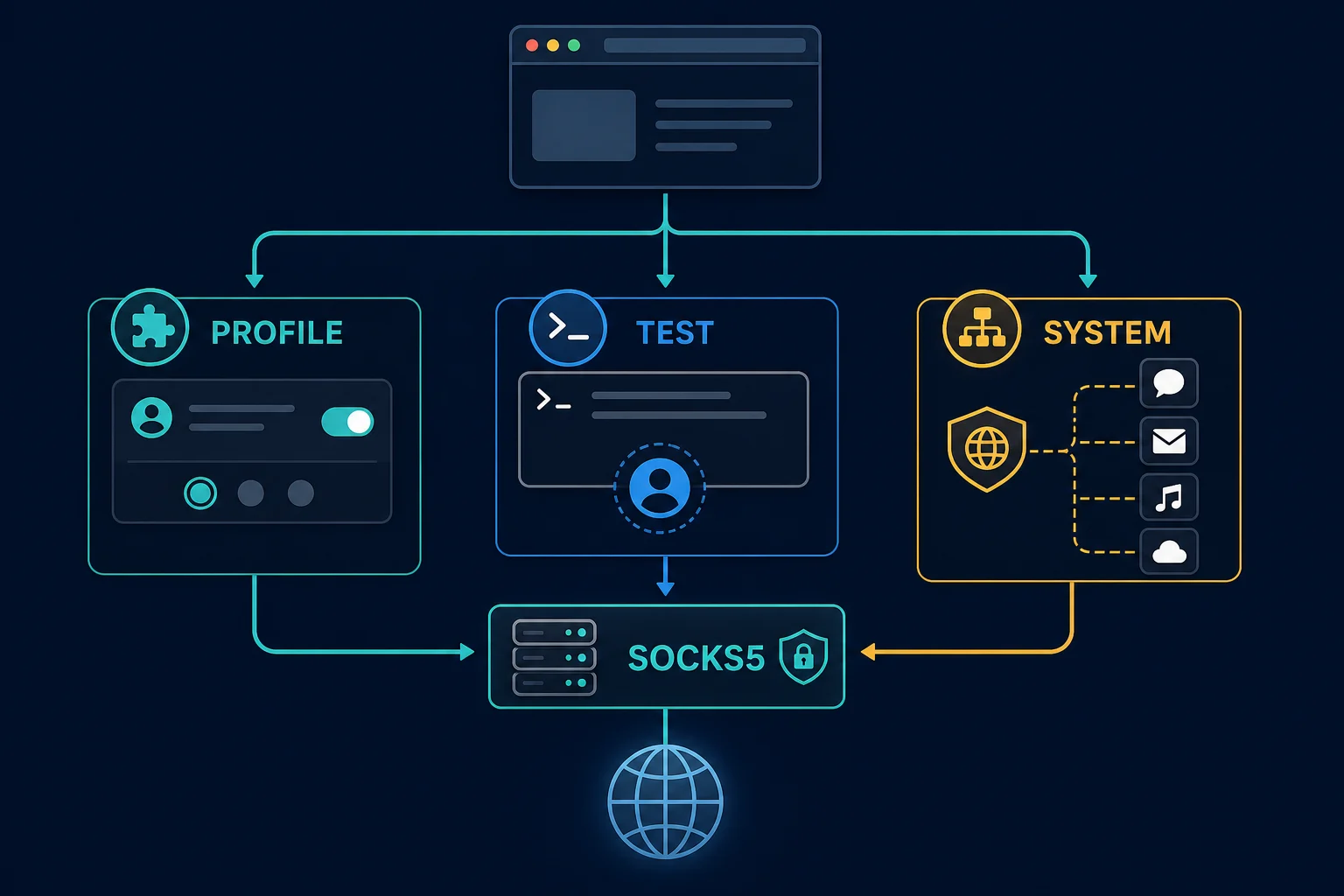
A Chrome SOCKS5 proxy can be set with a proxy extension, a Chrome launch flag, or an operating-system route. Use an extension when only one Chrome profile needs easy on/off switching. Use --proxy-server when you want a clean, reproducible browser test. Use a system or routing-client setup only when Chrome and other applications should share the route.
There is one critical limitation: Chrome can connect to SOCKS5 and resolve destination hostnames through it, but Chrome does not support SOCKS5 username/password authentication. A normal extension that only changes Chrome's proxy setting inherits that limitation. Direct Chrome setup therefore needs an unauthenticated local tunnel, a source-IP-allowlisted endpoint, or another authentication layer outside Chrome.
This guide shows how to choose the right scope, configure each method, verify the exit IP and DNS behavior, and remove the route without disturbing unrelated browser profiles or applications.
Chrome SOCKS5 Proxy: Quick Setup
Choose the method by scope and authentication before entering a host and port:
| Goal | Best method | Important limit |
|---|---|---|
| Switch SOCKS5 on and off in one Chrome profile | Trusted proxy extension | The extension controls the profile's proxy setting and cannot add native SOCKS5 authentication |
| Run a temporary, isolated Chrome test | --proxy-server with a separate user-data directory |
Requires a new Chrome process and a non-password SOCKS5 route |
| Route Chrome and selected desktop apps | Trusted local routing client | More traffic and credentials are entrusted to the client |
| Route compatible apps through an OS SOCKS setting | macOS or a Linux desktop with a SOCKS field | Scope varies by app; Windows' manual proxy page is not a SOCKS5 setting |
| Use a username/password proxy directly in Chrome | Prefer the provider's HTTP(S) endpoint | Chrome supports HTTP proxy authentication, not SOCKS5 authentication |
If your provider gives you both HTTP and SOCKS endpoints and your only goal is browsing websites, HTTP(S) is usually the simpler Chrome choice. Read SOCKS5 vs HTTP proxy before adding a local forwarding layer only to preserve the SOCKS label.
How Chrome Handles SOCKS5
Chrome does not provide a normal in-browser form where you can enter a SOCKS5 host, port, username, and password. The Open your computer's proxy settings control delegates configuration to the operating system. Extensions, enterprise policy, PAC scripts, and launch arguments can also determine the effective proxy.
Chromium's official proxy support documentation defines socks5://host:port as a supported proxy identifier. In Chrome, SOCKS5 has three behaviors that matter here:
- Destination hostname resolution is sent to the proxy. Chrome has no separate
socks5h://switch. - The route covers TCP-based URL requests, not arbitrary UDP traffic.
- No SOCKS5 authentication methods are supported.
The last point is easy to miss. A URL such as this is not a working way to give Chrome SOCKS5 credentials:
socks5://username:[email protected]:1080
Chrome does not use credentials embedded in manual proxy settings. A provider username can also contain location or session controls, so dropping the username is not a harmless workaround—it changes or breaks the requested route.
Before setup, collect the actual protocol, host, SOCKS5 port, authentication method, and expected exit location. Do not infer the protocol from host:port:user:pass; that is only a field layout. The proxy converter can rearrange fields, but it cannot turn an HTTP endpoint into SOCKS5 or make Chrome support a missing authentication method.
Method 1: Use a Chrome SOCKS5 Proxy Extension
A proxy extension is convenient when a single Chrome profile needs a small set of named routes. It can set Chrome to a fixed SOCKS5 server, apply bypass rules, and switch back to direct or system mode without changing the rest of the computer.
Chrome's official chrome.proxy API documentation confirms that an extension needs the proxy permission to control these settings. Treat that as meaningful access: the extension can change where the profile sends supported network requests.
Choose an Extension Carefully
Use an extension only when you can identify its publisher and understand its permissions. Check:
- Whether it explicitly supports SOCKS5 rather than only HTTP proxy lists.
- Whether it is maintained and has a clear privacy policy.
- Whether it requests permissions beyond proxy control and authentication handling.
- Whether configuration is stored locally, synced, or sent to a vendor service.
- Whether it depends on a companion desktop application.
- Whether it makes clear that one effective proxy configuration applies to the Chrome profile.
Avoid unknown extensions bundled with free public proxy lists. A proxy already occupies a sensitive network position; adding an untrusted extension increases the number of parties that can influence the route. Continue using HTTPS because SOCKS5 itself is a relay protocol, not content encryption.
Configure the Extension
The labels vary, but the safe sequence is:
- Create a new proxy profile in the extension.
- Select SOCKS5 explicitly.
- Enter the hostname without
socks5://when host and scheme use separate fields. - Enter the assigned SOCKS5 port.
- Add only deliberate bypass rules, such as a local development hostname.
- Apply the profile to the regular Chrome profile.
- Open a new tab and verify the public IP before visiting the target site.
Do not enter a SOCKS5 endpoint in an HTTP field. The two protocols start connections differently, so a mismatch commonly produces ERR_PROXY_CONNECTION_FAILED, a reset, or a timeout.
Incognito windows require separate attention. Extensions are disabled there unless you allow them, and proxy behavior can differ with extension scope or policy. Test regular and Incognito windows independently rather than assuming they share the same verified route.
Understand the Authentication Limit
Some proxy extensions also use Chrome's web request authentication events to supply HTTP proxy credentials. That does not change Chromium's explicit lack of SOCKS5 authentication support.
If an extension claims to support authenticated SOCKS5, determine how it does so. It may use a companion application, connect to its own gateway, translate an authenticated upstream proxy into an unauthenticated local port, or require source-IP allowlisting. Those are separate network components, not a hidden capability of the standard Chrome proxy setting.
Test the exact design with non-sensitive credentials and an IP-check endpoint. Do not assume that a saved username proves it was used on the SOCKS5 handshake.
Method 2: Launch Chrome With --proxy-server
The launch flag is the clearest Chrome-only method for an unauthenticated SOCKS5 endpoint, local SSH dynamic tunnel, or source-IP-allowlisted gateway. Use a separate user-data directory so an existing Chrome process does not absorb the request and continue with its old settings.
On Windows, close the test profile and launch:
"C:\Program Files\Google\Chrome\Application\chrome.exe" ^
  --user-data-dir="%TEMP%\chrome-socks5-test" ^
  --proxy-server="socks5://proxy.example.com:1080"
On macOS:
open -na "Google Chrome" --args \
  --user-data-dir=/tmp/chrome-socks5-test \
  --proxy-server="socks5://proxy.example.com:1080"
On Linux, the executable may be google-chrome, google-chrome-stable, or chromium:
google-chrome \
  --user-data-dir=/tmp/chrome-socks5-test \
  --proxy-server="socks5://proxy.example.com:1080"
The temporary profile isolates cookies, extensions, cache, and proxy state from normal browsing. It does not make an untrusted proxy safe, and the launch flag is not a system-wide route.
Do not put a real password in the command. Chrome will not use it for SOCKS5 authentication, and the secret may remain in shell history or the operating system's process list. When the test is complete, close that Chrome process and relaunch normally without the flag. Delete the temporary profile only after confirming it contains nothing you need.
For Puppeteer or another automation framework, set the proxy where the framework launches Chrome instead of manually maintaining a desktop shortcut. The Puppeteer proxy launch guide covers launch arguments, authentication, and browser isolation for automated work.
Method 3: Use System Proxy Settings or a Routing Client
System scope is appropriate when more than one compatible application should follow the same route. It is also the least isolated option: changing the OS proxy can affect browsers, updaters, terminals, and other applications that honor that setting.
The available path depends on the operating system.
Windows
Do not put a SOCKS5 endpoint under Settings > Network & internet > Proxy. Windows' manual web proxy and WinHTTP settings are not a native system-wide SOCKS5 route. Microsoft's netsh winhttp documentation also states that SOCKS5 is not supported for the advanced proxy setting.
Use the launch flag for narrow Chrome testing. Use a reputable local routing client when several Windows applications need SOCKS5 or when a client must authenticate to the upstream endpoint. The Windows 11 SOCKS5 proxy guide covers both paths, including proxy-side DNS and per-app routing.
macOS
Apple exposes a SOCKS proxy option under System Settings > Network > [network service] > Details > Proxies. Apple's Mac proxy settings guide documents the host, port, bypass list, and password controls.
Enable the setting only on the network service you intend to change, then test Chrome and every other affected app. Chrome still owns its SOCKS5 connection behavior, so do not assume that a password saved in macOS overcomes Chrome's authentication limitation. Use a local authenticated forwarder or the provider's HTTP endpoint when the direct Chrome path fails.
Linux
Linux does not have one universal desktop proxy interface. GNOME's network proxy guide includes a manual SOCKS host and port, while other desktop environments and distributions use different settings. Chrome can inherit supported system settings, but applications do not all honor desktop proxy configuration consistently.
For a reproducible Chrome-only test, prefer the launch flag. For broader routing, use a maintained client with explicit app, DNS, IPv4, and IPv6 rules, then verify each application.
Authenticated Upstream SOCKS5
When the upstream SOCKS5 endpoint requires a username and password, place the authentication in software that actually supports it. A trusted local forwarder or routing client can authenticate upstream and expose a local unauthenticated SOCKS5 listener such as 127.0.0.1:1080 to Chrome.
That design adds a component with access to credentials and traffic metadata. Bind the local listener only to loopback, restrict local access, review its DNS behavior, and stop it when it is not needed. Do not expose an unauthenticated forwarding port to the local network.
Verify the Chrome SOCKS5 Proxy
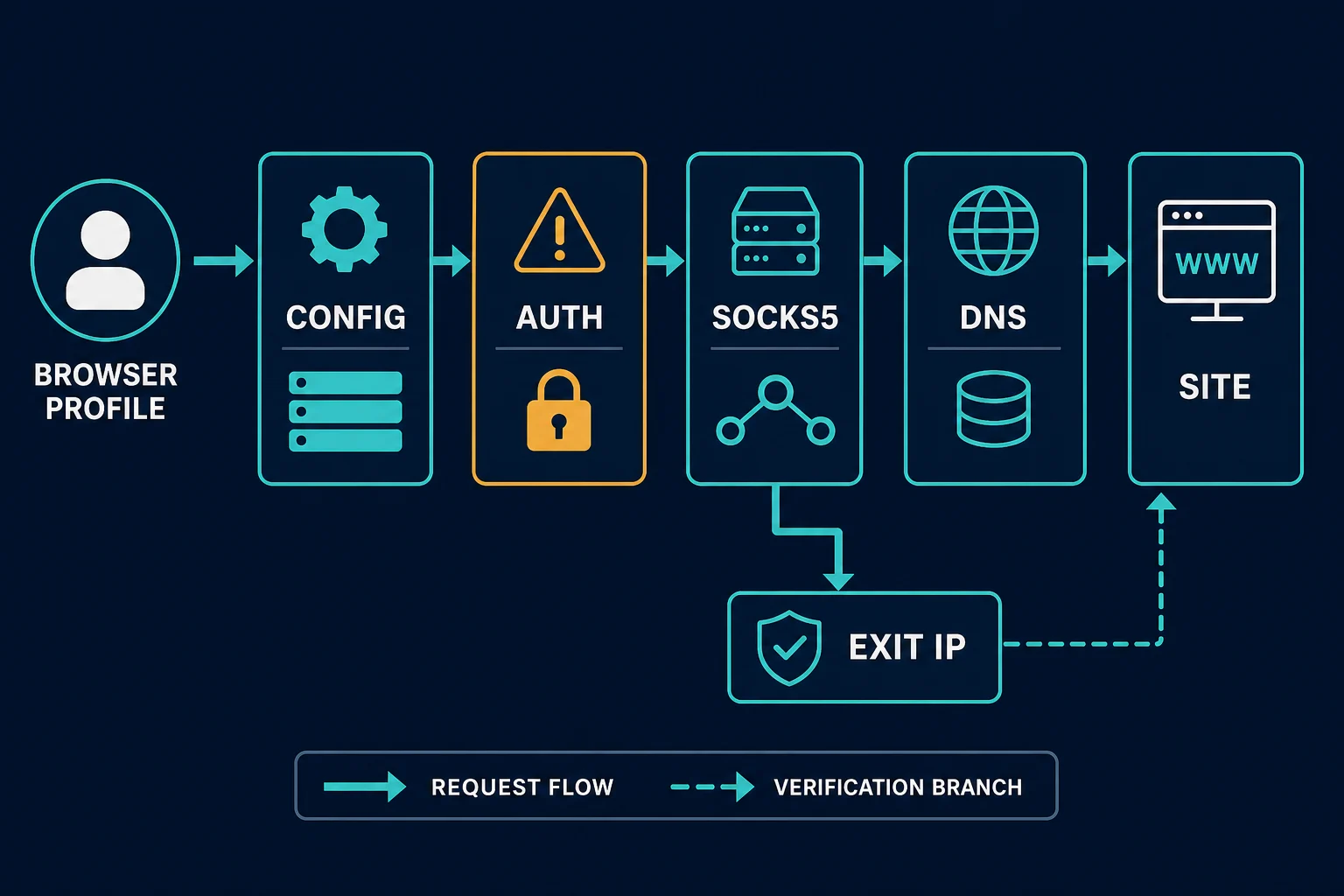
Verification should prove scope, routing, and cleanup—not just that one page loaded.
- Before enabling the proxy, note the normal public IP.
- Enable exactly one proxy method.
- Visit
https://ipv4.unknownproxies.com/ipin the affected Chrome profile. - Confirm the address matches the expected proxy exit.
- Open a second HTTPS site and confirm its certificate is valid.
- Test a hostname that was not already cached.
- Check another Chrome profile or app that should remain direct.
- Disable the extension, close the flagged process, or disconnect the routing client.
- Repeat the IP check and confirm the intended normal route returns.
An exit-IP change proves that the tested request used the proxy. It does not prove that every application, UDP flow, extension request, or alternate network path followed it.
Chrome sends destination hostname resolution through a configured SOCKS5 proxy, but a system routing client can introduce its own DNS rules. If the IP changes while hostnames fail, inspect the local client's proxy-DNS setting and logs before replacing the endpoint.
Troubleshoot Chrome SOCKS5 Proxy Errors
Change one layer at a time:
| Symptom | Likely cause | First check |
|---|---|---|
ERR_PROXY_CONNECTION_FAILED |
Wrong host or port, offline proxy, protocol mismatch | Recopy the SOCKS5 endpoint and test whether the port is reachable |
| Extension says connected but IP is unchanged | Wrong active profile, bypass rule, policy conflict, or direct fallback | Disable other proxy extensions and inspect the effective profile |
| Repeated credential prompt or immediate failure | Endpoint requires SOCKS5 authentication | Use IP allowlisting, a local authenticated forwarder, or an HTTP endpoint |
ERR_SOCKS_CONNECTION_FAILED |
SOCKS handshake or destination connection failed | Confirm the endpoint is SOCKS5 and test a neutral HTTPS destination |
| Hostnames fail while IP literals work | DNS handling in a local routing layer | Enable proxy-side DNS in that client and reconnect |
| Flag appears to do nothing | Chrome reused an already-running profile | Close it and relaunch with a unique --user-data-dir |
| Chrome works but other apps stay direct | Browser-only extension or launch scope | Use deliberate system or per-app routing if broader coverage is required |
| Neutral sites work but one target returns 403 or 429 | Destination policy, permissions, reputation, or request rate | Stop changing proxy fields and debug the HTTP response |
Check for Configuration Conflicts
Only one effective Chrome proxy configuration wins. A system proxy, PAC script, enterprise policy, extension, VPN, launch flag, and local routing client can overlap.
For a controlled test, disable unrelated proxy extensions, disconnect other VPNs, use a fresh test profile, and enable one route. On a managed browser, open chrome://policy and check whether an administrator controls proxy settings. Add other layers back one at a time.
Do not reset all browser or operating-system networking as a first step. That removes useful evidence and can disrupt managed configuration, saved networks, and unrelated applications.
Separate a Proxy Failure From a Website Block
If the IP endpoint and a neutral HTTPS site both load through the expected exit, the Chrome SOCKS5 proxy is probably configured. A target-specific 403 or 429 is an HTTP response from the destination, not proof of a broken SOCKS handshake.
Respect the destination's terms, access controls, and rate limits. Proxies are suitable for permitted regional QA, account isolation, monitoring, and automation; they are not a reason to override a site's decision to deny access. The 407 Proxy Authentication Required guide covers HTTP proxy authentication errors, which are different from Chrome's unsupported SOCKS5 authentication handshake.
Choose the Right Proxy and Session
Match the proxy identity to the browser task:
- A stable ISP proxy plan can fit repeated QA or account sessions that should retain one exit IP.
- A sticky residential proxy can fit permitted regional checks that need continuity for a bounded session.
- A rotating session fits independent public-page requests where cookies and account state do not need to persist.
Keep a stateful Chrome profile, cookies, region, and proxy session together. Changing exit IPs mid-session can look inconsistent and cause logouts or additional verification. The sticky vs rotating proxies guide explains the session tradeoff.
Unknown Proxies residential and ISP plans support SOCKS connections, but Chrome's authentication support should decide the connection method. Use an HTTP(S) endpoint when direct browser authentication is required, or use a compatible local routing layer when SOCKS5 is a genuine workflow requirement.
FAQ
Does Chrome Support SOCKS5 Proxies?
Yes. Chrome supports socks5://host:port, sends destination hostname resolution through the SOCKS5 proxy, and uses it for TCP-based URL requests. It does not support SOCKS5 authentication methods or arbitrary UDP relay.
Can a Chrome Extension Use a Username and Password With SOCKS5?
Not through Chrome's standard SOCKS5 connection. An extension may save credentials for HTTP proxy authentication or use a separate companion service, local forwarder, gateway, or IP allowlist. Verify which mechanism it uses before trusting the setup.
Is a SOCKS5 Proxy Extension Better Than System Settings?
Use an extension for one Chrome profile and convenient switching. Use system or per-app routing when multiple applications need the route. The better option is the narrowest scope that meets the task and supports the endpoint's authentication.
Does Chrome Use Remote DNS With SOCKS5?
Yes. Chromium documents that Chrome always resolves destination hostnames through a configured SOCKS5 proxy. A separate local routing client may add its own DNS behavior, so verify that layer too.
Can I Configure SOCKS5 in chrome://settings?
Chrome's system settings link opens the operating system's proxy controls; it is not a full Chrome SOCKS5 form. An extension, launch flag, policy, PAC configuration, or OS-level route supplies the actual setting.
How Do I Turn Off a Chrome SOCKS5 Proxy?
Switch the extension to Direct or System, close the Chrome process launched with --proxy-server, or disable the OS/routing-client setting you enabled. Then relaunch Chrome and confirm that the expected normal public IP returns.
Final Thoughts
A Chrome SOCKS5 proxy works reliably when the configuration method matches its scope and authentication. Choose a trusted extension for one-profile switching, a launch flag for an isolated test, or a system/routing client when several applications need the same path.
Do not bury Chrome's lack of SOCKS5 username/password support under repeated credential retries. Verify the endpoint, use a compatible authentication layer, confirm the exit IP and DNS behavior, and remove the route cleanly when the task is complete.