eBay scraping is the process of collecting structured marketplace data such as listing titles, prices, seller details, item condition, shipping signals, and availability. A reliable workflow starts with permission, the least complex data source, a narrow URL scope, and validation that proves every record still belongs to the intended listing.
For most teams, the hard part is not fetching one page. It is keeping marketplace scraping accurate while listings expire, sellers revise offers, item variations change, and search results shift by location or account state. Treat eBay scraping as a controlled data pipeline, not as an open crawler.
This guide focuses on legitimate public-page or approved API collection for research, catalog matching, price monitoring, and marketplace analysis. Review eBay's terms, the current eBay robots.txt, and applicable law before collecting data. Use official APIs or licensed data sources when they provide the access and rights your project needs.
eBay Scraping Workflow for Marketplace Data
Build the workflow around listing identity and data quality. A practical eBay scraping pipeline separates source choice, discovery, fetching, extraction, and validation so a parser bug does not become bad business data.
- Define the exact marketplace, category, listing types, and fields you need.
- Check whether an official API, partner feed, seller export, or licensed source covers the use case.
- Create a bounded queue from approved search URLs, listing IDs, seller pages, or catalog mappings.
- Normalize URLs and reject anything outside the approved hosts and paths.
- Apply policy checks, pacing, and cache rules before each request.
- Fetch the page or API response with a timeout and clear user agent.
- Classify the response as listing, search result, unavailable, ended, sign-in, challenge, rate limit, or error.
- Extract fields into a versioned schema.
- Validate listing identity, price, currency, condition, seller, and availability before storage.
- Schedule the next check based on how often the listing or category changes.
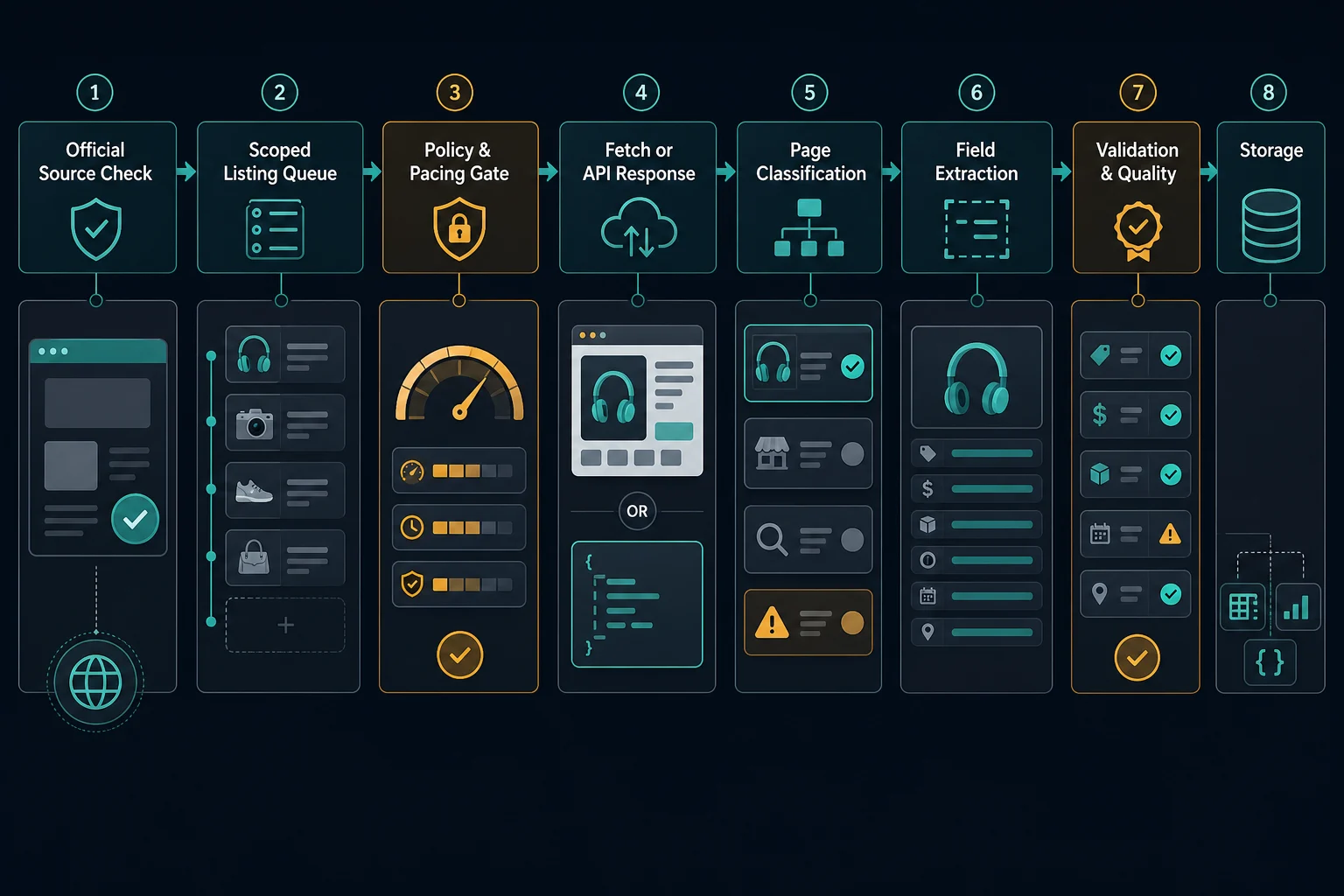
Keep raw responses or structured fixtures only when your policy allows it, and redact cookies, tokens, account data, and personal data. Fixtures are useful because eBay pages can vary by category, condition, seller, marketplace, shipping option, and item state.
Start With APIs Before HTML Scraping
The lowest-risk source is the one that explicitly supports your data need. If your use case can be handled through an approved eBay API, seller export, partner feed, or licensed vendor, evaluate that path before maintaining an HTML scraper.
APIs will not fit every marketplace scraping project. They may have eligibility rules, quotas, field limits, marketplace differences, or missing historical data. Still, you should evaluate them before maintaining an HTML scraper because APIs usually provide more stable identifiers and clearer usage boundaries.
Use this source decision table before writing selectors:
| Source | Best fit | Main tradeoff |
|---|---|---|
| eBay API | Approved item search or listing-detail access | Eligibility, quotas, field coverage, and marketplace support |
| Your own seller export | Monitoring your own listings, inventory, and orders | Limited to data your account can access |
| Licensed feed or vendor data | Commercial marketplace intelligence | Cost, contract limits, and freshness |
| Public listing HTML | Small, permitted research or monitoring scopes | Layout changes, policy review, and page-state handling |
| Browser-rendered page | Permitted fields that require rendering | Higher bandwidth, session complexity, and more failure modes |
The Robots Exclusion Protocol explains how crawlers discover and interpret robots.txt, but robots directives are only one input. Permission, terms, privacy review, and legal requirements still matter.
Define the Listing Schema Before Fetching Pages
Marketplace data gets messy when the schema is vague. An eBay listing can include auctions, buy-it-now prices, offers, seller ratings, variations, item condition, shipping charges, local pickup, promoted placements, and ended or unavailable states.
Define one record type before scraping:
{
  "marketplace": "EBAY_US",
  "listing_id": "example-listing-id",
  "canonical_url": "https://www.ebay.com/itm/example-listing-id",
  "title": "Example item title",
  "seller": "example-seller",
  "condition": "used",
  "format": "buy_it_now",
  "price": {
    "amount": "49.99",
    "currency": "USD",
    "type": "current_offer"
  },
  "shipping_amount": "5.99",
  "availability": "available",
  "observed_at": "2026-07-10T12:00:00Z",
  "parser_version": "ebay-listing-v1"
}
Use listing ID plus marketplace as the primary identity. Do not use the title as a key. Titles can change, and search URLs can contain tracking, sort, filter, and campaign parameters that do not identify a unique item.
Keep raw display text separate from normalized values. Store "$49.99" if it helps audits, but parse the amount and currency into explicit fields. Shipping and taxes should be separate unless your monitoring rule intentionally compares total landed cost.
Scope eBay Search and Listing URLs
Open-ended marketplace crawling creates duplicates, noisy data, and policy risk. Start from a bounded list: approved categories, search terms, listing IDs, seller IDs, or internal product mappings.
For search-result collection, store the exact query assumptions:
- Marketplace, such as
EBAY_USorEBAY_GB. - Category and keyword scope.
- Sort order and filters.
- Item condition, buying format, and price range when relevant.
- Region, language, and shipping destination assumptions.
- Maximum page depth and refresh interval.
For listing-detail collection, canonicalize before enqueueing:
- Normalize the hostname for the intended eBay marketplace.
- Extract the listing ID from the URL.
- Remove tracking, affiliate, campaign, and session parameters.
- Reject redirects that leave the approved marketplace or change item identity.
- Deduplicate by marketplace plus listing ID.
- Record where the URL came from: search, seller page, API result, or internal mapping.
If your goal is product price tracking rather than general marketplace research, read the price monitoring pipeline guide before scaling. It covers observation history, validation gates, and alert deduplication after collection.
Use HTTP First, Browser Rendering Only When Needed
Begin with the simplest permitted source that returns the required data. If an API response or initial HTML contains the fields you need, a browser adds cost and failure modes without improving accuracy.
Use browser automation only when a permitted field genuinely appears after rendering or when the page workflow requires browser state. Browser sessions load scripts, images, storage, cookies, and subresources, so they consume more bandwidth and make proxy/session alignment more important.
| Observation | Better starting point |
|---|---|
| API exposes the needed listing fields | API client |
| Initial HTML includes the required public fields | HTTP client |
| Required permitted fields appear only after rendering | Browser context |
| Page is sign-in, challenge, or access denial | Stop and diagnose scope or policy |
| Search result changes by region | API marketplace parameter or region-aligned route |
For browser work, the Playwright proxy setup guide covers context isolation and proxy assignment. For a lighter HTTP client workflow, the Python proxy requests guide covers proxy URL formats, authentication, timeouts, and quick route checks.
Validate eBay Marketplace Scraping Results
Extraction success is not data success. A page can return HTTP 200 while showing an ended item, unavailable listing, sign-in wall, consent screen, challenge, or search page instead of the target listing.
Validate every accepted record:
- The listing ID matches the queued listing ID.
- The marketplace and currency match the intended market.
- The title is present and within reasonable length bounds.
- The selected seller and item condition are captured when they matter.
- The price type is known: buy-it-now, current auction bid, accepted offer, coupon, or unavailable.
- Shipping is either parsed, explicitly out of scope, or marked unknown.
- Availability distinguishes active, ended, sold, out of stock, and removed.
- The response is not a sign-in, challenge, consent, blocked, or error page.
- Parser version and observation time are recorded.
For search-result scraping, validate rank and page position separately from listing detail. A sponsored result, duplicate card, promoted listing, or related item can be real, but it may not belong in the same dataset as organic search position.
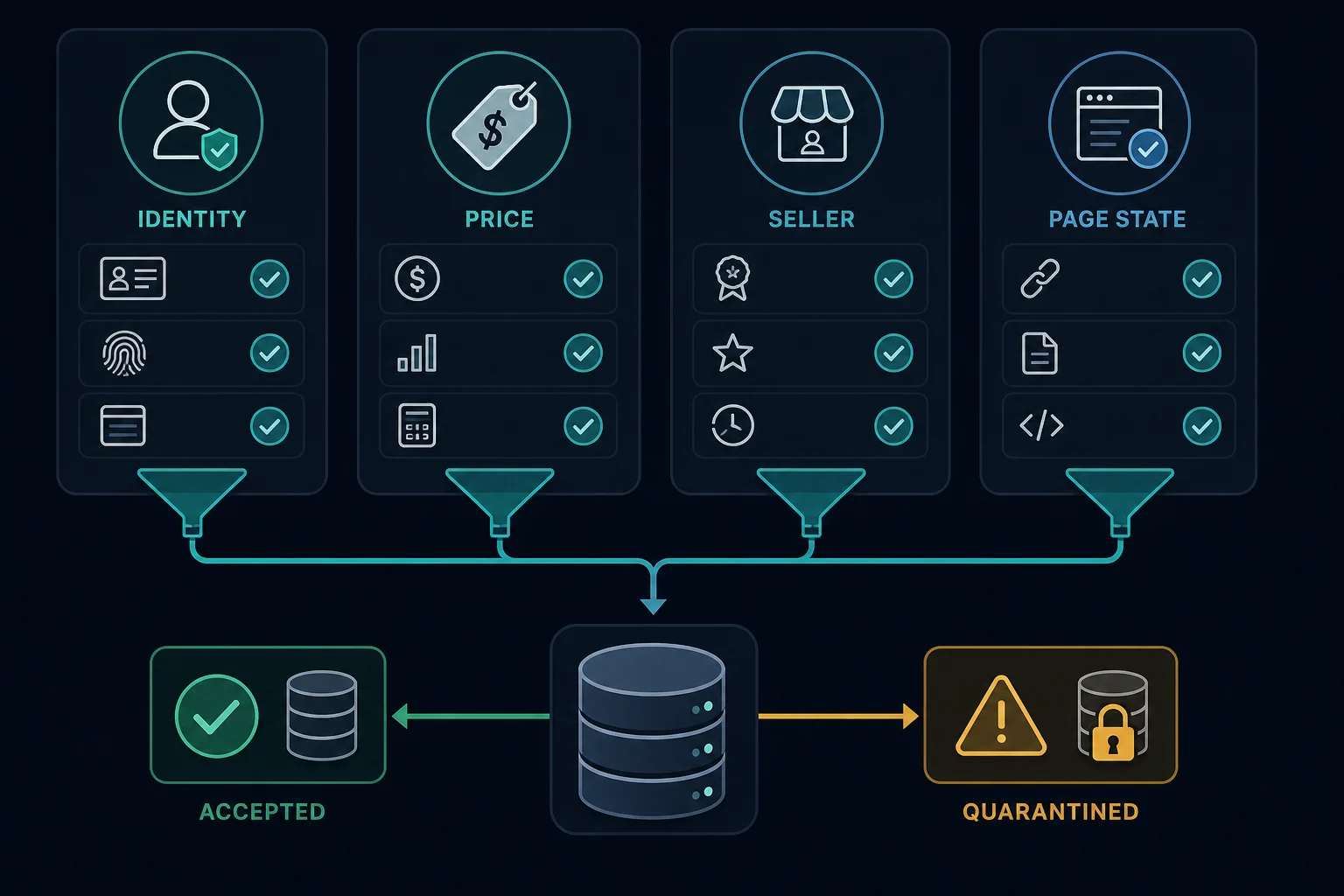
Track invalid records instead of dropping them silently. A sudden increase in ended items, missing prices, unknown currencies, or wrong-page classifications usually means your source, parser, or schedule needs review.
Handle Rate Limits, Blocks, and Retries Carefully
Classify failures before retrying. A retry loop that treats every error as temporary can create more traffic and worse data.
| Result | Likely meaning | Action |
|---|---|---|
| 403 | Access, policy, authentication, or WAF denial | Stop automatic retries and review scope, request behavior, and permissions |
| 429 | Request rate is too high | Honor cooldowns, reduce concurrency, and add jitter |
| 5xx | Target or upstream instability | Retry a small number of times with exponential backoff |
| Timeout | Network, proxy, browser, or target delay | Retry once after logging the failing layer |
| 200 with wrong page | Challenge, sign-in, consent, ended item, or parser mismatch | Classify and quarantine the observation |
The HTTP reference for 429 Too Many Requests notes that servers may include Retry-After. Treat that value as a minimum wait, then restart gradually instead of sending all workers back at once. The local HTTP 429 guide covers backoff and pacing in more detail, while the HTTP 403 guide helps separate access denial from rate pressure.
For recurring monitoring, calculate load before increasing task count. The delay calculator can turn task count, proxy count, and delay into a practical pacing model, but site-specific rules and permissions still control the final schedule.
When Proxies Fit eBay Scraping
Proxies are routing infrastructure. They do not grant permission, override eBay policies, repair selectors, or make excessive request rates acceptable. They can help legitimate eBay scraping when routing affects the measurement or when workers need stable outbound paths.
Useful proxy fits include:
- Localized marketplace checks where price, shipping, availability, or search order differs by region.
- Independent public listing checks that need route diversity and conservative pacing.
- Browser sessions where one cookie jar, locale, and route should stay aligned.
- Cloud-hosted workers that need consistent outbound IP assignment.
- QA checks that compare how public pages render from different markets.
Choose the proxy mode based on the workflow:
| Workflow | Proxy pattern |
|---|---|
| Independent listing-detail checks | Rotating residential sessions between tasks |
| Search page to listing-detail path | Sticky residential session for the whole path |
| Repeated monitoring of a small listing set | ISP or sticky session with strong pacing |
| Browser-rendered page | One stable route per browser context |
| Same denial from every route | Stop and review policy, page state, and scraper behavior |
The best proxy for web scraping guide compares residential, ISP, and datacenter fit by target strictness and workflow shape. If you need country, state, or city routing for marketplace scraping, residential proxies are the natural starting point. For session behavior, compare sticky vs rotating proxies before assigning workers.
Monitor Data Quality, Not Just HTTP Status
An eBay scraper can look healthy at the transport layer while returning poor data. Track the request and the accepted observation separately.
Useful metrics include:
- Fetch count by status code and classified page type.
- Accepted, quarantined, and rejected records.
- Missing field rates by marketplace, category, and parser version.
- Price, shipping, and currency parsing failures.
- Ended, sold, unavailable, and removed listing rates.
- Duplicate listing IDs and canonicalization failures.
- 403 and 429 rates by worker, route, and schedule.
- Median and high-percentile latency.
- Bandwidth used per accepted record.
Set alerts on data-quality changes, not only scraper crashes. If accepted records drop from 96% to 62%, that matters even when the job exits successfully.
For broader marketplace and retail tracking, the competitor price scraping guide covers comparable offer definitions and review loops. The Amazon ecommerce scraping guide is useful when you need the same pipeline pattern for another large marketplace with different identifiers and page states.
eBay Scraping FAQ
Is eBay scraping allowed?
It depends on the data, source, access method, permissions, terms, and jurisdiction. Review eBay's current rules, robots.txt, and applicable law before collecting data. Use official APIs, licensed feeds, or approved exports when they fit.
What data can be collected from eBay listings?
A scoped workflow may need listing title, listing ID, seller, item condition, price, currency, shipping, availability, buying format, category, and observation time. Collect only the fields required for the project, and validate each field before storage.
Should eBay web scraping use an API or HTML?
Start with an official API or licensed data source when it covers the use case. Use HTML only for a narrow, permitted scope where API coverage is not enough and you can handle page-state changes responsibly.
Do I need a browser for scraping eBay?
Not by default. Use a browser only when the required permitted field depends on rendering or browser state. If the API or initial HTML contains the needed data, an HTTP client is easier to operate and audit.
Are residential proxies useful for marketplace scraping?
They can be useful for legitimate regional checks, route diversity, and independent public-page tasks. They do not fix forbidden access, poor pacing, bad selectors, ignored robots guidance, or collection outside your approved scope.
Conclusion
eBay scraping works best when marketplace scraping is scoped, permission-aware, and measured as a data pipeline. Start with APIs or approved sources, restrict the URL queue, classify page states, validate listing identity and price fields, pace requests conservatively, and use proxies only when routing changes a legitimate measurement.
If you already have a permitted listing set, the next step is to build a small test run, measure accepted-record quality, and fix validation failures before increasing volume.