An ecommerce scraping tool should turn product pages, APIs, or feeds into validated product data without wasting requests or hiding bad records. The right choice depends on the data source, field requirements, page rendering needs, schedule, and how much operational control your team needs.
Start with the least complex source that gives you the rights and fields you need. Use an official API, licensed feed, or merchant export when it fits. If public-page collection is permitted, choose a tool stack that scopes URLs tightly, fetches at a conservative rate, extracts into a defined schema, and rejects unclear page states before the data reaches reports.
This guide focuses on choosing and operating one ecommerce scraping tool for product data collection. For an Amazon-specific workflow, use the ecommerce scraping guide. For recurring price alerts, use the price monitoring pipeline guide.
Ecommerce Scraping Tool: Quick Decision
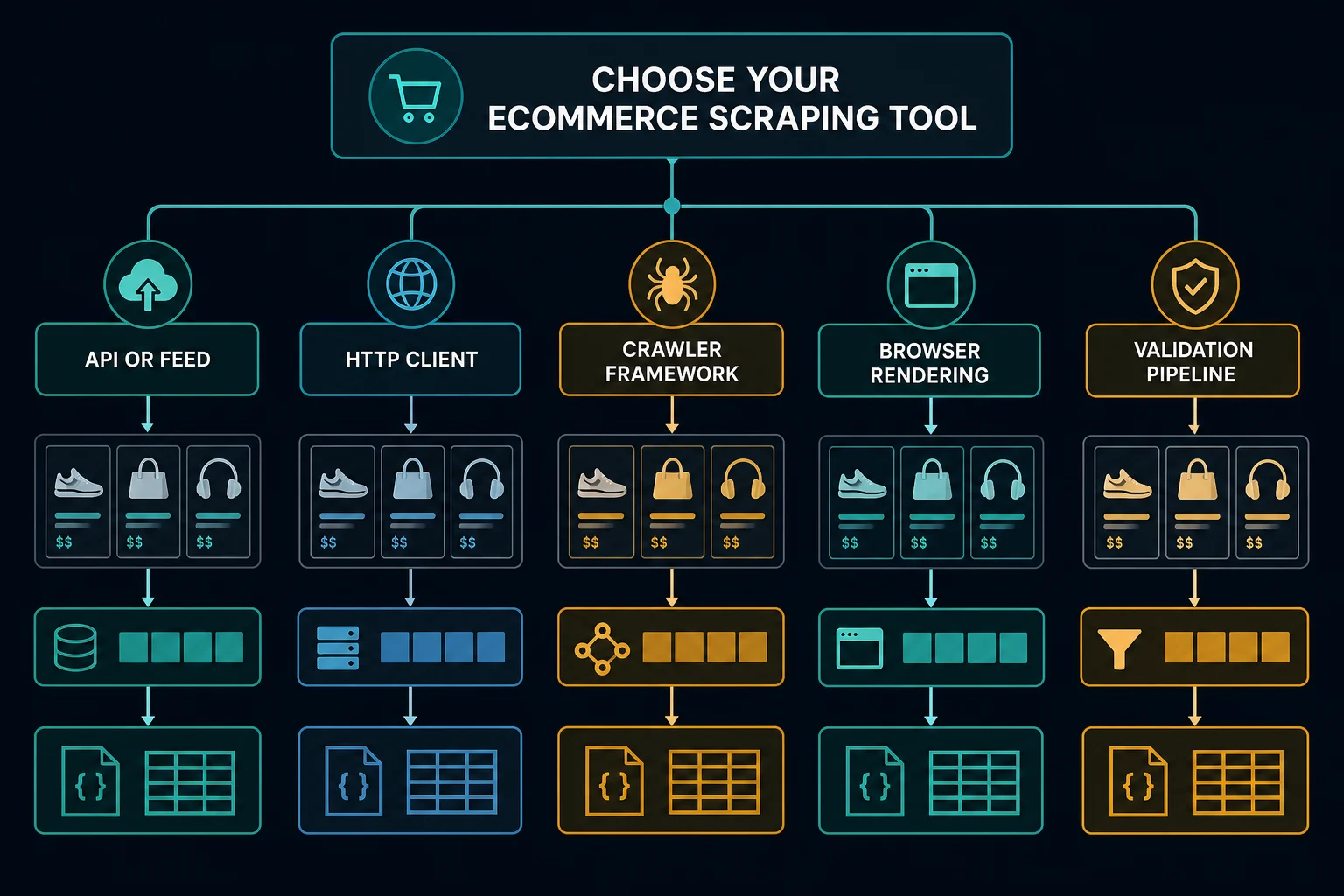
Choose the tool from the required page behavior, not from what looks most powerful.
| Requirement | Better starting point | Why |
|---|---|---|
| Authorized structured data is available | Official API, licensed feed, or merchant export | Stable fields, clearer access rules, less parser maintenance |
| Product fields are in initial HTML | HTTP client or crawler framework | Lower cost, easier retries, simpler fixtures |
| Fields require permitted JavaScript rendering | Playwright, Puppeteer, or another browser runner | Browser state and rendering are part of the measurement |
| Thousands of recurring URLs need scheduling | Crawler plus queue, cache, and validation layer | The scheduler matters as much as extraction |
| Multiple sources have different layouts | Source-specific adapters | One universal selector usually creates weak data |
| Regional availability or pricing must be measured | Tool with locale, proxy, and session controls | Route, cookies, language, and market must stay consistent |
Do not default to a browser just because one page is difficult. Browser automation is valuable when rendering is necessary, but it also adds CPU load, bandwidth, cookies, storage, subrequests, and more session failure modes.
Start With Source Rights and Data Scope
Before comparing tools, define the allowed source and the exact fields.
Answer these questions first:
- Which domains, marketplaces, countries, and page types are in scope?
- Is there an official API, feed, partner export, or internal seller export?
- Which fields are required: title, SKU, GTIN, price, seller, availability, reviews, images, variants, or shipping?
- Is the data personal, restricted, logged-in, or contract-controlled?
- How often does the data need to be refreshed?
- What should happen when a page returns a consent page, login page, challenge, 403, 429, or wrong product?
Check site terms, applicable contracts, robots.txt, privacy obligations, and legal requirements before collection. The Robots Exclusion Protocol explains how crawlers retrieve and interpret robots rules, but robots directives do not replace permission or legal review.
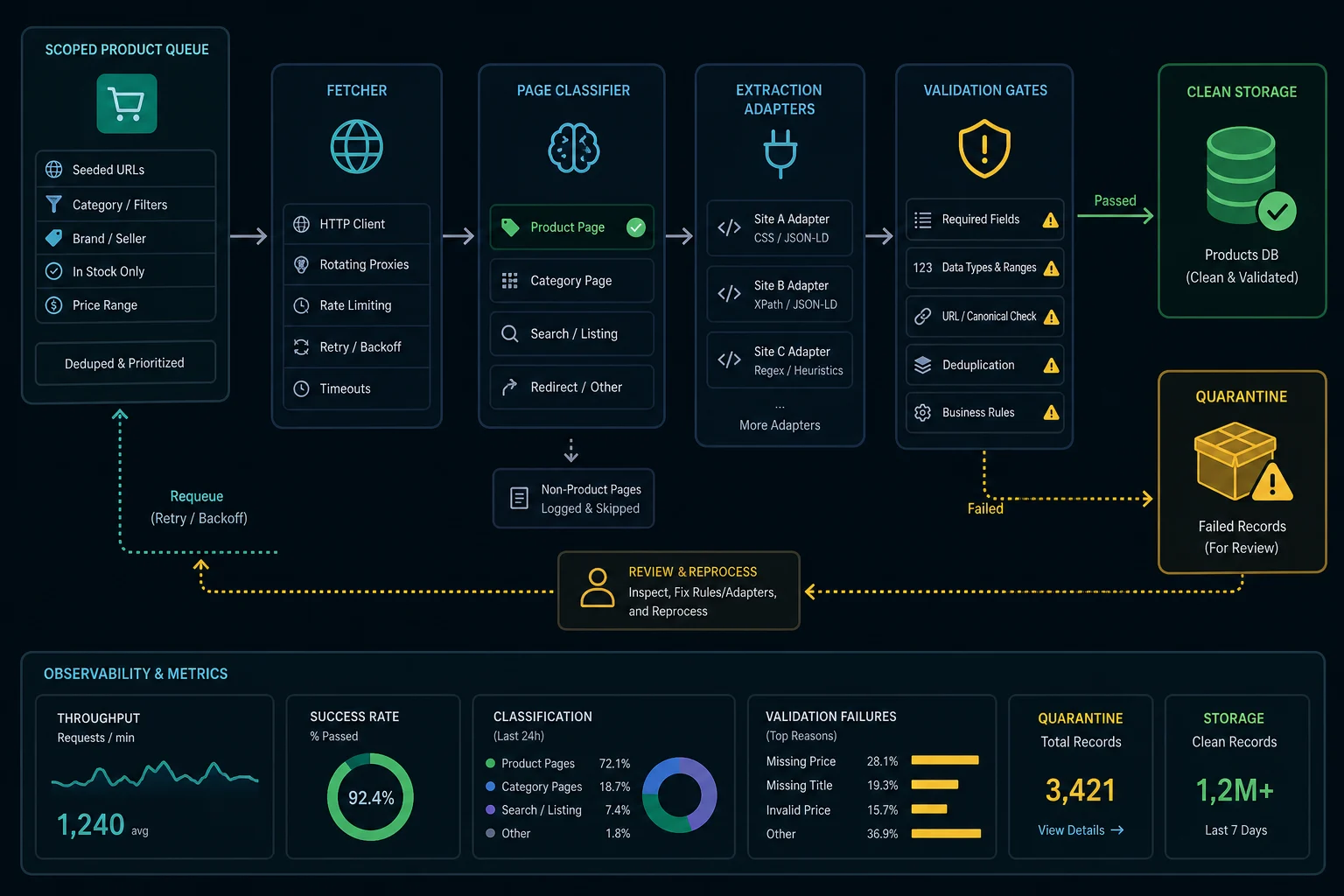
A good ecommerce scraping tool makes scope hard to accidentally exceed. It should use host allowlists, URL canonicalization, product identity checks, rate controls, and page classification before extraction.
API, Feed, HTTP Client, or Browser?
The best tool is usually the simplest tool that returns trustworthy data.
Official API or Licensed Feed
Use an API or feed when it gives you the required fields under terms that fit the project. APIs usually provide structured responses, quotas, documentation, and fewer layout-change failures. The tradeoff is eligibility, field limits, cost, and usage restrictions.
Even with an API, validate product identity, market, price type, currency, and timestamp. A structured response can still represent a different offer than the one your downstream system expects.
HTTP Client
Use an HTTP client when the required permitted fields are present in the initial HTML or JSON response. Python requests, httpx, Node fetch, and similar clients are easier to operate than browsers because they have fewer moving parts.
An HTTP-based ecommerce scraping tool should support:
- Timeouts for connect and read phases.
- Clear request headers and content-type checks.
- Conditional requests where cache validators are available.
- Bounded retries with jitter.
- Response classification before parsing.
- Redacted request and response logging.
- Fixture-based parser tests.
If you are implementing in Python, the Python proxy requests guide covers proxy format, sessions, timeouts, and verification.
Crawler Framework
Use a crawler framework when you need scheduling, queues, depth limits, duplicate filtering, retries, pipelines, and source-specific parsers around many URLs. A framework can be useful for catalog-scale jobs, but it still needs a narrow scope.
Framework features that matter for ecommerce data:
- Per-source concurrency caps.
- URL normalization and deduplication.
- Request priority and recrawl intervals.
- Middleware for headers, cookies, cache, and proxies.
- Item pipelines for validation and quarantine.
- Per-source metrics and failure classification.
The Scrapy documentation is a useful reference for crawler concepts such as spiders, items, middleware, and pipelines.
Browser Automation
Use a browser only when the required fields are unavailable without permitted JavaScript execution or when the measurement itself depends on browser state. Browser tools such as Playwright and Puppeteer can handle rendering, storage, cookies, network events, and page interactions, but they are more expensive to scale.
For browser-based ecommerce scraping:
- Keep one browser context per logical session, market, or account state.
- Do not rotate proxy identity during one page load or checkout-style flow.
- Block unnecessary assets only when doing so does not remove fields you need.
- Wait for specific content or network states rather than arbitrary sleeps.
- Save redacted fixtures for normal, unavailable, consent, challenge, and error pages.
The local Playwright proxy guide explains context-level proxy setup, and the Puppeteer proxy guide covers similar browser routing patterns.
Build the Tool Around a Product Schema
Ecommerce scraping fails when the tool collects text without knowing what that text means. Define the output schema before writing selectors.
A practical product observation can look like this:
{
  "source": "shop.example",
  "source_product_id": "SKU-492",
  "canonical_url": "https://shop.example/products/SKU-492",
  "market": "US",
  "title": "Example product",
  "variant": {
    "size": "1 pack",
    "color": "black"
  },
  "seller": "Example Retailer",
  "price": {
    "amount": "49.95",
    "currency": "USD",
    "type": "standard"
  },
  "availability": "in_stock",
  "observed_at": "2026-07-09T12:00:00Z",
  "parser_version": "shop-example-v3"
}
Keep raw display text when it helps audits, but normalize the data that your system compares. Store money as decimal values in application code and databases. Keep currency, market, seller, offer type, tax assumptions, shipping, and variant state attached to every observation.
Do not let a selector silently substitute list price for current price, subscription price for standard price, or one marketplace seller for another. If the intended field is missing, classify the observation as incomplete and route it to review.
Extraction Features That Matter
The extraction layer should produce typed records or explicit failures. It should not pass partly parsed pages downstream as if they were product data.
Look for these capabilities:
| Feature | Why it matters |
|---|---|
| Source-specific adapters | Retailers use different layouts, currencies, variants, and seller models |
| Page classification | A 200 response can still be a login, consent, challenge, or unavailable page |
| Multiple selector strategies | Layout tests and localization can change one container while another remains stable |
| Structured data support | JSON-LD or embedded state may be more stable than visual classes when permitted |
| Parser versioning | Every observation should say which adapter produced it |
| Fixture tests | Saved redacted examples catch layout changes before production runs |
| Quarantine path | Suspicious records should not trigger reports or pricing decisions |
For recurring competitor checks, the competitor price scraping guide goes deeper on offer comparability, source scoping, and review loops.
Scheduling, Rate Limits, and Backoff
An ecommerce scraping tool is partly a scheduler. If it cannot pace work, back off, and separate retries from normal collection, the parser will receive noisy data.
Use these operating rules:
- Keep a canonical queue keyed by source, product ID, market, variant, and offer type.
- Add deterministic jitter so jobs do not all start at the top of the hour.
- Cache unchanged responses where the source permits it.
- Honor
Retry-Afteron 429 responses. - Cap retries per URL and per source.
- Put retries back into the queue with a next-run time instead of sleeping inside workers.
- Stop automatic retries on repeated 403 responses and review scope or access.
The MDN reference for 429 Too Many Requests notes that a server may include Retry-After. Treat that as a minimum wait, then resume gradually. The local HTTP 429 guide covers scraping backoff patterns in more detail.
The delay calculator can help translate task count, delay, and proxy pool size into a request pacing estimate before you scale.
Proxy Support in an Ecommerce Scraping Tool
Proxy support matters when routing changes the measurement or isolates legitimate workloads. It does not grant permission, repair selectors, or make excessive request rates acceptable.
Choose proxy behavior from the workflow:
| Workflow | Proxy pattern |
|---|---|
| Repeated checks for one market | Stable ISP proxy or sticky session |
| Independent regional availability checks | Rotating residential proxies with market targeting |
| Browser-rendered product page with cookies | One sticky route for the whole browser context |
| Simple permissive public pages | Direct connection or datacenter proxy may be enough |
| Every route gets the same denial | Stop and review scope, policy, page state, and pacing |
Keep headers, cookies, locale, browser context, and proxy identity consistent inside one logical session. Rotating the IP while reusing the same cookies can make a tool look less coherent, not more.
If you are choosing proxy type for ecommerce scraping, compare datacenter proxies vs residential proxies. For broad location coverage and sticky or rotating modes, residential proxies are usually the relevant product fit. For exact setup behavior, read how to use residential proxies.
Monitoring and Data Quality Checks
A production tool should make bad data visible before it reaches dashboards, alerts, or pricing decisions.
Track these metrics by source, market, parser version, and route:
- Fetch count by HTTP status and page classification.
- Valid observation rate.
- Missing title, price, currency, seller, and availability rates.
- Product mismatch and redirect rates.
- Median and high-percentile latency.
- 403, 429, timeout, and browser crash rates.
- Retry count per accepted record.
- Quarantined observations by reason.
- Bandwidth and rendering cost per valid record.
Alert on ratio changes, not just hard failures. A sudden rise in 200 responses with missing prices usually means the page type or layout changed. A spike in valid-looking prices with a new currency or seller can be more dangerous than a visible crash.
Use a canary set before large runs. Include normal in-stock products, unavailable products, sale prices, multiple sellers, variant pages, localized pages, consent pages, challenge pages, and expected 404 or redirect cases. If the canary fails, pause the source queue before collecting more questionable data.
Common Ecommerce Scraping Tool Mistakes
Choosing a Browser Too Early
Browsers are useful, but they should solve a specific rendering requirement. If the fields exist in initial HTML or an API response, an HTTP client plus validation is usually easier to scale and debug.
Treating Extraction as the Whole Product
Selectors are only one layer. The tool also needs source scope, URL normalization, schedule control, response classification, validation, storage, monitoring, and review paths.
Comparing Unlike Offers
A tool that captures "the first price on the page" will eventually compare a list price with a sale price, a subscription price with a one-time price, or a marketplace seller with the first-party seller. Define the offer type explicitly.
Rotating Proxies Inside Stateful Sessions
Proxy rotation should match the unit of work. Rotate between independent tasks. Keep one stable route for a browser context, cart flow, account session, or multi-page product workflow.
Ignoring Legal and Policy Review
An ecommerce scraping tool should be designed around approved sources and responsible collection. Public visibility does not automatically mean every use, field, schedule, or access method is allowed.
Ecommerce Scraping Tool FAQ
What is an ecommerce scraping tool?
An ecommerce scraping tool collects product data from approved ecommerce sources and turns it into structured records. A useful tool includes fetching, extraction, validation, scheduling, retries, monitoring, and review workflows.
Should I build or buy an ecommerce scraping tool?
Buy or use an API when a provider covers your sources, fields, freshness, compliance needs, and budget. Build when you need source-specific control, custom validation, internal workflow integration, or ownership of parser behavior. The comparison of data scraping tools covers the main libraries, managed APIs, and no-code options.
Is an API better than scraping ecommerce pages?
An API or licensed feed is usually better when it provides the data and rights you need. Public-page collection is a fallback for permitted use cases where official sources do not cover the required fields or observations.
Does ecommerce scraping need proxies?
Not always. Proxies are useful for regional measurement, workload isolation, and avoiding concentration from cloud workers. They do not fix forbidden access, bad pacing, inconsistent sessions, or broken extraction logic.
Should ecommerce scraping use Playwright or Puppeteer?
Use Playwright or Puppeteer when required fields depend on permitted browser rendering or page interactions. Use an HTTP client when the fields are already present in the initial response.
Conclusion
The best ecommerce scraping tool is the one that matches the source, fields, and operating risk of the job. Start with authorized structured data when possible, use HTTP clients before browsers when the page allows it, validate every product observation, and treat proxies as routing infrastructure rather than a shortcut around policy or data quality.
Before scaling, prove the full loop on a small product set: scoped URLs, paced fetching, page classification, typed extraction, validation, quarantine, storage, and monitoring. That is what turns ecommerce scraping from a fragile script into a dependable data workflow.